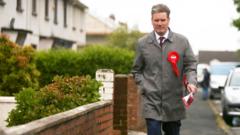
Keir Starmer is out. Less than two years after leading the Labour Party to a historic landslide victory, the prime minister stood outside 10 Downing Street and choked back tears as he announced his departure. The mainstream press is already spinning a lazy narrative. They want you to believe this was a sudden, unpredictable mutiny driven by a few disgruntled backbenchers. They are wrong.
The collapse of the Starmer government was entirely predictable. It was the slow, agonizing accumulation of political miscalculations, unforced errors, and a fundamental failure to understand the very electorate that put him in power. When the history books look back at June 2026, they won't point to a single bad week. They will look at a leader who managed to alienate his base, panic his MPs, and invite his fiercest internal rival right through the front door of Westminster.
If you want to understand why Britain is now looking at its seventh prime minister in ten years, you have to look past the carefully staged tears on the Downing Street steps. You have to look at the cold, hard numbers and the staggering sequence of backroom betrayals that made his position completely untenable.
The King of the North Claims His Throne
The immediate catalyst for Starmer's downfall didn't happen in London. It happened in Makerfield. Last week, Andy Burnham, the wildly popular former Mayor of Greater Manchester, won a crucial by-election to secure a seat in the House of Commons.
British prime ministers must be sitting members of parliament. Everyone in Westminster knew exactly what Burnham was doing. He didn't give up his high-profile mayoral platform just to sit on the backbenches and behave himself. He came to London to take the crown.
Labour Leadership Triggers (2026 Rules)
---------------------------------------
Stage 1: Support from 20% of Labour MPs (81 nominations)
Stage 2: Nominations from 5% of constituency parties OR 3 affiliates
Stage 3: Vote by the full party membership
Burnham's decisive win in that working-class seat gave him an immediate, powerful mandate. It was a seat that Labour strategists genuinely feared they might lose to Nigel Farage's Reform UK. Burnham didn't just win it. He crushed it. He proved he could blunt the right-wing populist advance in the post-industrial heartlands. That is something Starmer hadn't done for months.
The moment the Makerfield result landed, the house of cards collapsed. Behind closed doors, the shadow operations began. Over the weekend, more than half a dozen cabinet ministers privately told Starmer that his time was up.
By Monday morning, the public execution began. Wes Streeting, the former Health Secretary who many thought might run for leader himself, released a bombshell letter. He withdrew any potential bid and threw his full weight behind Burnham. Streeting openly stated that the party couldn't waste the summer arguing over small differences when the country needed real change. It was a brutal, coordinated display of political pragmatism. Starmer looked out his window and realized he had no army left to command.
The Ghost of Jeffrey Epstein Over Downing Street
You cannot talk about Starmer's exit without addressing the massive elephant in the room. His international judgment proved fatal. The single biggest unforced error of his premiership was the appointment of Peter Mandelson as the British ambassador to the United States.
Mandelson is a legendary Labour power broker, but he carries heavy baggage. Specifically, his historical entanglement with the disgraced financier Jeffrey Epstein. Starmer thought he could ignore the brewing storm. He was wrong.
The political fallout surrounding the Epstein scandal has hit British public life like a sledgehammer in 2026. Look at what happened to Andrew Mountbatten Windsor. The brother of King Charles was stripped of his royal titles and forced to pack his bags from his longtime royal residence after devastating new revelations came to light. The public mood turned incredibly hostile toward anyone connected to that network.
When Starmer doubled down on Mandelson, it triggered absolute revulsion among his own rank-and-file MPs. It strained relations with Washington and gave opposition parties an open goal. Starmer tried to weather the storm. He insisted that he could manage the blowback. But in politics, perception is reality. By linking his young government to an elite international scandal while regular British citizens were struggling to pay rent, Starmer destroyed his own moral authority.
The May Local Election Disaster
MPs don't mutiny because they dislike a leader's personality. They mutiny when they think that leader is going to cost them their jobs. The turning point was the nationwide local elections in May.
It was an unmitigated disaster for Labour. Activists on the doorstep reported a terrifying level of hostility from voters. The anger wasn't just directed at specific policies. It was a general, burning frustration with a political system that seemed completely broken.
When the local election results rolled in, the data painted a bleak picture for Number 10. Voters weren't flocking back to the Conservatives. Instead, they were fracturing. Working-class voters defected in droves to Reform UK, mirroring the populist MAGA movement across the Atlantic. On the other flank, younger, urban voters abandoned Labour for the Greens.
Starmer's project was built on a simple premise. He promised he was a safe pair of hands who could deliver stability. But the local elections proved that stability was being interpreted as stagnation. The trickle of MPs quietly asking Starmer to outline an exit strategy turned into a roaring torrent. They realized that if they went into the next general election with Starmer at the helm, they would face an electoral wipeout.
Harsh Policies and Weak U-Turns
Good leaders can survive unpopular policies if they show conviction. Weak leaders get crushed because they try to please everyone and end up pleasing no one. Starmer fell squarely into the second camp.
His government pushed through aggressive welfare cuts and heavily restricted winter fuel payments for pensioners. It was an attempt to show fiscal responsibility to the financial markets. The blowback was immediate and severe. Anas Sarwar, the Labour leader in Scotland, broke ranks as early as February, openly calling for Starmer to step down over the damage these policies were doing to the party's core brand.
Instead of standing his ground, Starmer panicked. He began executing a series of rapid, messy policy U-turns. He tried to reverse the cuts to pacify the left wing of his party, but the damage was already done.
The left thought he was cruel. The right thought he was weak. The public thought he was incompetent. His communication skills, which had always been formal and legalistic rather than inspiring, failed him entirely. He couldn't explain the original pain, and he couldn't justify the retreat. He looked like a man trapped in a storm without a compass.
The Irony of the India-UK Trade Deal
The timing of this resignation carries a bitter irony. Just days before walking out to the Downing Street lectern, Starmer was in France for the G7 summit. He sat down with Indian Prime Minister Narendra Modi and finalized the long-awaited India-UK Comprehensive Economic and Trade Agreement.
They set a firm date. The deal is scheduled to come into force on July 15. This is a massive, 48-billion-pound trading relationship designed to act as a launchpad for British economic growth. Starmer spent years rebuilding Labour's relationship with the British Indian diaspora, which had been deeply alienated under Jeremy Corbyn's tenure. He visited temples, spoke out forcefully against Hinduphobia, and made the trade deal a core pillar of his economic strategy.
Now, the deal will cross the finish line just as Britain enters a period of deep political transition. Starmer won't be around to collect the credit or manage the implementation. He did the heavy lifting, but his domestic failures ensured he won't reap the rewards.
What Happens Right Now
Britain cannot afford a prolonged period of paralysis. The Labour National Executive Committee is moving fast.
- July 9: Nominations for the leadership contest officially open.
- July 16: Nominations close before the parliamentary summer recess.
- September: A new prime minister will be in place when parliament returns.
If the party unites behind Andy Burnham without a formal, drawn-out contest, he could walk into Downing Street by mid-July. If other challengers emerge, Starmer will serve as a caretaker prime minister through the summer, representing the UK at the upcoming NATO summit.
The era of technocratic, cautious Labour leadership is dead. The next leader inherits an economy under immense pressure, a highly volatile electorate, and a party that has shown it will ruthlessly discard anyone who cannot deliver victory. Starmer brought Labour back from the political dead after 2019, but he forgot a fundamental rule of power. Winning an election is only the beginning. If you don't know how to govern, your own people will find someone who does.