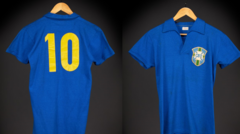
A skinny 17-year-old kid sobbed uncontrollably on the shoulder of his goalkeeper, Gilmar. He had just scored two goals to win his country’s first-ever World Cup. He was wearing a blue shirt that was literally bought at a local Stockholm shop just days before and hand-stitched in a hotel room.
That kid was Pelé. The year was 1958.
Fast forward to today, and that exact same piece of hastily prepared fabric just sold at Sotheby’s in New York for a mind-boggling $4.9 million.
If you think that’s an absurd amount of money to pay for a sweaty, faded piece of sportswear, you’re not alone. But you're also missing the point. The market for sports history has completely transformed. What used to be a niche hobby for eccentric collectors has turned into a massive alternative asset class.
Let's unpack why Pelé’s iconic 1958 World Cup final shirt commanded such a staggering price tag, why it represents a massive shift in how we value football history, and why the buyer actually got a bargain.
How a blue shirt bought in Stockholm became soccer history
To understand the value of this shirt, you have to understand the sheer panic that created it.
Brazil is famous for its iconic yellow and green kit. But they didn't always wear yellow. Up until 1950, they wore white. That was until they lost the de facto 1950 World Cup final to Uruguay in front of nearly 200,000 devastated fans at the Maracanã. The country went into a state of national mourning. The white kits were branded a cursed, unpatriotic disgrace, and they were never worn again.
In 1953, a contest was held to design a new kit using the four colors of the Brazilian flag. The famous yellow shirt with blue shorts was born.
When Brazil marched all the way to the 1958 World Cup final in Sweden, they ran into a logistical nightmare. Sweden, the hosts, also wore yellow. FIFA rules dictated that one team had to change, and a draw was organized to decide who got to keep their home colors. Brazil boycotted the draw, Sweden won, and Brazil was forced to change.
The problem was that the Brazilian delegation hadn't packed an alternative kit.
They refused to wear white because of the ghosts of 1950. Out of sheer desperation, Brazil’s head of delegation, Paulo Machado de Carvalho, declared that they would play in blue—the color of Our Lady of Aparecida, Brazil’s patron saint.
Staff members literally ran out into the streets of Stockholm to buy plain, off-the-rack blue shirts. They spent the nights leading up to the final hand-sewing the Brazilian crests and yellow numbers onto the jerseys.
The shirt Pelé wore while chipping the ball over Swedish defender Bengt Gustavsson and smashing it into the net was a DIY project.
After the historic 5-2 victory, Pelé gifted his historic number 10 shirt to his roommate and teammate, Dida. It stayed with Dida's family for decades, spent some time in a Brazilian museum, and was eventually sold to a collector in 2004.
The staggering math behind sports memorabilia
It's easy to look at a $4.9 million price tag and think the sports memorabilia market has lost its mind.
But let's look at the numbers. In 2004, this exact same shirt sold at auction for £70,505 (which was roughly $105,600 at the time).
That is an increase of nearly 4,600% over 22 years.
Very few traditional investments offer that kind of return. High-net-worth individuals and investment funds are actively treating these physical items like fine art. They realize that while companies can issue more stock and developers can build more luxury apartments, nobody can ever make another 1958 World Cup final jersey worn by a teenage Pelé.
The demand is massive, and the supply is exactly one.
The most expensive football jerseys in history
Where does this sale leave Pelé in the grand hierarchy of sports memorabilia? Let's look at how the top tier of football shirts stack up.
- Diego Maradona’s 1986 "Hand of God" Shirt – Sold for $9.3 million in 2022. This remains the absolute high-water mark for a single soccer jersey.
- Lionel Messi's 2022 World Cup Shirts – A collection of six jerseys worn during Argentina's historic run in Qatar sold for $7.8 million in 2023.
- Pelé’s 1958 World Cup Final Shirt – Sold for $4.9 million in July 2026.
Some critics argued that Pelé's shirt should have fetched even more. Before the bidding started at Sotheby's, some experts estimated it could go for upwards of $6 million. But the fact that it secured 10 bids from more than five active bidders shows how competitive the high-end market has become.
Why Pelé’s shirt sold for much more than before
There's a simple reason why this shirt exploded from $105,600 in 2004 to $4.9 million in 2026.
It’s the storytelling.
In the early 2000s, sports memorabilia was mostly about signatures and trading cards. People wanted autographs. But over the last decade, collectors have shifted their focus entirely toward "game-worn" items with ironclad provenance.
Sotheby's didn't just sell a blue shirt. They sold the physical manifestation of the exact moment global football changed forever. Before 1958, Brazil had never won a World Cup. After 1958, they became the undisputed spiritual home of the beautiful game.
Pelé was the catalyst for that entire cultural shift.
Brendan Hawkes, the vice president of sports strategy at Sotheby's, noted that when you actually hold the shirt, the most striking thing is how tiny it is. Pelé was a lean, 17-year-old kid when he wore it. The physical size of the jersey is a quiet reminder of just how young he was when he carried the hopes of an entire nation on his back.
The wild evolution of sports assets
We are living in an era where sports assets are outpacing traditional luxury investments like watches, wine, and classic cars.
In 2024, a baseball jersey worn by Babe Ruth during the legendary 1932 "called shot" game in the World Series sold for a jaw-dropping $24.1 million. That proved that the absolute peak of the sports memorabilia market is now operating on the same financial plane as masterpiece paintings by Picasso or Monet.
Football is the most popular sport on earth, but its memorabilia market has historically lagged behind American sports like baseball and basketball.
That is changing fast. The global soccer audience is massive, and as wealthy fans from Asia, the Middle East, and North America enter the collector space, the prices for iconic football items are climbing rapidly. If a Babe Ruth jersey can command $24 million, a $4.9 million price tag for the shirt worn during the birth of Pelé's legend actually looks like an undervalued asset.
What this means for the future of football history
If you're a regular fan, this trend might feel a bit depressing. It means the most sacred artifacts of the game we love are increasingly locked away in the private vaults of billionaires, hidden from the public eye.
But there is a silver lining. The massive financial value now placed on these items means they are finally being treated with the historical respect they deserve. Instead of rotting in cardboard boxes in a former player's attic, these shirts are being meticulously preserved in climate-controlled environments. They are analyzed, authenticated, and cataloged with the same scientific rigor used for ancient historical manuscripts.
If you want to understand where the sports memorabilia market is going next, keep your eyes on these three trends.
- Fractional Ownership – Don't be surprised if the next iconic shirt is bought by a consortium of fans who buy "shares" of the item via digital platforms.
- The Rise of Modern Legends – While vintage items like Pelé's shirt hold historical mystique, game-worn gear from Lionel Messi and Cristiano Ronaldo is already commanding millions, pointing to a massive future market for 21st-century artifacts.
- Rigorous Photo-Matching – The premium in this market is entirely based on proof. High-resolution digital archiving now allows experts to match individual thread imperfections in vintage photos to the physical shirts, making authentication indisputable.
Ultimately, Pelé's 1958 shirt isn't just sports gear. It's a relic of a moment when a kid from Três Corações changed how the world looked at Brazil, and how Brazil looked at itself. That kind of cultural magic is incredibly rare, and as this auction proved, people are willing to pay almost anything to own a piece of it.