Every year, thousands of nocturnal seabirds smash into illuminated coastal buildings, ships, and offshore infrastructure because artificial light scrambles their navigation. Turning off the lights completely isn't an option when crews need illumination to work safely through the night. But researchers in Canada just stumbled onto a remarkably simple fix that doesn't require plunging workplaces into darkness.
By simply changing the color or adding high-contrast patterns to vertical surfaces, scientists drastically cut down bird strikes. If you manage coastal property, design offshore platforms, or care about avian conservation, this changes how you look at outdoor lighting and architecture.
The Problem With Night Lights and Seabirds
Leach's Storm-Petrels and many other pelagic seabirds spend their lives navigating vast, dark oceans. They rely on subtle cues and fly inland to breed under the cover of darkness to avoid predators. When humans drop bright floodlights onto coastal facilities, lighthouses, or fishing vessels, everything goes wrong.
Birds don't just get attracted to the glow from a distance. They fly straight into the lit area, become disoriented, and collide with walls, windows, and metal beams. Once they hit the ground, they're sitting ducks for exhaustion, dehydration, and local predators.
For vulnerable populations like the estimated 39,000 breeding pairs on Bon Portage Island in Nova Scotia—the largest colony of Leach's Storm-Petrels in the province—these artificial death traps take a brutal toll. Conservationists have spent decades arguing for dark-sky initiatives and light curtailment, but industry pushback is fierce. You can't just power down an active industrial port or an offshore oil rig in the middle of a night shift.
What the Bon Portage Island Study Found
To figure out a compromise, a team of researchers including Alina Rutherford, Michael Robertson, Linda Hutchinson, and Dave Shutler set up a brilliant field experiment right inside the Nova Scotia breeding colony.
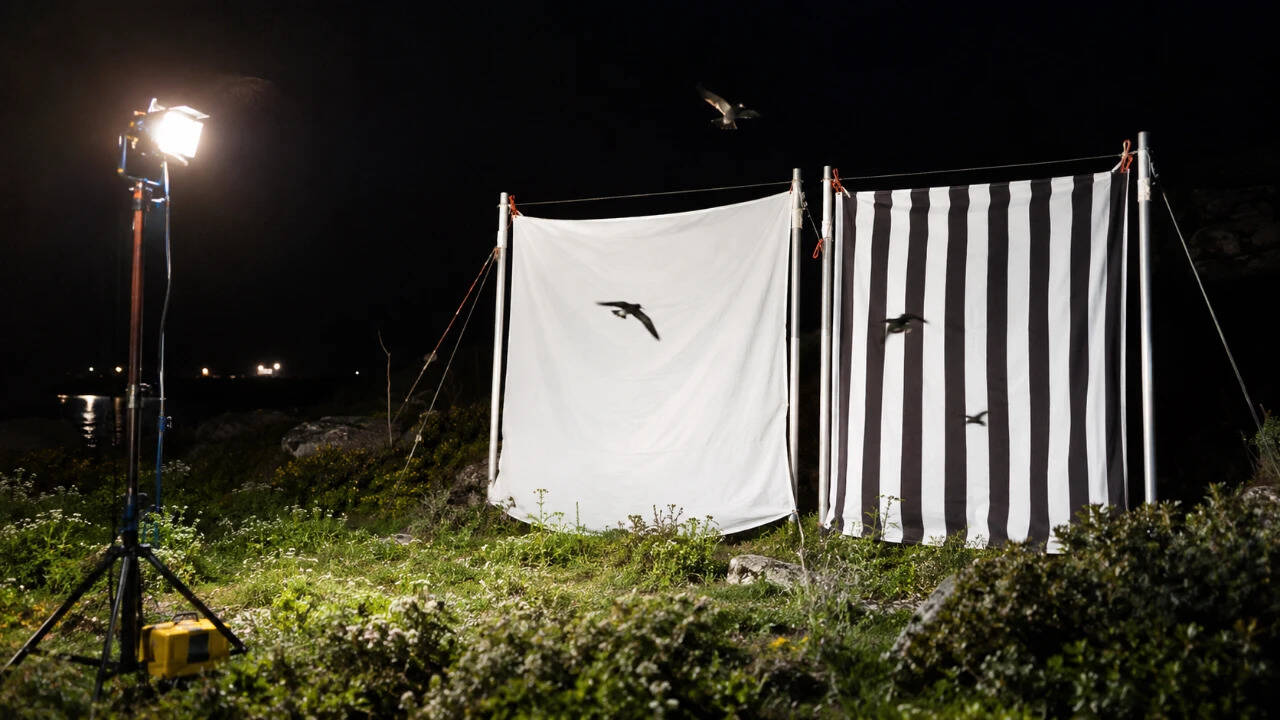
Over the course of 40 nights across 2024 and 2025, the team suspended large cloth sheets measuring roughly 2.3 by 2.6 meters from poles inside the colony. These sheets acted as stand-ins for building walls or industrial barriers. They rigged floodlights to illuminate the fabric, turning them on and off in five-minute intervals to observe how the storm-petrels reacted.
The results weren't subtle.
When the lights were switched on, storm-petrels were roughly nine times more likely to strike the sheets compared to when the lights were off. But when researchers altered the color and pattern of the sheets, the collision rates plummeted.
White sheets reflected nearly five times as much light as black sheets, and white materials racked up 2.7 times more individual bird collisions than black ones. Darker surfaces naturally bounced back less blinding glare, making them far safer for birds cruising past in the dark.
Stripes Beat Plain Walls Every Time
The most fascinating part of the 2025 phase of the study involved patterns. The team tested plain white sheets against sheets marked with grids or vertical stripes using black fabric paint covering about half of the surface.
Vertically striped sheets caused 2.8 times fewer bird collisions than plain sheets. When the researchers tallied every single impact—including repeated strikes by the same disoriented bird—striped sheets performed even better, recording 3.7 times fewer total collisions. Grid patterns also slashed total impacts by 3.4 times compared to plain surfaces.
Here is why that matters for real-world architecture. The patterned sheets reduced collisions even when the total amount of light reflecting off them was roughly equal to the plain sheets. The birds weren't just avoiding dark patches; they were responding to the visual contrast. The stripes gave their eyes something concrete to register, breaking up the disorienting illusion of a blank, glowing wall.
How to Apply These Findings to Real Infrastructure
If you're involved in building design, coastal facility management, or maritime operations, you don't need to wait for sweeping regulations to start protecting local wildlife. You can take immediate, practical steps based on these insights.
- Swap out brilliant white exterior paints: If your facility sits near the water or a known migratory corridor, ditch stark white or high-reflectance exterior finishes. Opt for darker, matte tones that absorb light instead of bouncing it across the landscape.
- Incorporate high-contrast exterior design: Instead of uniform, monolithic walls, use architectural accents, dark paneling, or vertical striping on the lower and mid-levels of buildings where bird traffic is heaviest.
- Audit your night lighting footprint: Combine darker surfaces with smart lighting controls. Direct beams downward, use shielded fixtures to eliminate upward glare, and keep illumination levels to the absolute minimum required for human safety.
We can't turn off the lights entirely, but we can stop building invisible walls in the dark. Adding a bit of visual contrast to our architecture offers an easy, low-cost way to keep seabirds out of harm's way.