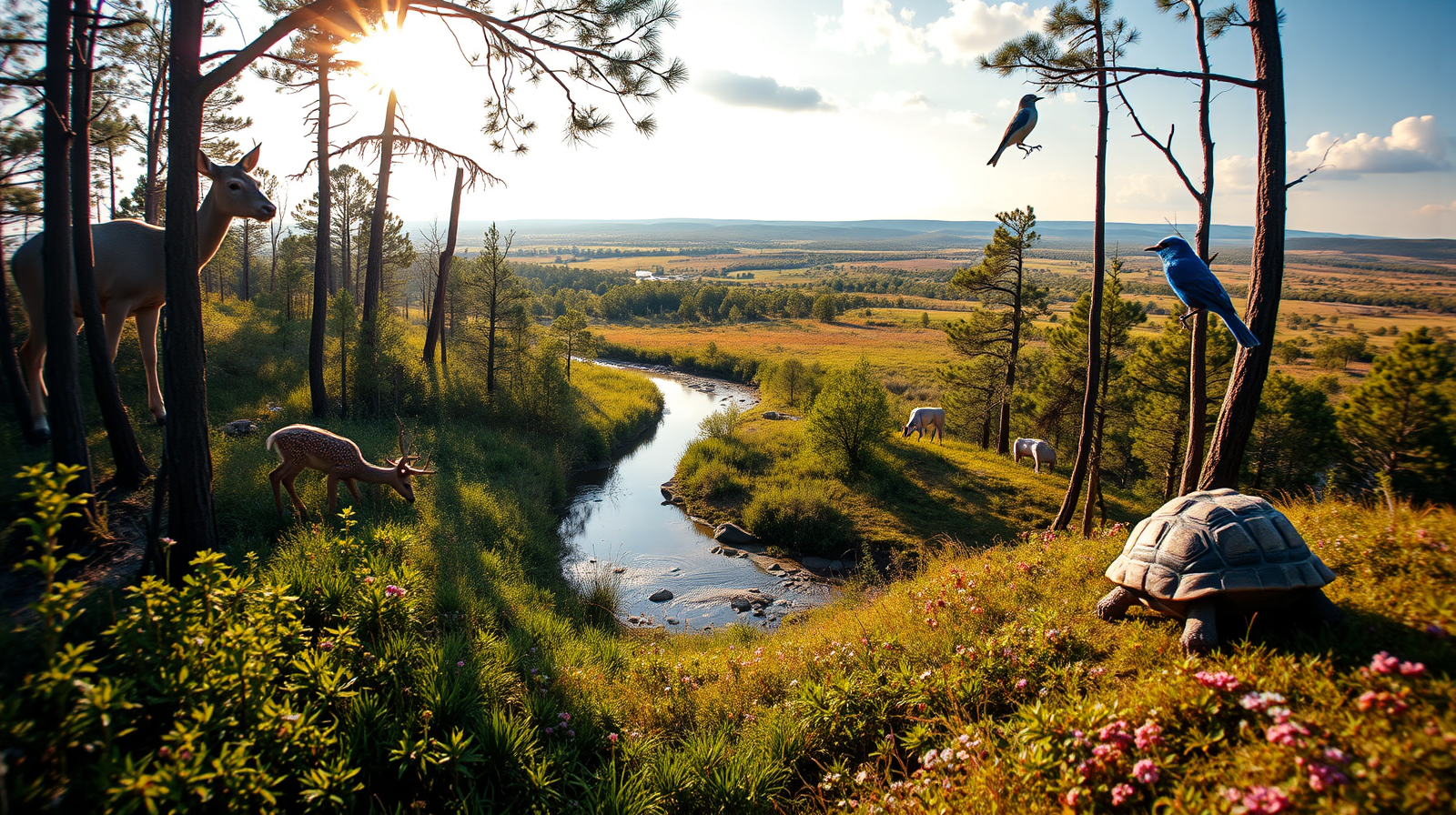
Most people who strike it rich playing card rooms buy beach houses or luxury yachts. M.C. Davis took a radically different route. He spent roughly $90 million buying up 54,000 acres of exhausted farmland and heavily logged pine forest in the Florida Panhandle.
He didn't want a private hunting estate or a sprawling subdivision. He wanted to resurrect a ghost.
That money bought a massive footprint of damaged earth. Over the years, Davis and his team planted more than eight million longleaf pine seedlings. They turned a commercial timber wasteland into Nokuse Plantation, which is now one of the largest private nature preserves in the southeastern United States. It is an incredible gamble on a E.O. Wilson-inspired conservation vision that spans centuries rather than decades.
How a Card Player Found Conservation
Before he became a land baron and conservationist, Davis spent his youth and early twenties sitting in Florida card rooms. He made a living playing poker and reading people. Later, he transitioned into buying and trading real estate and mineral rights, accumulating a massive fortune.
The pivot toward ecology happened almost by accident. While stuck in traffic near Tampa, Davis saw a highway sign advertising a seminar about Florida black bears at a local high school. He dropped in out of sheer curiosity. He walked out realizing he didn't even know his home state supported a native black bear population.
That single seminar triggered an obsession. Davis dove into heavy ecological reading, studying Thoreau, John Muir, and E.O. Wilson. He realized the landscape around him was dying a quiet death. He decided his money could either sit in a bank account or fix the problem.
He chose the dirt.
Starting in 2000, Davis began acquiring low-value pulpwood plantations and worn-out peanut farms across Walton County. He stitched parcels together until he owned 54,000 contiguous acres. He called it Nokuse, borrowing the Muscogee word for black bear.
Rebuilding the Missing Longleaf Pine Ecosystem
To understand why Davis spent a fortune on scrubland, you have to understand what used to be there.
Centuries ago, the longleaf pine ecosystem was the dominant signature of the American South. According to the U.S. Forest Service, these open, park-like pine woodlands stretched across roughly 90 million acres from Virginia down to Florida and over to Texas.
Then came the loggers, the agricultural expansion, and a century of total fire suppression. Industrial timber companies clear-cut the native pines and replaced them with fast-growing, non-native commercial species planted in tight, artificial rows. By the time conservationists started tracking the damage, the ecosystem's historic range had collapsed by nearly 97 percent.
When Davis bought the property, those ancient longleaf giants were gone. His team faced a brutal cleanup job. They systematically cleared out non-native pulpwood trees and began hand-planting containerized longleaf seedlings.
Instead of mimicking industrial timber layouts, workers planted about 300 seedlings per acre in random, scattered patterns. They wanted to mimic how nature intended the forest to look and grow. Between 2004 and 2014, that meticulous hand-planting effort pushed past the eight million tree mark.
Why Fire and Understory Matter More Than Just Trees
Planting trees is easy compared to bringing a dead ecosystem back to life. A forest isn't just a collection of vertical timber; it is a complex biological web.
Once the pines went into the ground, the Nokuse team shifted focus toward the forest floor. Native grasses, wiregrass, and wildflowers form the understory layer that supports everything else. These plants provide food for native pollinators and create the fine, dry fuel necessary to sustain low-intensity natural fires.
For decades, modern development had stopped natural wildfires from sweeping through the region. Without fire, invasive brush chokes out native plants and the ecosystem suffocates. Nokuse reintroduced controlled, prescribed burns across the landscape to clear out the debris and trigger longleaf pine cone release.
The results arrived fast. Native wildlife bounced back into the recovering habitat. Gopher tortoises, foxes, bobcats, raccoons, and birds of prey like ospreys and eagles returned in force.
Furthermore, Nokuse shares a border with Eglin Air Force Base, which holds a rare, surviving fragment of 500-year-old old-growth longleaf pines. A dedicated wildlife underpass now connects Nokuse directly to this military-protected old-growth forest, allowing bears and tortoises to cross safely between the two sanctuaries.
Planning for a Three-Hundred-Year Horizon
M.C. Davis passed away in 2015, long before his vision could fully materialize. He knew that reality well before he signed the first land deed.
Longleaf pines live for centuries. They take generations to reach maturity, meaning a true old-growth forest cannot be rushed by human impatience. Davis openly stated that his restoration plan was built on a three-hundred-year timeline. He poured millions into a project he would never live to see completed.
He also funded a 28,000-square-foot nature discovery center on the property, named after evolutionary biologist E.O. Wilson, costing roughly $12 million to cement public education as part of the legacy.
Today, the trust and staff he left behind continue the work. The trees keep growing. The controlled burns keep clearing the floor.
It turns out the biggest gamble M.C. Davis ever made wasn't at the card table. It was betting that human hands could repair a forest we spent two centuries tearing down, leaving the payoff for generations who haven't even been born yet.