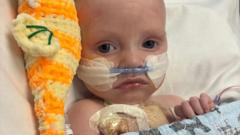
When doctors start talking about end-of-life care for a baby who was completely healthy just weeks prior, time fractures. For parents Catrin and Dylan Green, that nightmare became a brutal reality when their infant son, Macs, suffered two sudden cardiac arrests. Diagnosed with dilated cardiomyopathy—a severe condition leading directly to heart failure—little Macs faced an impossible countdown.
Most people assume modern medicine can easily pivot when a child's heart fails. It cannot. Pediatric organ support is a high-stakes puzzle constrained by tiny anatomies, scarce specialized equipment, and long waiting lists. For a different view, see: this related article.
The Reality of Pediatric Heart Failure
Dilated cardiomyopathy doesn't always wave warning flags. Macs went from a normal routine to crashing hard. He ended up in Bristol Royal Children's Hospital hooked up to an extracorporeal membrane oxygenation (ECMO) machine, which is basically an external bypass pumping oxygen through the blood because the heart itself has quit.
Being on ECMO is a temporary fix with an expiration date. Organs suffer, complications mount, and families live in a permanent state of dread. Doctors talked about palliative care because his tiny body was failing under the strain. Further coverage on this matter has been published by Psychology Today.
How a Berlin Heart Flips the Script
The turning point came when medical teams managed to transfer Macs to Newcastle's Freeman Hospital to get a Berlin Heart fitted.
If you've never heard of a Berlin Heart, it's an ventricular assist device—an air-driven mechanical pump that sits outside the body and takes over the heavy lifting of circulating blood. According to NHS Blood and Transplant figures, only a tiny fraction of children across the UK get these devices fitted in a given year. It is specialized, risky, and rare.
For Macs, the device did something miraculous. It allowed doctors to take him off the heavy sedatives and drugs keeping him under.
Dylan Green described the shift plainly: "He's smiling, he's responding to us. Before now, he's just been a small baby lying on a bed."
The Long Road Ahead
Surviving the surgery doesn't mean the race is won. Devices like the Berlin Heart buy precious time, but they are bridges, not destinations. Macs still needs a full heart transplant.
Families caught in this loop face an agonizing wait. Pediatric hearts are notoriously difficult to source. Parents are told to brace for an 18-month wait, sometimes stretching to two years or more, all while managing a complex external machine that comes with its own severe clotting and infection risks.
If you want to understand why pediatric organ donation advocates push so hard, look no further than these hospital wards. Every single breakthrough device relies entirely on another family making an unthinkable choice during their darkest hour.
Macs is smiling now, kicking his legs, and acting like a normal baby again. His parents have their son back for today, but tomorrow remains a quiet cliffhanger.
Learn how pediatric organ registries work, talk to your family about your choices, and support specialist children's heart units before a crisis hits your own doorstep.