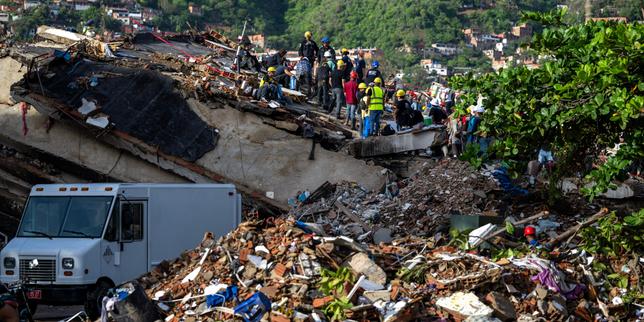
International rescue teams are landing in Caracas. Millions of dollars in emergency funds are being pledged. But talk to anyone on the ground in La Guaira or the barrios of Caracas right now, and they'll tell you the exact same thing. Help isn't coming from a bureaucratic pipeline. It's coming from the guy next door.
On June 24, 2026, northern Venezuela took a catastrophic hit. Two massive earthquakes struck just 39 seconds apart. A magnitude 7.2 foreshock followed instantly by a crushing 7.5 mainshock. It's the most powerful seismic event to strike the country since 1900. The official toll has already climbed past 1,900 dead and 10,500 injured. With tens of thousands still missing under the rubble, the numbers are going up every single hour. If you found value in this piece, you might want to read: this related article.
Yet, look past the headlines about global aid packages. The real survival story isn't happening in high-level coordination meetings. It's happening in the dirt.
The Myth of Sudden Infrastructure Failure
A lot of foreign reporting paints this disaster as a sudden collapse of a functional system. That's just wrong. Venezuela's infrastructure didn't fail on June 24. It has been fraying for over a decade due to a protracted economic crisis. For another look on this event, check out the latest update from Wikipedia.
When the ground started shaking at 6:04 PM local time, it didn't just break concrete. It amplified vulnerabilities that Venezuelans have lived with every day.
- Hospitals were already operating on life support. Before the quakes, basic medical supplies like sterile gauze and saline were luxury items. Now, 91 emergency hospitals are dealing with severe structural shaking, fighting power blackouts while treating complex trauma cases.
- Water shortages are an old enemy. More than 90% of households faced chronic utility cuts before the disaster. When the San Sebastián fault system ruptured, it shattered water lines that were already rusted and patched together.
- The grid was a gamble. Rolling blackouts were normal life. The earthquake simply turned off the lights completely across the Capital District, Miranda, and Carabobo.
When international outlets express shock that locals aren't waiting around for official emergency services, they miss the point. Venezuelans aren't waiting because they've learned, through years of hyperinflation and systemic neglect, that self-reliance is the only strategy that works.
When Solidarity Becomes the Only Currency
Take a drive down to Caraballeda, a coastal town north of Caracas in the hard-hit La Guaira state. You won't see a perfectly organized government grid. You'll see everyday people using their bare hands to shift blocks of fallen concrete.
Look at Moisés Faramaya, a local former miner whom neighbors call "La Taupe" (The Mole). He didn't wait for heavy machinery or specialized acoustic gear to arrive from abroad. He crawled into the tight, shifting spaces of an collapsed apartment building because he knew exactly how unstable ground behaves. He helped pull survivors out of gaps that professional teams hadn't even reached yet.
This isn't an isolated act of heroism. It's a structural necessity. When the state lacks the resources to send an ambulance to every collapsed block, the community becomes the first responder, the triage nurse, and the logistics manager all at once. Neighborhood committees that used to manage scarce food distribution are now pooling flashlight batteries, sharing clean water from private cisterns, and setting up makeshift outdoor kitchens.
Global Promises versus Ground Realities
The international response sounds impressive on paper. The United States announced 150 million dollars in aid and deployed Marines to help clear the debris-choked port of La Guaira. France sent 85 specialized search-and-rescue workers. Copernicus satellite tracking has been activated by the European Union.
That's all necessary. The port needed to be opened to handle the influx of food and medicine. But foreign aid doesn't automatically translate to immediate relief in a country with broken internal logistics.
If a ship unloads tons of medical supplies at La Guaira, but the roads leading up to the mountain passes into Caracas are blocked by landslides, those supplies stay on the tarmac. If a local hospital lacks the fuel to run its backup generators, sophisticated medical kits sit unopened in dark hallways.
The immediate survival bottleneck isn't a lack of global goodwill. It's internal distribution, disrupted communications, and a local healthcare network under severe, unprecedented stress.
What Needs to Change to Actually Help
If you want to support the recovery, you have to look at what actually gets through the logistics logjam. Sending random goods or expecting centralized authorities to manage the flow effectively misses the reality of how the country functions.
Support Hyper-Local Networks
Large-scale international institutions are good for major logistics like clearing ports. But for daily survival, resources need to reach organizations with established, deeply rooted local networks. Groups like Caritas Venezuela or localized community funds are already inside the affected barrios. They don't need to build a distribution network from scratch; they're already using the ones that kept people alive through the economic crisis.
Focus on Water and Power Autonomy
The immediate focus cannot just be about digging through rubble. The secondary crisis is already starting. Without clean drinking water, waterborne diseases will tear through displaced camps in La Guaira and Yaracuy. Funding and supplying portable water purification systems and small solar power kits directly to community hubs will save more lives over the next month than high-tech rescue gear.
The double earthquake didn't create a new Venezuela. It just stripped away the remaining illusions of structural stability, leaving behind what has kept the country going for years: its people.