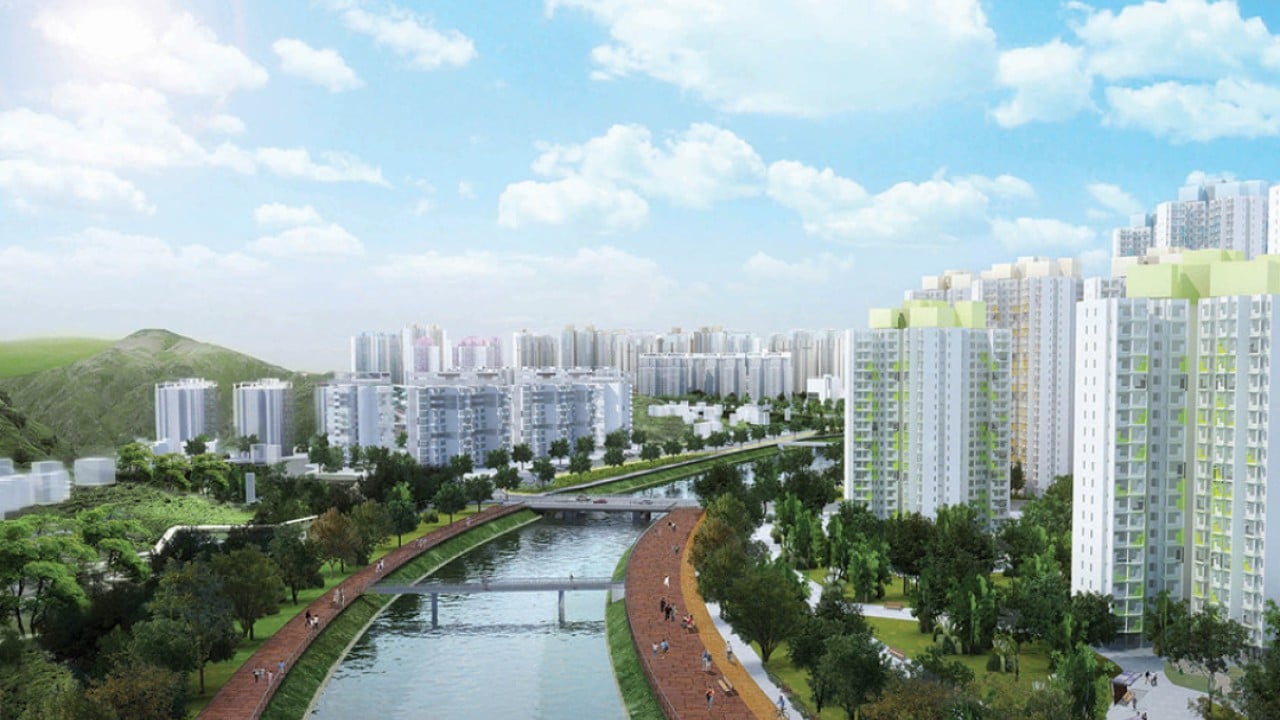
Hong Kong's housing authority wants you to get excited about an extra forty square feet. In a recent media push, Housing Minister Winnie Ho laid out the government's grand vision for the Northern Metropolis, promising that public housing flats in the new megaproject will be roughly 10% larger than traditional urban units. The administration is planning to boost the proportion of larger flats—meaning those around 400 square feet—from 20% to 25% over its current five-year plan.
For a family crammed into a subdivided unit, any extra space feels like a luxury. But let's be entirely honest here. Increasing a flat's footprint from 360 square feet to 400 square feet isn't a revolutionary leap in living standards. It's a minor patch on a fundamentally broken urban template.
If you look past the official optimism, the real test of the Northern Metropolis isn't whether the walls are pushed out by a couple of feet. The real test is whether the government can build actual communities, avoid the crushing isolation of old-school satellite towns, and deliver on these promises before a whole generation gives up on having families entirely.
Why 10% More Space Won't Fix the Birth Rate
The government openly links better housing to boosting the city's dismal birth rate. Columnists and officials alike argue that if young couples have more space, they'll finally start having kids.
It sounds logical on paper. In reality, it misses how people actually live. A 400-square-foot flat is still incredibly tight for a couple, let alone a couple with a child and potentially a domestic helper.
The administration's target is to make 400 square feet the baseline for a "basic family." But when you look at the skyrocketing cost of living and the sheer lack of physical breathing room, an extra 10% of floor space doesn't move the needle on a couple's financial or emotional readiness to raise a child.
The Ghost of Tin Shui Wai
The biggest worry about the Northern Metropolis isn't the flats themselves. It's the infrastructure surrounding them.
Hong Kong has history here. Decades ago, the government built Tin Shui Wai in the New Territories. They packed it with high-rise public housing but forgot to bring jobs, community services, or decent transit links. It became known as the "city of sorrow" because residents were marooned in an urban desert, spending hours commuting to low-wage jobs in Kowloon or Hong Kong Island.
The Northern Metropolis plan covers a massive 300 square kilometers near the mainland border, aiming to house 2.5 million people. The government swears this time is different. They're pitching it as an IT and innovation hub that blends housing with high-tech jobs.
But building residential towers is easy. Attracting global tech firms and creating thousands of localized, well-paying jobs takes decades. If the residential blocks open long before the tech industry arrives, we're just creating another massive commuter suburb, forcing hundreds of thousands of low-income workers onto an already strained MTR network every single morning.
The Subdivided Flat Countdown
While the government hypes up the future of the northern border, the immediate reality for Hong Kong's poorest is tied to the new Basic Housing Units Ordinance. The law now mandates that subdivided flats must meet strict minimum standards to be legally leased.
- Minimum floor area of 8 square meters (about 86 square feet)
- Floor-to-ceiling height of at least 2.3 meters
- A mandatory standalone toilet
- At least one proper window
Winnie Ho noted that 19,000 subdivided units are undergoing renovations to hit these targets, with the first certified "Basic Housing Unit" expected to get official approval very soon.
This cleanup is long overdue, but it creates a massive logistical headache. Upgrading these tiny spaces means some will inevitably be structural write-offs. Landlords will price out tenants or exit the market. Beijing ordered local officials to completely eliminate substandard housing by 2049, the centennial of the People's Republic of China. To hit that deadline without sparking a homelessness crisis, those Northern Metropolis public flats can't just be a distant blueprint. They need to be online, affordable, and accessible right now.
What Needs to Happen Next
If you're tracking the progress of Hong Kong's mega-developments, stop focusing on the floor plans and start watching the infrastructure milestones.
First, watch the Fanling Bypass and the proposed Northern Link railway. If the transit infrastructure lags behind the residential handovers, the initial wave of tenants will face brutal daily commutes.
Second, look at the actual tenancy mix. The government must balance the push for larger family units with the reality of an aging population. Officials have already acknowledged they still need to build smaller units tailored for elderly residents who don't need raw square footage but require heavy integration with medical and social care services.
The Northern Metropolis has the scale to genuinely reshape Hong Kong's housing market. But a bigger flat is just a bigger box if it sits in an isolated neighborhood without jobs or community roots. True livability requires a functional city, not just a slightly wider living room.


