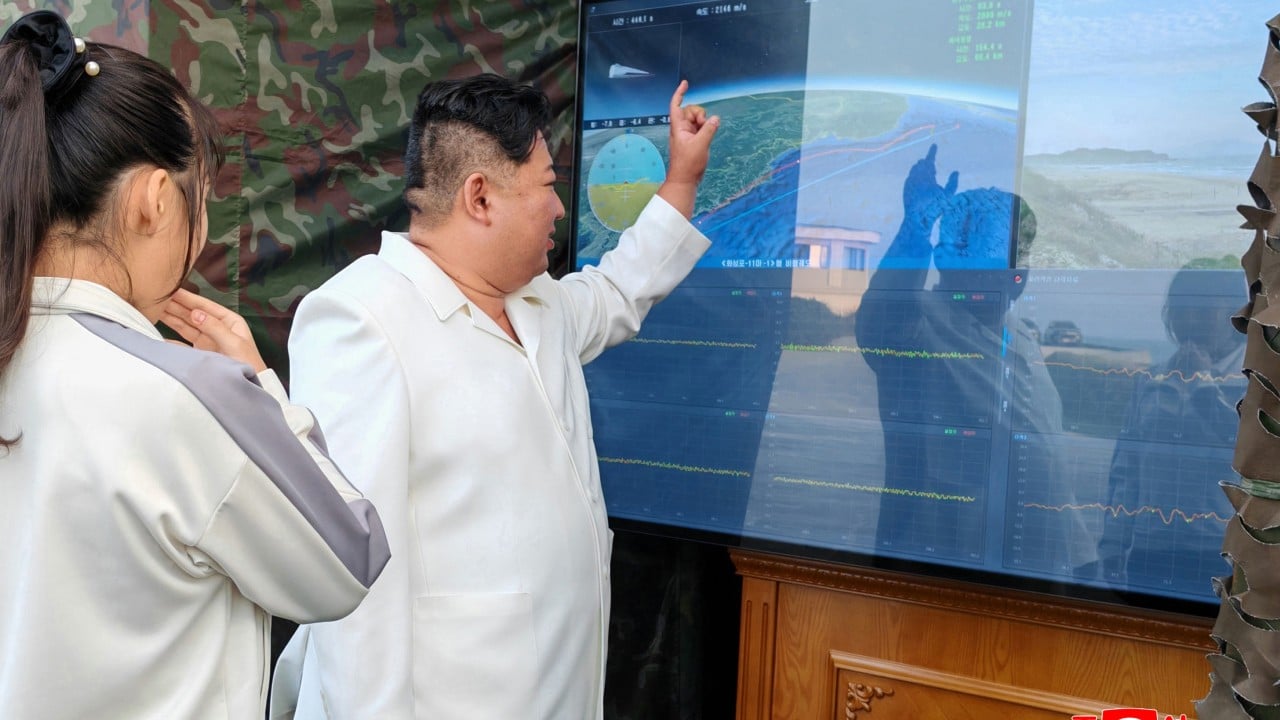
When Pyongyang fires a fresh batch of ballistic missiles right before a major diplomatic summit, nobody should act surprised. North Korea's recent short-range missile tests—flying hundreds of kilometers into the sea under the watchful eye of Kim Jong-un—weren't random military routine. They were a calculated media stunt designed to crash the upcoming meeting between US President Donald Trump and Chinese President Xi Jinping.
If you look past the standard diplomatic statements, the real strategy becomes obvious. Pyongyang wants to ensure that denuclearization stays off the table entirely.
The Timing Tells the Real Story
The math of international provocation is simple. North Korea dropped two short-range ballistic missiles from Wonsan just days before the United Nations General Assembly opened and right on the doorstep of the high-stakes US-China summit in Washington.
The first missile traveled roughly 450 kilometers, while the second stretched past 600 kilometers. State media quickly confirmed these were tests of a new hypersonic weapon system.
Why right now? Because Kim Jong-un knows that trade, technology, and artificial intelligence usually dominate talks between Washington and Beijing. By blasting missiles into the East Sea, Pyongyang forces its way onto an agenda that would rather ignore it.
Rewriting the Rules of Engagement
For years, Western policy operated on the fantasy that strict sanctions and diplomatic pressure would eventually force North Korea to give up its warheads. That approach is dead.
Today, Pyongyang treats its nuclear status as an absolute fact. Trump has publicly noted that North Korea possesses dozens of very powerful nuclear weapons. In the secretive politics of the Korean peninsula, a US president counting an adversary's warheads out loud sounds an awful lot like quiet recognition.
Kim's administration has even redrawn internal maps, officially redefining inter-Korean relations as ties between "two hostile states". South Korea is being written out of the script entirely. Pyongyang wants direct dialogue with Washington, but only on its own terms—meaning negotiations over arms control or economic concessions, never disarmament.
What Beijing and Washington Want to Ignore
Neither Xi Jinping nor Donald Trump wants a fiery crisis on the Korean peninsula right now. Trump is juggling domestic pressures and broader global flashpoints, while Xi wants economic stability and predictable trade corridors with the US.
At their previous meeting in Beijing, the security threat posed by the peninsula barely made a public ripple. Both superpowers prefer managing the North Korean threat to solving it.
That silence suits Pyongyang just fine. Indifference from the world's most powerful capitals buys the regime time to refine its intercontinental capabilities and build out solid tactical delivery systems. Every time Washington and Beijing look away, North Korea pushes the envelope further.
Managing the Fallout
If you are tracking where regional security goes next, watch how the US-China joint statements handle Asian security. If the peninsula gets sidelined once again, expect more missile tests, sharper rhetoric from Kim Yo-jong, and an even more rigid posture from the North.
Pyongyang has made its message crystal clear. Denuclearization is off the menu, and any future talks must start from the premise that the North is a permanent nuclear power. Ignore that reality, and the next set of missiles will fly even further.