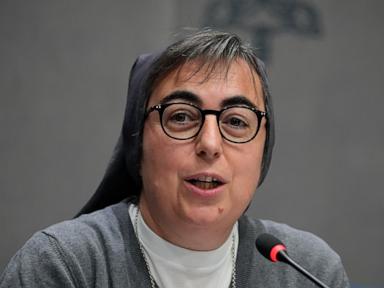
The Vatican just made a move that blindsided a lot of traditionalists and signaled exactly how the current papacy intends to handle institutional power. Pope Leo XIV officially promoted Sister Alessandra Smerilli to head the Vatican office responsible for migrants, the environment, and human development. It is the new Pope's first major appointment of a woman to the Holy See hierarchy.
If you think this is just a routine administrative reshuffle, you are missing the bigger picture. This decision tells us exactly where the Catholic Church stands on the internal battle over women in leadership. It also highlights the intricate administrative acrobatics required to balance centuries-old theological rules with the practical demands of governing a modern global institution.
The Strategy Behind Smerilli Promotion
Sister Alessandra Smerilli isn't your average bureaucrat. She is a highly trained economist who has been working inside the Vatican machinery for years. Up until this promotion, she served as the number two official within the Dicastery for Promoting Integral Human Development. Now, she is taking over the entire department as prefect.
She steps into the shoes of Canadian Cardinal Michael Czerny, a high-profile figure who is retiring as he hits his 80th birthday.
This isn't just about putting a new face in an old office. The department Smerilli now leads handles some of the most volatile and urgent issues facing the global church. We are talking about migration crises, climate change policy, and global economic disparity. Placing an economist in charge of this specific department shows that the Vatican wants data-driven, practical execution rather than just theological statements.
The Clerical Loophole You Need to Understand
Here is where the story gets really interesting, and it is an angle that standard news wires completely glossed over.
Simultaneously with Smerilli's appointment, Pope Leo XIV named Cardinal Fabio Baggio as the pro-prefect of the exact same office. Why create a dual-leadership structure? Why can't a woman just run the department outright without a cardinal attached to her heels?
It comes down to a structural reality within Catholic governance. The Church explicitly reserves ordination and the priesthood for men. Many top-tier Vatican offices require their leaders to perform specific sacramental and canonical functions that the institutional Church dictates must be done by a priest or a cardinal. By appointing Baggio alongside Smerilli, the Pope created a workaround. Smerilli holds the institutional title of prefect and drives the policy, while Baggio handles the sacramental obligations that require a man in holy orders.
Critics see this as a half-measure. They argue that it keeps women in a position where they always need a male counterpart to validate their institutional authority. On the other side, reformists view it as a brilliant piece of legal maneuvering. It pushes female authority to the absolute limit of what current canon law allows without triggering an outright schism over ordination rules.
Following a Modern Precedent
Pope Leo XIV is making it clear that he will not roll back the organizational reforms started by his predecessor, Pope Francis. Francis made a conscious effort to place women into high-level management positions within the Holy See. He did this largely to address decades of intense criticism from Catholic women who do the vast majority of the groundwork worldwide—running schools, managing hospitals, and keeping parishes alive—yet find themselves locked out of the ultimate decision-making rooms.
We have seen this playbook before. Not long ago, Sister Simona Brambilla was appointed to co-lead the department responsible for the world's religious orders. We also have Sister Raffaella Petrini running the internal administration of the Vatican City State, overseeing everything from the local police force to the revenue generated by the Vatican Museums.
What makes Smerilli's appointment stand out is the sheer political weight of her portfolio. Migration and climate change are not quiet, internal administrative topics. They are frontline cultural and geopolitical issues.
Real World Implications for Global Migration Policy
When a Vatican department speaks on migration, governments listen. The Church possesses a massive diplomatic network with permanent observer status at the United Nations. Under Smerilli's leadership, we can expect a sharp shift toward focusing on the economic root causes of global displacement.
Her background in economics means she looks at migration through the lens of labor markets, climate disruption, and systemic poverty. She isn't just looking at the moral obligation to welcome the stranger. She is looking at the structural global failures that force people to flee their homes in the first place.
This appointment will likely ruffle feathers in conservative political circles, especially across Europe and North America, where anti-immigration rhetoric often overlaps with traditional Catholic voting blocs. Having a high-profile nun leading the Vatican's migration policy creates a direct challenge to politicians who attempt to use Christian values to justify highly restrictive border policies.
The Institutional Road Ahead
Smerilli has a mountain to climb. The Roman Curia, which is the administrative heart of the Catholic Church, is notoriously resistant to change. Bureaucratic inertia has swallowed up many well-intentioned reformers over the centuries.
To see real impact from this appointment, look for a few key indicators over the next twelve months. Watch how the budget inside her dicastery is allocated. Pay attention to whether she or Cardinal Baggio takes the lead during major international summits. Track whether her office issues specific policy papers targeting global financial institutions.
The success of this appointment will not be measured by the historic nature of the announcement. It will be measured by whether an economist in a habit can successfully steer the moral and financial influence of the world's largest religious institution toward solving tangible humanitarian crises.