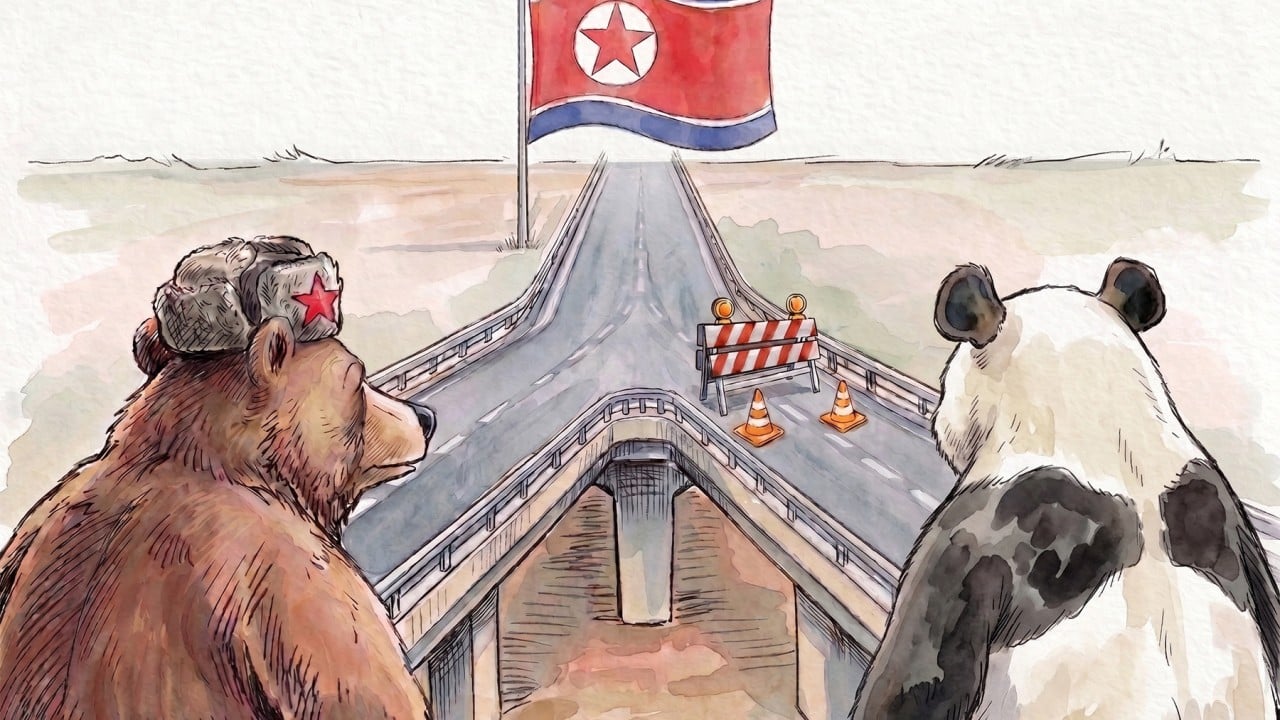
Geopolitics rarely moves in straight lines, but concrete and steel can send a very sharp signal. The newly opened road bridge across the Tumen River connecting Russia’s Khasan region to North Korea’s Rason special economic zone isn't just about moving cargo. It's a physical reminder that regional power dynamics are shifting away from Beijing's comfort zone. For years, international analysts painted Northeast Asian politics as a neat, Beijing-led bloc of authoritarian allies. This new crossing shatters that lazy assumption.
If you look at a map, the implications become instantly clear. China's landlocked northeastern provinces of Jilin and Heilongjiang sit agonizingly close to the Sea of Japan, yet they lack direct maritime access because the lower reaches of the Tumen River are shared strictly between Russia and North Korea. Beijing has spent decades trying to negotiate broader navigation rights and port access through the Tumen corridor. Now, Moscow and Pyongyang have built a direct highway link right over that exact choke point without waiting for Chinese sign-off or granting Beijing the concessions it wanted.
The Tumen River Choke Point
Let's talk about the geography. The new kilometer-long span sits just downstream from the century-old, low-level Korea-Russia Friendship rail bridge. Because the height of these structures remains low, large cargo ships cannot easily sail up the Tumen to open waters. China wanted changes. China wanted a voice in regional infrastructure development that would finally unlock its access to the sea. Instead, Russia and North Korea finalized a bilateral project that handles hundreds of vehicles daily, entirely bypassing Chinese territory or logistics networks.
This isn't merely a trade convenience. It's a direct bypassing maneuver. When Vladimir Putin and Kim Jong Un agreed to this initiative during their high-profile summit meetings, they weren't plotting a grand tri-nation partnership with China. They were carving out a bilateral survival lane. North Korea wants to reduce its total economic overdependence on Beijing. Pyongyang hates being treated like a junior partner or a mere buffer zone. By opening up direct road links to Russia, Kim gets alternative energy sources, technological support, and diplomatic cover.
What the Analysts Miss
Most mainstream commentary frames this simply as a military artery for moving munitions and troops between Moscow and Pyongyang. Yes, that logistics pipeline is real and heavily documented as the war in Ukraine drags on. North Korean troop deployments and artillery shells have found a smooth, direct route straight into Russian territory. But stopping at the military angle misses the deeper diplomatic chess match happening right beneath Beijing's nose.
Look at the contrast in execution speeds. China’s New Yalu River Bridge has sat largely unused for over a decade because local infrastructure plans stalled out. Meanwhile, Moscow and Pyongyang pushed this Tumen River road project through with relentless speed. That contrast highlights a stark reality. Russia and North Korea can coordinate rapid, unilateral actions that disrupt regional power balances while leaving Beijing to manage the fallout.
Beijing now faces an awkward strategic dilemma. If it complains too loudly, it risks pushing its two northern neighbors into an even tighter independent alignment. If it stays silent, it watches its economic and political monopoly over North Korea erode piece by piece. Pyongyang is playing Moscow against Beijing to maximize its leverage, proving that even isolated rogue states can outmaneuver economic superpowers when the timing is right.
The bridge is open. The trucks are rolling. And the myth of a unified, Beijing-dominated northern coalition is cracking under the weight of realpolitik.
Tumen River bridge project explained
This video provides background on the Tumen River deal and the regional infrastructure negotiations involving Russia, North Korea, and China.