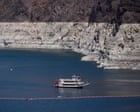
The largest reservoir in the United States just hit rock bottom. Literally. Lake Mead dipped to 1,040.5 feet above sea level, breaking the grim record set back in July 2022.
If you live anywhere near the American West, this isn't just another environmental headline. It is a blinking red light for an entire regional economy. For nearly a century, the giant artificial lake formed by Hoover Dam has acted as an insurance policy for millions of people. That policy is now bouncing checks.
The Colorado River system is running on fumes. Overuse, rising temperatures, and a disastrously thin snowpack in the Rocky Mountains have drained the region's savings account.
What the Numbers Actually Mean on the Ground
Data from the U.S. Bureau of Reclamation tells a relentless story. The water level has been sliding downward daily, exposing pale white "bathtub rings" of mineral deposits high up on the canyon walls. Boat ramps sit stranded hundreds of feet from the current waterline.
Roughly 40 million people across seven states, tribal lands, and Mexico rely on this single plumbing network. When Lake Mead drops, the shockwaves hit municipal water managers, commercial shipping, and massive agricultural sectors in Arizona, California, and Nevada.
Jack Schmidt, director of the Center for Colorado River Studies at Utah State University, put it bluntly when looking at the recent metrics: the basin has entered uncharted territory. We are no longer dealing with a temporary drought cycle. This is structural aridification.
The Hydropower Threat Hiding Beneath the Dam
Water security gets most of the press, but electricity production is the next domino ready to fall.
The Hoover Dam generates massive amounts of carbon-free hydroelectric power for public utilities across Nevada, Arizona, and California. Drop the water level just another five feet, and the oldest turbines lose their efficiency.
If those intake valves starve, the dam's power generation capacity plummets by up to 70 percent. Grid operators don't have an instant replacement for that baseline energy. Communities would face sudden power spikes and severe transmission strain during peak summer heatwaves.
Why State Negotiations Keep Stalling
For years, federal mediators have tried to force lower basin states into a binding agreement on massive water cuts. Voluntary reductions haven't moved the needle fast enough.
Agriculture takes the brunt of the criticism because farming consumes the lion's share of the Colorado River's flow. Irrigation districts in places like California's Imperial Valley argue they feed the country, making arbitrary water cuts an existential threat to food production. Yet, municipal leaders counter that residential taps in Las Vegas and Phoenix cannot simply run dry.
Federal officials finally dropped a heavy-handed management framework allowing for aggressive mandatory shortages. It's a top-down intervention that local stakeholders hate, but the math leaves very little room for debate.
Moving Forward as the Basin Shrinks
Hoping for a massive winter blizzard to rescue the Colorado River is a losing strategy. Even an exceptionally wet winter only buys a temporary pause, as evaporation rates and chronic overallocation immediately eat away at any gains.
Real adaptation requires permanent behavioral shifts. Cities are ripping out non-functional turf grass, ramping up wastewater recycling, and changing municipal codes. Farmers are investing in drip irrigation and fallowing fields to conserve every possible drop.
The era of abundance on the Colorado River is over. Surviving the new normal means treating water like the scarce, precious commodity it has always been.