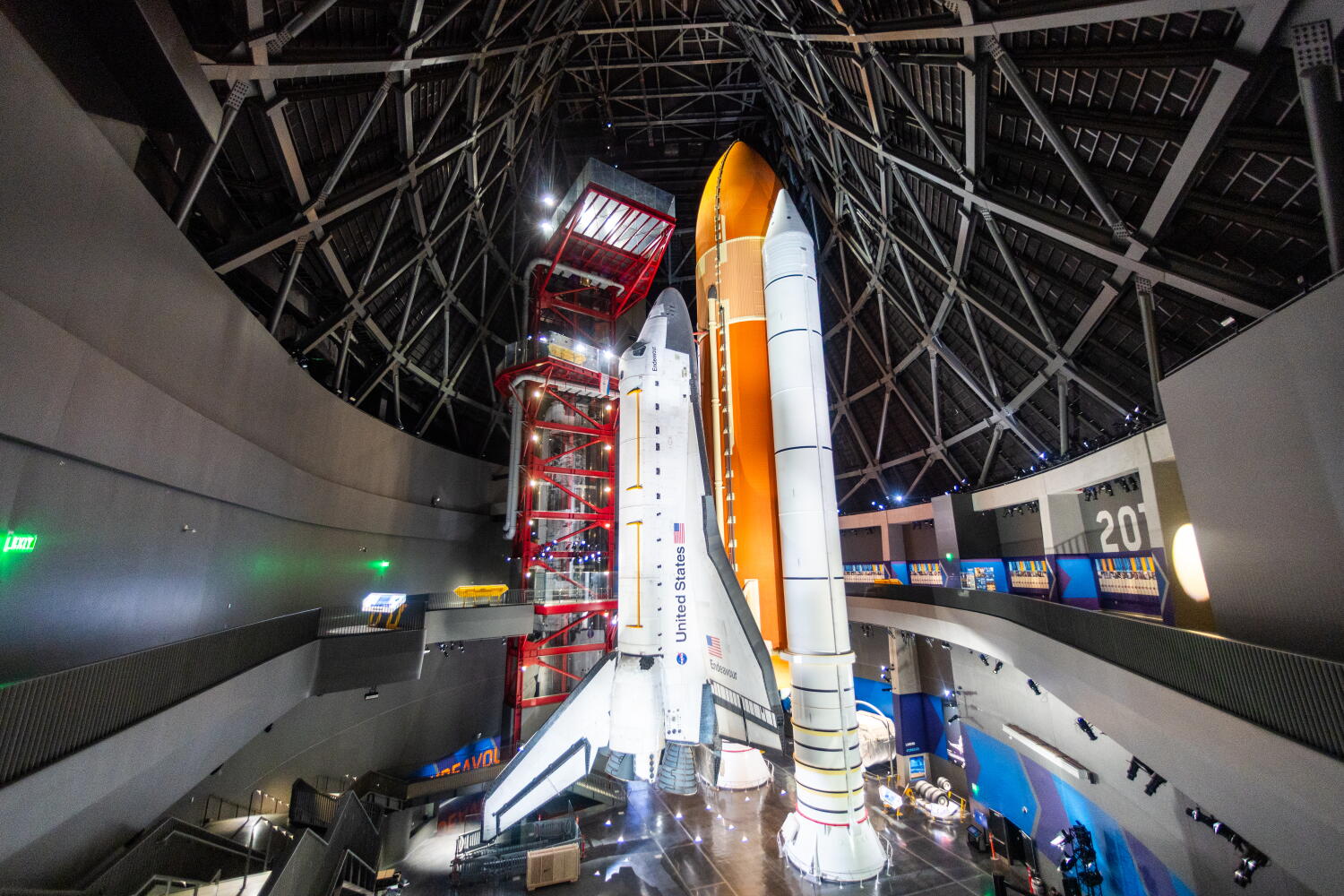
Standing twenty stories tall inside a gleaming stainless-steel architectural marvel in Exposition Park, Space Shuttle Endeavour doesn't just sit in a room. It points straight at the sky.
Los Angeles just redefined what a museum experience can be. For over a decade, visitors to the California Science Center watched Endeavour horizontal, resting quietly like a retired thoroughbred in a stable. That casual horizontal era is over. The orbiter now stands fully assembled in a vertical, launch-ready configuration complete with authentic solid rocket boosters and ET-94, the last remaining flight-qualified external tank. It is the only display of its kind anywhere on the planet.
If you think you've seen what NASA's retired orbiters look like up close, you haven't seen anything yet.
The Engineering Nightmare Behind a Vertical Masterpiece
Building a 200-foot-tall, column-free structure to hold an actual space shuttle vertically wasn't simple. Architects at ZGF and engineers at Arup faced structural physics problems that kept contractors awake at night. MATT Construction had to lower massive 10,000-pound aft skirts onto an 1,800-ton concrete slab with an alignment margin of less than one-tenth of an inch.
Using a towering 300-ton crane inside an urban environment required surgical precision. You don't get a second chance when you're stacking multi-ton pieces of American space history.
Most aerospace exhibits treat artifacts like dusty relics behind velvet ropes. They want you to look and keep moving. The $450 million Samuel Oschin Air and Space Center throws that rulebook out the window.
Inside the Three New Multilevel Galleries
The massive 200,000-square-foot expansion isn't just about one retired vehicle. It splits its massive footprint across three distinct galleries that force visitors to interact with the mechanics of flight:
- The Samuel Oschin Shuttle Gallery: Home to the vertical Endeavour stack, multi-level viewing gantries, and glass-floor platforms that let you peer directly down at the spacecraft's underside.
- The Korean Air Aviation Gallery: A deep dive into atmospheric flight where you can examine the physics of lift, drag, and jet propulsion through hands-on engineering challenges.
- The Kent Kresa Space Gallery: Focused entirely on spacecraft systems, orbital mechanics, and what it actually takes to survive outside Earth's atmosphere.
You aren't reading plaques. You're walking past 100 historic aerospace artifacts paired with 100 hands-on exhibits designed by people who clearly understand that humans learn best by doing, not reading.
How to Beat the Crowds and See It Right
General admission to the California Science Center remains free, but the massive demand for the new Air and Space Center means you can't just stroll in off the street without a plan. Reservations are strongly encouraged, and visitors who show up without advance booking risk getting shut out when daily capacities hit their limits.
A $4 reservation service fee applies per ticket, though members of the Science Center bypass the fee entirely. If you're planning a trip for a large group of 20 or more, forget the online portal and call the center directly at 213-744-2019 to secure a group slot.
Go early on a weekday if you hate fighting crowds for elevator views on the gantry. Walk straight to the upper platforms first while everyone else lingers on the ground floor staring up in disbelief. Take your time on the glass floors, and pay close attention to the thermal protection tiles scorched by atmospheric re-entry. That wear and tear tells a real story that no textbook can match.