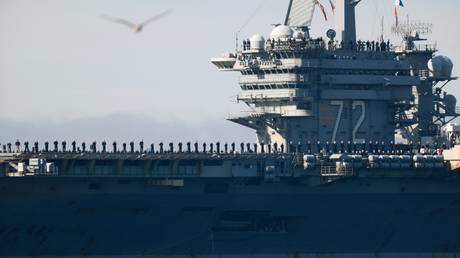
When deployment extensions turn infinite, human breaking points follow closely behind. Right now, roughly 5,000 sailors and Marines aboard the aircraft carrier USS Abraham Lincoln are living through a nightmare of endless exhaustion while operating near Iran.
We aren't talking about standard military gripes about chow or schedule adjustments. We are talking about desperate sailors trying to jump overboard, shipmates wrestling peers back from the flight deck edge at the last second, and a crew trapped in an operational purgatory that leadership struggles to manage.
Let's look at what is actually happening behind the sanitized Pentagon press releases.
The Reality of Endless Deployments
The USS Abraham Lincoln left port back in November. It was supposed to return home in May. Instead, months ticked past with zero public return date provided, trapping the crew in a continuous loop of high-stress combat operations.
Active-duty personnel describe the atmosphere using phrases like "turning and burning". Shift rotations are brutal. Sleep is a luxury. When you keep thousands of young service members locked inside a floating city for over eight months under constant tactical tension, something eventually snaps.
For some crew members, that snap manifested as an absolute refusal to keep going.
Inside the Overboard Incidents
Details emerging from family advocacy groups and open-source military reporting paint a grim picture. Families spoke out after receiving frantic communications or enduring agonizing silences from loved ones.
Annabelle Loma shared the story of her husband, a sailor with a thirteen-year career, who attempted to jump from the carrier after being chronically overextended. Instead of immediate medical compassion, his primary dread centered on whether the Navy would slap him with a dishonorable discharge for burning out under the strain. Think about that. A career military member pushed so far past his limits that he sought a permanent exit, only to fear administrative punishment for breaking.
In a separate incident, a watchstander spotted a peer preparing to go over the side. That sailor lunged across the deck, grabbing the individual's arms and dragging them back to safety just as backup arrived. Shipwide announcements and frantic word-of-mouth warnings quickly replaced standard operational news on the mess decks.
Beyond Exhaustion: Living Conditions on the Lincoln
Mental fatigue doesn't happen in a vacuum. It feeds on physical degradation.
Reports compiled from family briefings with Navy leadership highlight severe quality-of-life failures aboard the carrier. Crew members faced food shortages, dwindling portions, and long lines just to get basic meals. Essential items vanished from ship store shelves, leaving sailors without soap, toothpaste, or deodorant.
Add broken toilets, clogged laundry facilities, and mold spreading through the showers, and you get an environment designed to grind down human dignity. When you treat sailors like disposable machinery, they start reacting like broken parts.
How the Pentagon is Responding
Top brass can no longer pretend these are isolated anomalies. Acting Navy Secretary Hung Cao and other senior leaders faced more than 200 angry and terrified family members in San Diego, alongside subsequent virtual town halls.
Vice Adm. Joseph Cahill acknowledged the immense pressure during these sessions, telling families that leadership hears their concerns regarding force sustainability. Plans are supposedly underway for the USS Theodore Roosevelt carrier strike group to relieve the Lincoln.
Yet relief timelines remain vague, heavily muffled behind operational security walls. For a sailor standing watch today, promises of tomorrow do very little to stop the panic of the present.
What Needs to Change Right Now
The Navy has plenty of counselors, chaplains, and medical sheets on paper. What they lack is an operational tempo that respects human biology.
Extended deployments without hard stop dates destroy retention, ruin mental health, and cost lives. If the military expects to maintain a dominant global posture, it has to stop treating manpower as an infinite resource.
Check on the service members in your life, support military family advocacy networks demanding transparency, and stop accepting chronic overextension as just part of the job.