Gravity shapes almost every biological process on Earth, down to the way a flower smells.
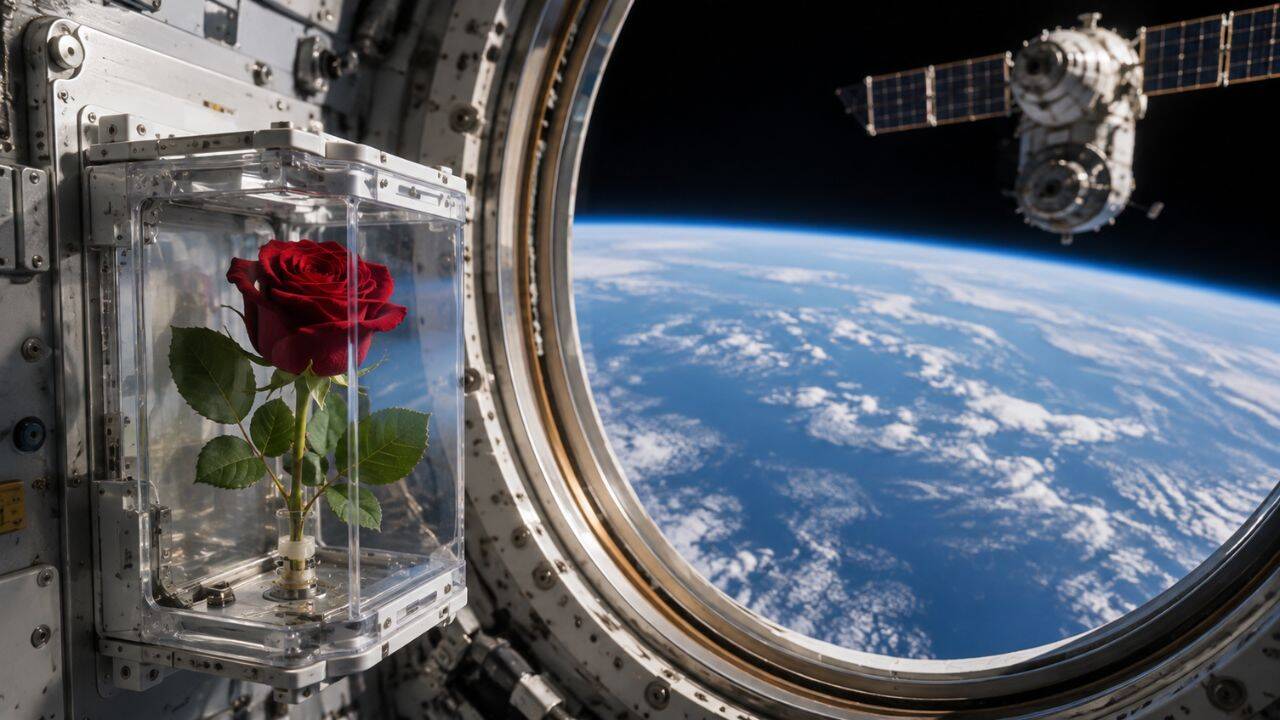
Back in 1998, Space Shuttle Discovery carried a tiny miniature rose named "Overnight Scentsation" into orbit. Researchers wanted to see how microgravity altered the volatile organic compounds that give flowers their distinct aromas. The results stunned the payload team. The rose didn't just smell different; it produced an entirely unique bouquet of scent molecules that it had never generated down on Earth.
Space changes plants. It's that simple.
The Science Behind Orbital Floriculture
When you smell a rose, you're inhaling a complex cocktail of chemicals. On Earth, gravity pulls fluids downward, dictating how water and nutrients move through vascular tissues. Atmospheric pressure and air currents also play massive roles in how scent molecules disperse around the bloom.
Take away Earth's pull, and the rules break down.
Inside the Space Shuttle's payload bay, International Flavors & Fragrances (IFF) used a specially designed solid-phase microextraction device to capture the scent of the orbiting rose. When scientists analyzed the gas chromatography data back on solid ground, they found that the microgravity environment caused the miniature rose to synthesize significantly fewer of certain terpene compounds while heavily ramping up others.
The plant reacted to the orbital stress by altering its biochemical pathway. It adapted.
Why Perfume Giants Cared About a Space Rose
This wasn't just a quirky stunt for NASA scientists looking for something fun to pack into a shuttle cargo hold. Commercial perfumers jumped at the data immediately.
If you can trigger a plant to manufacture new scent profiles by altering its environmental physics, you unlock an entirely new toolkit for fragrance creation. The data retrieved from that 1998 flight directly influenced commercial perfumes developed in the years that followed. Companies realized they didn't have to rely solely on traditional terrestrial extraction methods.
Environmental stress forces adaptation. Plants are chemical factories. Shift the gravity, shift the chemistry.
Living Plants in Orbit Today
That single rose paved the way for decades of plant biology research aboard the International Space Station. Astronauts don't just look at flowers anymore; they eat space lettuce, grow dwarf tomatoes, and monitor Zinnias blooming in the Veggie plant growth system.
Growing things in space is notoriously difficult. Without gravity to guide water movement, roots can drown in pools of floating moisture, or starve if water doesn't cling to them properly. NASA engineers had to invent specialized clay-based root modules and controlled LED lighting arrays to keep orbital botany alive.
Every single leaf and petal that survives up there teaches us how to sustain human life on long-duration missions to Mars and beyond.
What This Means For Your Houseplants
You don't need a multi-million-dollar space program to test how environment alters plant chemistry.
Stress a houseplant, and watch what happens. Under-water a mint plant slightly, and watch its essential oil concentration spike, making the leaves taste sharper and more pungent. Expose a tomato plant to physical wind resistance using a small fan, and watch its stems grow thicker and woodier as it responds to the mechanical stress.
Plants listen to their surroundings. They read the physics of their environment and rewrite their own biology on the fly.
The 1998 rose experiment proved that Earth isn't the only place where nature can create beauty. It showed us that biology is flexible, resilient, and endlessly surprising when stripped of the forces we take for granted every single day.
Next time you stop to smell a flower, remember that its entire aromatic profile is a delicate negotiation between its genetics and the crushing pull of gravity. Change the physics, and you change the world.