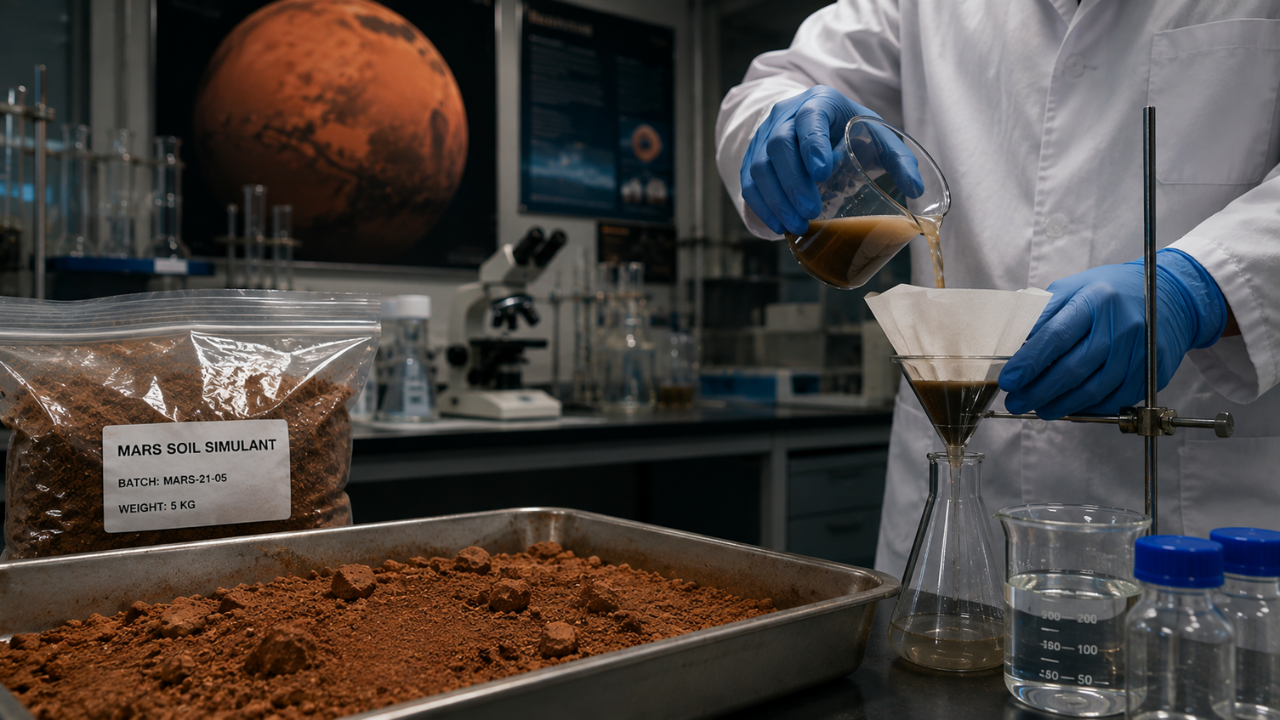
Space exploration gets plenty of funding for rockets and flashy launch events, but what happens after the crew actually lands? Long-duration space missions run into an immediate, unglamorous crisis: wastewater management. Enter Jeremiah Bents, a high school student from Cloquet, Minnesota, who decided to tackle this exact dilemma.
Instead of building model rockets, Bents focused on whether synthetic Martian regolith could help filter ammonia out of contaminated water. His laboratory work recently earned him the Earth Systems Science Award at the Minnesota Academy of Science State Science & Engineering Fair in St. Paul. It is a stark reminder that some of the most practical questions about living off-world are being answered in high school labs.
Simulating the Red Planet in Minnesota
Real Martian soil is hard to come by. Space agencies guard actual planetary samples tightly, and bringing tons of regolith back to Earth isn't economically viable yet. Bents didn't work with actual material sourced from Mars. Instead, he used a laboratory substitute known as a Mars soil simulant.
He wasn't flying solo on the project, either. Bents secured backing from professional researchers, including Dr. Nathan Johnson, Dr. Jacob Schmidt, and senior NASA scientist Dr. Chris McKay. McKay actually supplied a specialized variant of Mars simulant for Bents to test. This collaboration bridged the gap between a standard classroom science fair project and real-world planetary science.
Testing the Filtration Limits
The core of the project, formally titled A Mars Mission: Testing Filtering Effectiveness of Mars Soil Simulants When Removing Ammonia from Water, targeted a specific chemical headache. Human waste systems and life support loops on long missions generate significant amounts of ammonia. If you want astronauts to survive for months or years on another planet, recycling water isn't optional. It is a matter of absolute survival.
Bents set up a controlled experiment to see how well the regolith simulant could strip ammonia contaminants from liquid samples. Mineral compositions in Martian dust react in unique ways with various compounds. By testing the simulant's filtering capacity, the project explored whether local planetary materials could double as natural water purification beds, reducing the weight of life-support equipment that missions need to haul from Earth.
Why Student Research Actually Matters
It is easy to dismiss science fair projects as academic exercises destined for a garage shelf. But independent experiments by students often test hypotheses that institutional labs skip due to funding constraints or rigid priorities.
Bents was not the only student from the Cloquet area making waves at the state fair. Alongside local peers exploring wastewater treatment, wildfire smoke dynamics, and aquatic science, his work highlighted a growing trend of students engaging directly with environmental and aerospace engineering challenges. When mentors like Chris McKay supply materials to high school researchers, it creates a pipeline of young talent thinking critically about space resource utilization.
We are still decades away from establishing permanent human outposts on Mars. When those crews finally arrive, survival will depend on using whatever is lying around on the surface. Jeremiah Bents took a small step toward figuring out how to turn toxic dust into a lifeline.
/AI (artificial intelligence)/Businessman touching the brain working of Artificial Intelligence (AI) Automation by Suttiphong Chandaeng via Shutterstock.jpg)


