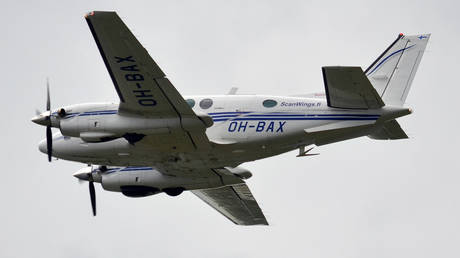
When a medical transport plane slammed into a New Mexico mountainside on a pitch-black night, killing all four people on board, it exposed a terrifying blind spot in modern aviation safety. The U.S. military was running electronic warfare exercises nearby at the time. They were jamming GPS signals across a massive swath of airspace.
You might think civilian aircraft simply shrug off these military tests. They don't.
According to National Transportation Safety Board (NTSB) documents, the twin-engine Beechcraft C90 lost its GPS capability just minutes after takeoff from Roswell Air Center. The flight crew was headed to Ruidoso to pick up a patient. Instead, they flew straight into a disaster.
Let's look at what actually happened and why this issue isn't going away.
The Chain Reaction in the Cockpit
Military GPS jamming doesn't mean a jet gets shot out of the sky with a missile. It means the invisible electronic grid pilots rely on suddenly goes dark or feeds them garbage data.
On that night in May, the military was conducting tests connected to NAVFEST at the White Sands Missile Range. Federal Aviation Administration (FAA) notices had warned about GPS interference across a huge radius. But warnings on paper don't stop a cockpit crisis in real time.
When the medevac crew lost their GPS, their primary navigation and terrain warning systems degraded or failed. They had to switch gears instantly while navigating a moonless, pitch-black night over dangerous terrain.
Air traffic controllers scrambled to help. They gave the pilots radar vectors. They even asked the military to pause the jamming for a few minutes. But the damage to the workflow was already done. High stress, heavy workloads, and missing data combined to create a classic aviation accident chain.
The Wider Problem Nobody Talks About
This crash isn't an isolated incident. Across the globe, electronic warfare testing and regional conflicts are turning civilian skies into electronic battlefields.
Commercial pilots report sudden GPS dropouts with alarming frequency. When electronic warfare units crank up their jammers to train for drone defense, the interference bleeds far beyond test ranges.
Think about what happens when a commercial airliner loses its positioning data over busy airspace. Pilots are trained to handle it. They fall back on traditional instruments and ground-based beacons. But human error and high-stress environments mix poorly. Every layer of safety you strip away increases the odds of a catastrophe.
"Loss of GPS isn't a minor inconvenience. It removes critical situational awareness tools and spikes pilot workload when they can least afford it."
What Needs to Change Right Now
We can't just tell pilots to fly better. The military needs to rethink how it tests electronic warfare equipment.
- Better Real-Time Coordination: Posting a generic advisory days in advance isn't enough when active flights are in the air.
- Tighter Signal Containment: Test ranges need better technology to keep jamming signals from spilling over into civilian air corridors.
- Safer Fallbacks: Airlines and charter operators must ensure their crews routinely practice flying without digital crutches.
Technology made flying safer than ever. But it also made us dangerously dependent on a single, vulnerable satellite signal. Until the military and aviation regulators fix how they share the sky, the next blackout might be just around the corner.