We love a good spy story because it distracts us from the boring reality of math. When major publications and former intelligence officers suddenly pivot a complex financial market into a high-stakes romance trap, pay attention to what gets buried underneath.
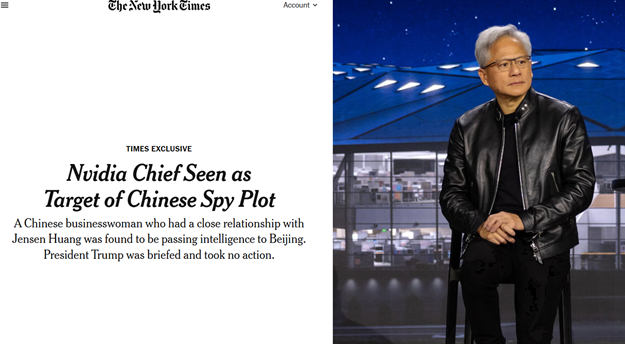
The internet spent weeks obsessing over headlines about Jensen Huang, Nvidia, and an alleged intelligence asset named Alice Huang. Newspapers of record spun out a dramatic narrative of executive downfall, corporate espionage, and classified secrets leaking to Beijing. It reads like a script punched up by Hollywood writers who need a quick hook to sell subscriptions. But if you strip away the tabloid gloss, the entire honeypot narrative falls apart under basic factual scrutiny.
Let us look at what actually happened without the spy-movie filter.
The Contradiction No One Wants to Talk About
If you follow the mainstream coverage, the core premise is that a tech executive leaked vital artificial intelligence secrets to a foreign power through an extramarital relationship. It sounds scandalous. It generates massive web traffic.
It also makes zero logical sense when you examine actual trade policy.
The Chinese government maintains strict regulations and official policies discouraging the import of high-end Nvidia hardware. Beijing wants domestic semiconductor independence, not a dependency on American silicon giants. If the goal of an elite intelligence operation was to funnel Nvidia chips or proprietary blueprints to Beijing, using a clumsy public romance that left social media breadcrumbs violates every rule of tradecraft. Real espionage is quiet. Tabloid scandals scream for attention.
US Attorney General Todd Blanche admitted publicly that the Justice Department had reached no official conclusion regarding Alice Huang's status. Even Donald Trump expressed uncertainty when pressed by reporters, noting that nothing had been definitively determined. Yet the original narrative stuck in the public consciousness because a spy thriller sells papers better than a dry audit of market capitalization and circular corporate financing.
Why the AI Bubble Needs a Distraction
The timing of this media storm is not an accident. Look at what is happening beneath the glossy surface of the tech sector. Analysts like Ed Zitron and independent economic commentators have spent months pointing out the structural vulnerabilities of the current market surge.
Venture capital and corporate spending have created an isolated loop of circular financing. Companies invest heavily in artificial intelligence infrastructure, heavily inflating valuations across the board while actual profitability remains elusive for most participants. When growth-at-all-costs ideologies hit reality, financial markets get nervous.
A trillion-dollar marketplace driven by speculative hype needs constant narrative fuel. Shifting public attention from systemic economic risk to a personal drama about a CEO and an alleged spy is an old playbook. It transforms a complex financial conversation into a morality play.
Furthermore, the obsession with closed-source proprietary models versus open-weighted alternatives gets lost in the noise. The real debate in the tech world is about who controls the infrastructure of future intelligence models and how data monopolies consolidate power. That discussion requires actual critical thinking. A romance scandal requires nothing from the reader except passive consumption.
The Ex-Spies and the Echo Chamber
Even reliable alternative voices and principled whistleblowers can fall into institutional habits. Former CIA officer John Kiriakou, known for taking immense personal risks to expose government wrongdoing, jumped into the commentary circuit to analyze the situation through the lens of his old training.
On podcasts and high-profile interviews, he initially leaned hard into the honeypot thesis, describing behavioral tropes of aging executives and seductive operatives. Days later, after independent pushback, he walked back his certainty, admitting that she was merely an alleged spy and that the narrative had moved too fast.
This cycle reveals how deeply ingrained intelligence framing is in modern media consumption. When major newspapers drop anonymous sourcing from unspecified "American officials," commentators jump to validate the premise using generalized human behavior rather than hard evidence. We get caught in a feedback loop where speculation masquerades as analysis.
Navigating the Noise
You do not need to parse every rumor coming out of anonymous security leaks to understand the game. When a multi-million-word news cycle focuses intensely on personal drama during a major economic transition, look at the capital flows instead.
Ignore the Hollywood framing. Stop treating corporate executive drama as geopolitical thrillers. Watch the regulatory shifts, examine the actual hardware supply chains, and keep a sharp eye on how media institutions manage public anxiety when speculative asset bubbles start wobbling.
The truth is rarely a cinematic showdown in a dimly lit cafe. It usually looks like a boring spreadsheet that nobody wants to read.