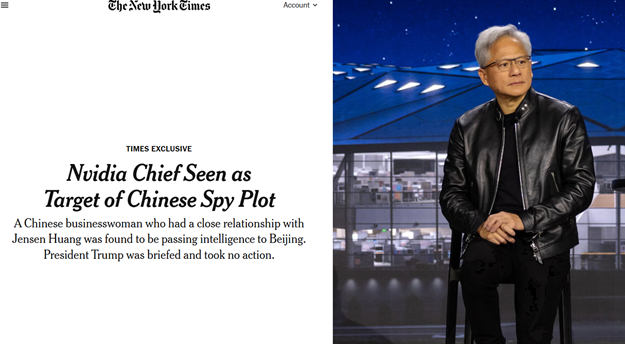
Export rules on paper don't stop a determined buyer when billions of dollars and personal access collide. The fallout around Alice Huang, former Nvidia chief executive Jensen Huang, and companies linked to China's defense ecosystem proves how porous global AI hardware enforcement actually is.
Reports linking Alice Huang to firms with ties to China's defense sector raise a blunt question for investors and policymakers: how did high-end computing clusters end up anywhere near military-linked research despite U.S. export restrictions? Even without proof that specific chips powered weapons or defense programs, the web of corporate entities, offshore hubs, and state-backed capital exposes major blind spots in how Washington, Singapore, Malaysia, and corporate boards police AI compute. For an alternative perspective, check out: this related article.
Allegations of espionage against Alice Huang remain disputed, and Beijing has repeatedly called spy claims unsubstantiated smears. U.S. Attorney General Todd Blanche stated on November 19 that the Justice Department had not concluded she was a Chinese spy, and public reporting has not established that restricted chips actually went toward Chinese military projects. Still, the overlapping business trails matter on their own.
http://googleusercontent.com/lmdx_content/LKPnSFBNJdCItnYdBdDSfxWWdjxAQmnUgofAIMStViROagciGLALaqTjGSlRFkzdTcqDXubPWHsjKrcJzRgziUbowWIiKNixPLrAbfqmkHCwbJoWxOqX320 Similar coverage on this trend has been shared by MIT Technology Review.
Why Alice Huang and China Military Ties Changed the Chip Debate
Early coverage of the Nvidia scandal focused heavily on personal ties, executive resignations, and political drama in Washington. Adding defense-linked corporate connections shifts the story from a boardroom shock to a structural supply-chain problem.
When an executive connected to a major buyer has family or business links to Chinese defense suppliers, compliance officers can't treat every transaction as a routine cloud sale. Corporate records and intelligence-style research cited in reporting point to roughly $3.6 billion in Chinese government funding flowing through entities connected to Huang or her associates, touching technology ventures that included data center hardware.
From my vantage point watching export enforcement over the years, regulators almost always fight the last war. Washington wrote rules focused on direct shipments across borders, while buyers adapted through shell entities, regional hosting hubs, and remote compute arrangements. That gap is why analysts at institutions like the Council on Foreign Relations have warned that enforcement often lags behind commercial workarounds.
- Defense proximity creates red flags: Ties to defense-adjacent suppliers or research labs force scrutiny over dual-use AI workloads, even when commercial use is claimed.
- State funding blurs ownership: Publicly available registries often hide ultimate beneficial control behind holding companies and offshore vehicles.
- Hardware demand creates leverage: Whoever controls scarce GPUs holds immense bargaining power with data center operators and cloud tenants.
How Megaspeed and Southeast Asian Hubs Became a Flashpoint
Look at how Megaspeed fits into the picture. The Singapore-registered firm started out as 7Road International, tied to a Chinese gaming business, before shifting toward data center ambitions. In 2023, Alice Huang and her husband, Kang Wei, pitched investors in Shanghai on building Southeast Asian AI infrastructure backed by chip access and anchor demand.
Over subsequent years, Megaspeed bought more than $4 billion in Nvidia hardware. Reporting has also pointed to Alibaba as a key customer and financial backer, while noting that Alibaba co-founded an AI research lab linked to Chinese military work such as war-game simulations and automated cyberattacks.
Southeast Asia became attractive for a simple reason: electricity, land, and regional connectivity. Through a subsidiary called Speedmatrix, Megaspeed operated servers in Malaysia—including in Johor—where reporting indicates remote cloud access and monitoring software raised alarms among U.S. officials and security researchers.
You don't need to smuggle a server rack in a suitcase if remote cloud access or third-party data centers can route compute workloads across borders.
Megaspeed has pushed back hard. The company says it operates lawfully, has retained outside counsel and U.S. legal advisors for internal reviews and a GPU census, and states that Alice Huang left in 2025. Meanwhile, Singapore authorities have investigated false declarations around server purchases and barred Huang from re-entering the country after finding she gave inaccurate information about her role, and Malaysian officials have opened probes into potential permit issues involving Speedmatrix.
What Most People Miss About Enforcement and Governance
Honestly, plenty of commentary treats this affair like a simple spy thriller. Real compliance failures are usually messier—and more instructive.
First, a business link isn't automatic proof of military use. As PBS News and other outlets have emphasized, serious allegations and active probes don't equal proven espionage or confirmed weapons development. Jumping straight from corporate ties to conclusive guilt muddies serious legal and security questions.
Second, strong financial results don't insulate a company from governance risk. Nvidia reported massive top-line growth—$115.8 billion in third-quarter fiscal 2027 revenue and $107.6 billion in data center sales—yet its shares still dropped roughly 22% from early November into mid-November amid investigations, Jensen Huang's resignation as CEO on November 12, and a subpoena from California Attorney General Rob Bonta. Wall Street prices trust and regulatory predictability right alongside revenue.
Third, policy swings create whiplash. Throughout 2025 and 2026, debates over export licenses, tariffs, remote cloud access, and enforcement priorities kept shifting. When rules change mid-stream or enforcement looks uneven, both companies and regulators pay a steep price in credibility.
Practical Next Steps for Investors, Executives, and Analysts
If you're tracking AI hardware, defense supply chains, or corporate governance right now, don't rely on surface headlines. Take concrete steps to separate noise from verified risk.
- Trace ownership beyond the headline entity. Check corporate filings in Singapore, the British Virgin Islands, Malaysia, and mainland China to see who held directorships, share transfers, or financing rights—and when those roles changed.
- Separate proven facts from open investigations. Track official filings, subpoenas, and regulatory statements from the Justice Department, Commerce Department, SEC, California Attorney General, and foreign ministries rather than treating unverified claims as settled facts.
- Audit remote compute and third-party hosting exposure. If you run or invest in AI infrastructure, map where GPUs physically sit, who controls network telemetry and remote access, and whether downstream customers touch restricted or defense-linked entities.
- Watch board oversight, not just quarterly beats. Pay close attention to newly formed compliance committees, external counsel reviews, and leadership transitions—those mechanisms determine whether a company can regain regulatory trust over the next year.