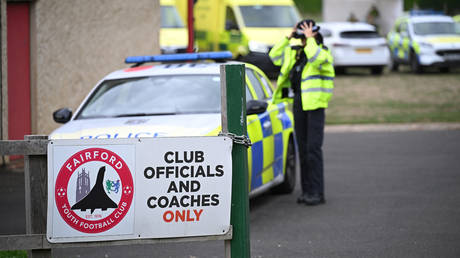
A quiet night in Gloucestershire shattered when emergency services swarmed a small village. Five men were arrested, homes were evacuated, and a major incident was declared near RAF Fairford. But as the smoke clears and investigators sift through the wreckage of what happened, locals and security analysts are left staring at a stark reality. Official updates haven't caught up with the public's anxiety.
If you live near a major military installation, you expect tight security. You don't expect bomb disposal robots picking apart suspicious vans at the end of your driveway.
What Actually Happened in Whelford
The timeline started ticking just before 1 a.m. on a Sunday. A local resident in the village of Whelford, located roughly two miles from RAF Fairford, spotted three suspicious vans moving toward the airfield. When initial calls to the base's internal security went unanswered, a 999 call was placed to Gloucestershire Constabulary.
Armed officers responded instantly. They intercepted the vehicles and arrested five men on initial suspicion of offences under the Explosives Act.
Within hours, the operation escalated dramatically:
- Counter-terrorism police stepped in to lead the investigation.
- The Metropolitan Police confirmed the suspects faced further arrests for the preparation of a terrorist act under Section 5 of the Terrorism Act.
- The British Army deployed a specialist Explosive Ordnance Disposal (EOD) team equipped with remote-controlled robots.
- Around 85 households were ordered to evacuate, with residents moved to a temporary shelter at a leisure centre in Cirencester.
A 400-metre cordon locked down the area. Yet, beyond these broad logistical strokes, officials have kept details tightly locked behind a wall of security clearance.
The Shadow of International Tensions
You can't look at RAF Fairford in isolation. The Gloucestershire base isn't just another quiet slice of the British countryside; it is a critical operational hub for the United States Air Force.
Earlier in the year, the UK government authorized US forces to use British bases—including Fairford—for defensive operations and targeted strikes against Iranian missile sites. That decision turned local fields into front-page geopolitical territory. In July, Iran’s Islamic Revolutionary Guard Corps issued explicit warnings, declaring that any base used for aggression against Iranian territory constituted a legitimate target.
Did those threats materialize in a sleepy English village? Investigators are keeping an open mind.
Assistant Chief Constable Richard Ocone and Counter Terrorism Policing Senior National Coordinator Deputy Assistant Commissioner Vicki Evans have both stressed that the investigation is in its early stages. They haven't confirmed whether the detained men were acting on behalf of a hostile foreign state or if this was an independent cell. That vacuum of certainty is precisely why public unease is spreading faster than official briefings.
The Real Cost of Local Vulnerability
For the 85 households yanked out of their beds at dawn, the immediate concern wasn't global geopolitics. It was basic safety and communication.
Local resident Julian Tudsbery described the abrupt awakening when police pounded on his door while he was still in his dressing gown. Families were heraded into buses and driven away while bomb disposal units prepared to examine vehicles loaded with unknown materials.
This incident exposes a brittle fault line in local infrastructure. When a routine citizen spots suspicious activity heading toward a high-value strategic asset, relying on a phone call that allegedly rang out before hitting 999 points to frightening friction in early-warning pipelines. If civilian vigilance hadn't triggered an immediate armed response, the outcome could have looked entirely different.
What Happens Next
The immediate threat in Whelford has been contained, according to police statements, and a 400-metre cordon remains the primary focal point as forensic teams gather evidence from the vehicles.
Yet, the questions hanging over Gloucestershire remain heavy:
- How deep does this cell go?
- Were these five suspects acting alone, or are there broader networks embedded across the UK?
- Will the Ministry of Defence upgrade security protocols for civilian communities living in the shadow of active US strike bases?
Defence Secretary Wes Streeting praised emergency services for acting swiftly, noting that the armed forces remain on standby 24/7. But praise doesn't answer why hostile actors managed to roll three suspicious vans within striking distance of a vital military perimeter without prior intelligence flagging them first.
Keep an eye on official updates from Counter Terrorism Policing rather than online speculation. If you live near a sensitive defence site, report unusual movements immediately through official channels like the anti-terrorist hotline. Security depends as much on local eyes and ears as it does on military radar.