Flying a fighter jet used to mean flying alone with your wingman a few hundred yards off your left wing. Now you're managing an entire network of autonomous drones while dodging radar waves and enemy missiles.
That shift hit ground simulators in a big way after reports from PLA Daily and the South China Morning Post showed an aviation brigade under China's Southern Theatre Command embedding loyal wingman drone simulations into training for young fighter pilots. Instead of treating unmanned aircraft as a distant science project, the People's Liberation Army is baking manned-unmanned teaming (MUM-T) straight into routine simulator drills.
Let's be honest about why that matters. Flying a real stealth fighter or multirole jet with an live loyal wingman drone costs a fortune, carries risk, and exposes sensitive tactics to prying eyes. Simulators let young pilots fail ten times before breakfast against waves of incoming targets and heavy electromagnetic interference without burning a drop of jet fuel.
How Loyal Wingman Drone Simulations Actually Work in the Cockpit
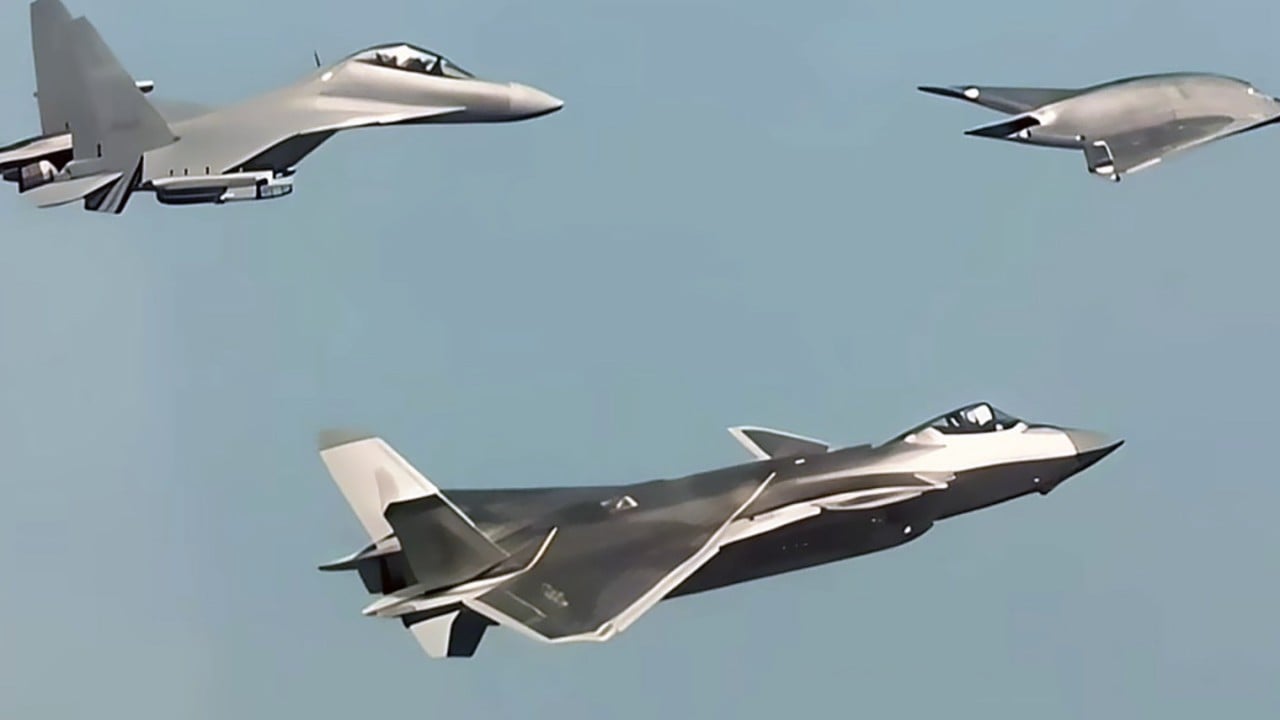
Most people picture a drone pilot sitting in an air-conditioned trailer clicking a mouse. Loyal wingman teaming flips that script. The human fighter pilot stays in the cockpit of a crewed jet—such as a Shenyang J-16 or Chengdu J-20—while AI-driven unmanned combat aircraft fly alongside as sensor nodes, decoys, electronic warfare helpers, or shooters.
In the Southern Theatre Command simulation drills reported in November 2026, young pilots practiced coordinated combat against simulated adversaries backed by virtual loyal wingmen. The training environment throws messy conditions at them: multiple waves of approaching threats and contested electromagnetic spectrums.
Here's the catch nobody talks about enough. A pilot doesn't fly a loyal wingman like a radio-controlled plane. If you make a young aviator manually steer three drones while dogfighting or evading surface-to-air missiles, their brain turns to mush. Good MUM-T relies on tasking by intent—the pilot sets mission goals or rules of engagement, and the drone's onboard autonomy figures out routing, formation spacing, or threat reactions.
I've watched plenty of defense tech demos look slick on a conference screen and fall apart the moment communication links get jammed. That's why simulating electromagnetic interference right inside the training loop is smart. If a data link degrades or drops, the pilot has to know whether the wingman reverts to pre-planned autonomy, holds station, or breaks off.
From Early Validation to Routine Pilot Training
This didn't pop up overnight. A June 2026 study from the U.S. Air Force's China Aerospace Studies Institute pointed out that PLA Air Force units were already validating MUM-T combat employment methods as early as 2024. That research highlighted the 9th Aviation Brigade of the Eastern Theatre Command, based at Wuhu airbase, testing J-20 concepts including coordinated penetration operations with unmanned systems.
Public visibility ramped up through late 2025 and 2026:
- December 2025 simulator reporting: PLA Daily described a Central Theater Command pilot working with system-generated accompanying drones in a simulator while engaging in training battles involving personnel operating real equipment far away.
- Public airframe showcases: State media and military footage highlighted low-observable unmanned platforms like the Gongji-11 (GJ-11, also linked to the Xuanlong 08 designation) operating alongside crewed fighters including the J-20, J-16, and J-16D electronic warfare aircraft.
- Routine brigade-level integration: Moving from test-unit validation to young-pilot simulator training signals an effort to make teaming standard doctrine rather than an elite experiment.
Still, let's keep a clear head about what public reports don't prove. Official media releases and promotional clips are designed to project capability and momentum. They don't hand us classified kill ratios, exact autonomy maturity, or proof of how smoothly those algorithms behave under real combat jamming.
Why Cockpits Are Changing Across Every Air Force
China isn't the only military wrestling with this shift. Across global air forces—from the U.S. Collaborative Combat Aircraft push and Boeing's MQ-28 Ghost Bat to platforms like Turkey's Bayraktar Kizilelma—the core problem is identical. Modern air defenses are dense, long-range, and lethal. Sending expensive crewed jets in alone against layered radar and missile networks is a bad trade.
Put a cheap or attritable unmanned wingman out front and suddenly the math changes:
- Forward sensing: A stealthy drone can push deeper into contested airspace to light up targets while the crewed fighter stays back or lines up a shot.
- Electronic warfare and saturation: Wingmen can carry jamming payloads or draw fire, forcing enemy air defenses to reveal themselves before committing high-value crewed jets.
- Cognitive load management: Ironically, adding drones can either save a pilot's workload or overload it completely. Bad user interfaces and clunky autonomy turn a helpful wingman into another nagging alarm in the cockpit.
That cognitive bottleneck is the real battleground. In real-world aviation, pilots routinely say the hardest part of modern combat isn't pulling G's—it's sorting signal from noise when ten sensors scream at once. Training young pilots on MUM-T in simulators early builds mental muscle memory before they ever touch a live airframe.
What Simulators Get Right and Where They Fall Short
Simulators are unbeatable for repetition, edge cases, and high-tempo decision-making. You can run the same contested strike fifty times, tweaking weather, radar threats, and drone malfunctions each run.
Yet every experienced flight instructor knows synthetic worlds have blind spots. Simulators tend to model clean physics and predictable software glitches better than chaotic real-world sensor ambiguity, physical wear, or unexpected human hesitation. Over-trusting a simulation can breed false confidence if live flight testing doesn't constantly challenge the assumptions baked into the code.
Practical Next Steps If You Track Defense Tech or Aviation
Whether you're an aerospace analyst, defense watcher, or someone trying to separate hype from substance in modern airpower news, a few habits will save you from bad takes:
- Separate test footage from fielded doctrine: A promotional clip or parade appearance shows hardware concepts and choreography, not proven combat readiness. Look for routine training reports across multiple units and theaters over time.
- Watch command-and-control over airframe headlines: A sleek drone gets the clicks, but data links, autonomy software, electronic warfare resilience, and cockpit workload determine whether teaming actually works.
- Cross-check primary and independent research: Pair state media reports with independent defense studies, such as assessments from the China Aerospace Studies Institute and CNA, to see which claims align with broader operational trends and which remain speculative.