When a multi-million-dollar private jet falls out of the sky onto an interstate highway, you expect a catastrophe with zero survivors. The laws of physics usually dictate that kind of grim outcome. Yet, the wreck that shut down northbound lanes late Tuesday night on June 16, 2026, in Laredo, Texas, turned into something entirely different. It became a masterclass in raw human instinct and community heroism, even amidst the heavy heartbreak of a major loss.
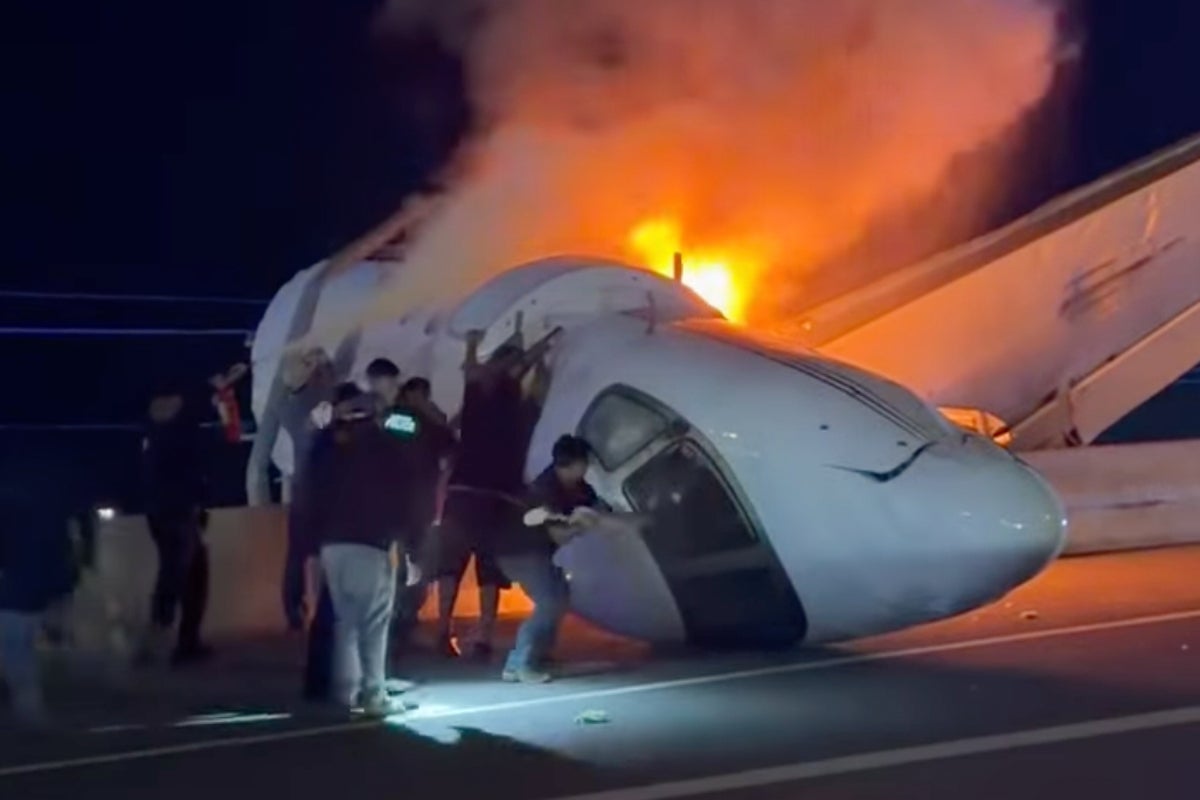
A Cessna Citation Latitude twin jet, operated by NetJets, was flying from the coastal resort city of San José del Cabo, Mexico, straight toward Austin, Texas. It never made it to the runway. The pilots reported mechanical failures and frantically requested an emergency landing at a nearby airport. Instead, the plane slammed down onto the highway, striking a concrete barrier, losing its tail section, and bursting into flames.
Most people see fire and run the other way. A group of Texas motorists did the exact opposite. Armed with nothing but tools from their trunks, they ran straight toward the burning fuselage.
The First Moments on the Burning Texas Highway
Ivan Franco was driving his tow truck through the dark when he spotted an orange glow of trailing sparks on the road ahead. At 23 years old, Franco did what few would dare to do. He didn't just slow down to look. He pulled over, grabbed a sledgehammer from his truck, and ran toward a scene that looked like a Hollywood disaster film.
Smoke was already filling the aircraft cabin. From a distance, the broken jet sat cockeyed across the concrete divider. The tail section had broken completely off, resting on a lower section of the roadway. Fire was licking the sides of the main fuselage.
Franco later admitted that he knew the entire aircraft could explode at any second. Your brain tells you to back off, but his hands kept moving. He wanted to break the windows because the pilots and passengers were completely trapped inside.
Another motorist, Zayra Garza, was driving her coworkers home when she stumbled upon the wreckage. Her husband didn't hesitate either. He jumped out of the car and sprinted to help Franco and a growing crowd of bystanders. Garza pulled out her phone to record the chaos, capturing a moment that has since gone viral. The video shows the main cabin door popping open just a fraction of an inch from the inside while a desperate voice screams for help.
Sledgehammers Shovels and Bulletproof Glass
The bystanders faced an immediate, brutal problem. Corporate jet windows are incredibly tough. Retired airline pilot John Cox, who serves as the chief executive officer of Safety Operating Systems, later pointed out that these windows are basically bulletproof. They are designed to withstand massive pressure differentials and high-speed bird strikes at 40,000 feet. You can't just kick them out with a boot.
Franco swung his sledgehammer with everything he had through the thick, choking smoke. Other drivers joined in, bashing the structural weak points of the door and windows with a shovel and random tools scavenged from their vehicles.
The rescuers put their backs into it, straining together to pry the jammed aircraft door open wide enough. Suddenly, a breakthrough happened. Three teenagers darted out of the smoke-filled opening, followed immediately by the first pilot and then the second.
Local police arrived within minutes, working hand-in-hand with the civilian rescuers. They didn't wait for heavy rescue gear. Officers rushed into the blinding smoke alongside the volunteers, trying to extract the final person trapped inside the cabin. The smoke became so dense that five police officers had to turn back, doubling over and coughing violently from smoke inhalation.
Firefighters equipped with oxygen masks finally managed to enter the plane. They pulled out a dog that was suffering from severe smoke inhalation. The pet was handed over to local animal control officers and is expected to survive.
The Cost of the Crash
Despite the massive effort, the night wasn't without tragedy. One passenger died inside the aircraft. Joshua Baer, a prominent figure and well-known leader in the Texas technology and startup ecosystem, lost his life in the wreckage.
Baer was highly regarded across the state for his work in building entrepreneurial communities. His death sent shockwaves through the Austin business community, turning a story of survival into a deeply bittersweet moment for the region.
The five survivors from the plane—the three teenagers and the two pilots—were transported to a local hospital and eventually released. The driver of a commercial truck that was struck by the jet's wing as it tore down the southbound lanes also managed to walk away from the incident alive.
Laredo Mayor Victor Treviño summarized the sentiment of the city the following morning. He stated it was nothing short of a miracle that the tragedy didn't turn into a mass fatality event. He credited the late-night timing of the crash, which meant fewer cars were on the road, alongside the instant response of everyday people.
Why This Accident Is Forcing a Closer Look at Aviation Safety
This wreck didn't happen in a vacuum. It represents the third major aviation incident in the United States over a span of just three days in mid-June 2026.
Just a day prior, a military B-52 crashed during a test flight at Edwards Air Force Base in California, resulting in eight fatalities. The day before that, a skydiving plane went down in Missouri, claiming 12 lives. This sudden cluster of accidents has put immense pressure on federal investigators to scrutinize recent maintenance and operational trends across both military and civil aviation.
The National Transportation Safety Board and the Federal Aviation Administration are digging through the charred remains of the Cessna Citation Latitude in Laredo. The focus remains heavily on the mechanical issue the pilots reported right before the crash. NetJets, which is owned by Warren Buffett's Berkshire Hathaway and operates on a fractional ownership model, stated they are cooperating fully with federal investigators.
What You Must Do If You Witness a Highway Aviation Crash
Most drivers never expect to see an airplane on their morning or evening commute. If you find yourself in a scenario like the one Ivan Franco encountered, knowing how to react can mean the difference between saving a life and becoming a casualty yourself.
Step 1 Inspect the Perimeter for Flammable Hazards
Aviation fuel burns incredibly hot and fast. Before approaching any downed aircraft, look at the ground. If you see liquid shimmering on the asphalt or smell an intense chemical odor, an explosion is imminent. Do not approach without heavy protective gear unless you can access an entry point away from the fuel leak.
Step 2 Focus on Lever Points Rather Than Breaking Glass
As the rescuers in Laredo discovered, cockpit and cabin windows on modern jets are engineered to survive extreme forces. Hitting them dead-center with a hammer rarely works. Instead, focus your energy on the door seals and hinges. Use crowbars, tire irons, or heavy tools to pry at the edges of the main exit door to break the mechanical latching mechanisms.
Step 3 Prioritize Airway Protection
Smoke inhalation kills far faster than flames in most aircraft cabin fires. If you are attempting a rescue, wrap a wet cloth or shirt around your nose and mouth. Keep your body as low to the ground as possible when pulling victims from the fuselage, as the toxic gases from burning synthetic cabin interiors rise rapidly.
The Laredo police are currently searching for every single civilian who stepped up on that highway to ensure their actions are formally recognized. It's a stark reminder that when the unexpected happens, regular people with everyday tools are often the real frontline of defense.