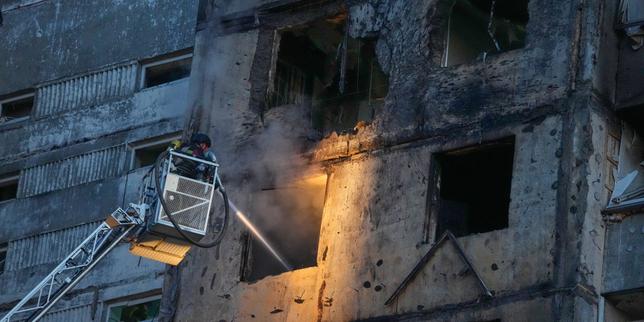
Air raid sirens don't just sound in Kyiv anymore. They dictate the rhythm of daily survival. When a fresh wave of explosive drones targeted the heart of Ukraine's capital on September 4, 2026, leaving roughly a dozen people injured and directly hitting the building housing the Ukrainian security services (SBU) near Saint Sophia's Cathedral, it wasn't an isolated anomaly. It was part of an escalating campaign aimed straight at the country's command infrastructure.
You're watching a war that refuses to stay locked in the eastern trenches. Instead, it claws its way into urban centers on a weekly basis, challenging air defense capabilities and testing civilian resilience to its absolute breaking point.
Why Kyiv Remains the Primary Target
Moscow's strategy with drone warfare has evolved from broad terror tactics into precision targeting of high-value administrative and security nodes. When the SBU headquarters took a direct hit, President Volodymyr Zelensky confirmed that the office of service chief Oleksandre Poklad was explicitly in the crosshairs. Poklad escaped injury because he wasn't at his desk, but the message was loud and clear.
The escalation highlights a brutal reality about modern capital defense. No matter how many Western-supplied interceptor batteries guard a metropolis, cheap long-range loitering munitions constantly probe for blind spots.
- Daytime Raids: Unlike earlier phases of the conflict where drone swarms flew strictly under the cover of darkness, recent strikes increasingly hit during daylight hours.
- Psychological Pressure: Hitting downtown zones near historical landmarks like Saint Sophia's Cathedral is designed to erode the psychological safety of urban residents who thought they were insulated by air shields.
- Infrastructural Strain: Emergency services are stretched thin, bouncing between residential fires, structural collapses, and targeted government offices within minutes.
The Human Cost Behind the Headlines
Numbers on a screen lose their weight quickly. Hearing that "roughly a dozen people were injured" glosses over the shattered glass, the blown-out apartment windows, and the frantic midnight scrambles to basements and subway stations. Medical personnel across Kyiv's trauma wards note a sharp spike in blast injuries, severe burns, and acute psychological shock among civilian populations.
When residential blocks take collateral damage from intercepted debris or direct impacts, families are forced to make split-second calculations about staying or packing whatever fits in a trunk. Honesty matters here: Kyiv isn't collapsing, but life inside it has turned into an endurance test of nerve and raw fatigue.
Air Defense Realities and What Comes Next
Ukraine's anti-drone mobile groups and electronic warfare units pull off miracles daily, neutralizing vast percentages of incoming hardware. Yet, saturation remains Russia's favorite blunt instrument. If you launch dozens of low-cost systems simultaneously, arithmetic guarantees that a fraction will leak through.
The strategy moving forward isn't just about buying more Patriot or NASAMS systems. It requires closing the industrial loop on domestic interceptor tech and interceptor drones that don't cost millions of dollars to destroy a machine worth twenty thousand. Until that economic and technological parity arrives, the skies over Kyiv will stay contested, dangerous, and loud.