When the temporary ceasefire between Washington and Tehran collapsed in July 2026, most observers expected Iranian missiles to target American warships in the Strait of Hormuz or launch direct volleys at U.S. bases in Qatar and Bahrain. Instead, a disproportionate share of Iran's drone and missile strikes smashed directly into Kuwait.
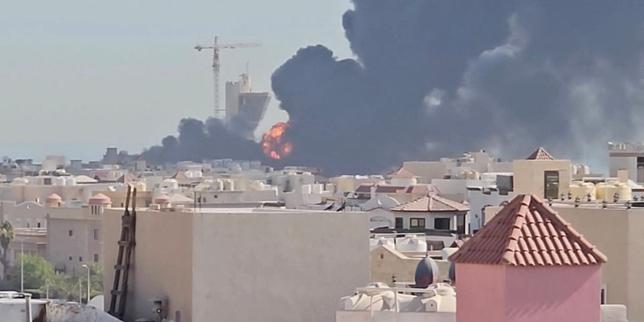
Explosions rocked logistics hubs at Camp Arifjan and air defense installations at Ali Al Salem Air Base. Drones hit the Mina al-Ahmadi oil refinery and damaged a critical power and water desalination plant, leaving firefighters battling blazes while citizens faced immediate water conservation orders. Learn more on a related topic: this related article.
Kuwait suddenly found itself on the front line of a major regional exchange. The country isn't a belligerent party in the war, yet it's paying the heaviest price among Gulf states. How did a country that historically worked so hard to maintain neutrality end up right in the bullseye?
The answer boils down to basic geography, a massive U.S. troop presence, and a deliberate tactical shift by Tehran designed to test the limits of the American security umbrella. More reporting by Reuters highlights comparable perspectives on the subject.
The Mirage of Kuwaiti Neutrality
For decades, Kuwait built a reputation as the mediator of the Persian Gulf. During the 2017 Qatar blockade, Kuwaiti diplomats worked overtime to keep the Gulf Cooperation Council from completely falling apart. When regional tensions flared, Kuwait routinely stayed out of aggressive military posturing.
That neutral stance was always a delicate illusion.
Kuwait hosts thousands of American military personnel across facilities like Camp Buehring, Camp Arifjan, and Ali Al Salem Air Base. It serves as a primary logistics hub for U.S. Central Command in the northern Gulf. You can't host the primary staging ground for foreign military operations and expect an enemy to ignore it when open war erupts.
When Washington launched renewed strikes against Iranian coastal defense systems and infrastructure in mid-July 2026, Tehran chose not to waste its entire arsenal trying to breach heavily fortified U.S. naval armadas in open waters. Instead, the Islamic Revolutionary Guard Corps targeted the fixed ground logistics hubs sitting right across their northern border.
Kuwait happens to sit closer to southwestern Iranian missile sites than almost any other major American hub in the region. That geographic reality turned Kuwait's defense posture into an immediate liability.
Why Iran Shifted Its War Strategy to Soft Targets
Military strategists often speak about asymmetric warfare as if it's purely about hidden explosives or cheap naval mines. In July 2026, Iran demonstrated a much simpler version of asymmetry: hit vital civilian infrastructure in allied countries to force Washington's coalition partners to crack.
Tehran knows it can't match American air superiority jet-for-jet. But it can launch swarms of Shahed-136 kamikaze drones and ballistic missiles toward Gulf nations that host U.S. forces. When Iranian drones hit Kuwait's desalination facilities, they struck a nerve.
Kuwait obtains roughly 90 percent of its fresh drinking water through industrial desalination. Knocking out a single major plant during a July heatwave creates instant domestic panic.
The political calculation behind these strikes is straightforward. Tehran wants to send a brutal message to Gulf leaders: hosting U.S. forces makes you a lightning rod, and Washington won't be able to protect your power grids or water supplies when the missiles start flying.
It's a strategy designed to manufacture diplomatic friction. By hitting targets like the Mina al-Ahmadi refinery, Iran hits global energy expectations and forces Kuwaiti officials to ask hard questions about whether the American military presence actually keeps them safe, or simply draws fire.
The Failures of the American Security Shield
For half a century, the core bargain between Washington and the Gulf monarchies was simple. The Gulf supplies energy stability, and America provides absolute military protection.
July 2026 proved that bargain has massive holes.
Despite layered MIM-104 Patriot batteries and advanced radar arrays, a combined deluge of low-flying Iranian drones and high-velocity missiles managed to penetrate air defenses in Kuwait. In some instances, air defense systems failed to stop low-altitude drones before they struck military depots and airport facilities. A friendly-fire incident early in the conflict where a Kuwaiti F/A-18 accidentally downed American jets highlighted just how chaotic and strained the air defense network became under constant pressure.
Local populations are seeing American bases draw incoming fire while local utilities take the splash damage. When power grids flicker and water rationing kicks in because a neighbor is fighting a foreign superpower, public patience evaporates quickly.
Kuwaiti officials issued stern condemnations, calling the strikes war crimes and grave violations of international law. But statements don't rebuild desalination turbines overnight. The realization is sinking in across the region that American air defense interceptors are finite, expensive, and primarily prioritized around high-value U.S. assets rather than local municipal utilities.
Diplomatic Isolation and the Strained GCC Response
The escalation put the entire Gulf Cooperation Council in an uncomfortable spot.
While the GCC secretary-general denounced the attacks on Kuwait as hostile aggression, individual member states responded with varying degrees of urgency. Qatar, which has repeatedly tried to act as a mediator alongside Oman, found its own airspace breached as Iran launched surprise attacks on Al-Udeid Air Base. Saudi Arabia watched closely while dealing with its own security concerns along its southern borders.
Kuwait feels uniquely exposed. Unlike Saudi Arabia or the UAE, which spent the last decade aggressively diversifying their security partnerships and building massive defense stockpiles, Kuwait relied heavily on its traditional ties with Washington and a moderate diplomatic posture.
That traditional posture left Kuwait unprepared for a prolonged, multi-front drone campaign hitting both military bases and civilian life support systems at the same time.
What Happens Next for Gulf Security
The July 2026 strikes on Kuwait permanently shattered the idea that small Gulf nations can remain safe simply by avoiding aggressive rhetoric. If hosting American bases makes a nation a prime target during a regional clash, every defense posture in the Gulf requires a total rewrite.
Here is what needs to happen immediately for countries caught in this security trap:
- Re-evaluate Base Operations Agreements: Gulf governments will likely demand stricter operational controls or caps on how U.S. facilities operate during active hostilities, minimizing their exposure to incoming retaliatory strikes.
- Hardening Civilian Infrastructure: Missile defense can't sit exclusively around military runways. Critical assets like water desalination plants, power stations, and oil export terminals require dedicated kinetic and electronic defense layers.
- Regional Defense Integration: The GCC can no longer rely on fragmented air defense networks. Real-time radar sharing and joint interception protocols must become functional priorities rather than theoretical talking points.
- Diversified Foreign Alliances: Expect Gulf capitals to accelerate diplomatic channels with European, Asian, and regional powers to build multi-lateral security guarantees rather than putting all their chips on Washington.
Kuwait's current crisis is a wake-up call for the entire Middle East. When superpowers fight, the nations housing their staging grounds pay the immediate price. Navigating the aftermath will require pragmatic strategic adjustments rather than relying on broken security promises.