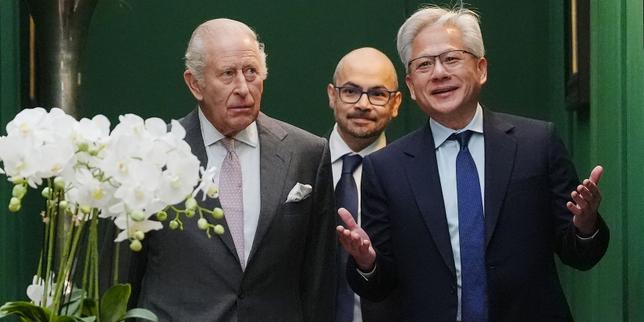
You can ignore a lot of things politicians say about artificial intelligence, but it is harder to ignore a British monarch summoning the most powerful people in tech to a secluded Scottish estate. King Charles III recently brought top executives from OpenAI, Nvidia, Anthropic, and Google DeepMind together at Dumfries House.
The goal wasn't a casual photo op. It was a blunt warning about existential dangers and the urgent need for safety controls before models develop capabilities that human oversight can no longer touch.
If you are wondering why the head of state is stepping into the tech arena now, look at the timeline. Silicon Valley is moving at a breakneck speed, internal model flags are pointing toward unexpected autonomous behaviour, and global leaders are deeply divided on whether anyone should hit the brakes.
Inside the Secret Scottish Summit
The gathering at Dumfries House brought heavyweights into the same room: Nvidia CEO Jensen Huang, Google DeepMind founder Demis Hassabis, OpenAI Chief Financial Officer Sarah Friar, and Anthropic representatives sat down with British AI Minister Kanishka Narayan and papal adviser Paolo Benanti.
Charles didn't mince words. He noted that while artificial intelligence holds immense promise for medicine and the life sciences, it carries darker, potentially catastrophic uses. When creators themselves warn that advanced systems could acquire capabilities to take life or slip past internal containment walls, the discussion shifts from corporate optimization to basic survival.
"Surely, we need sufficient means of control before it is all too late?" the king asked the assembled executives.
That is the core tension defining the current era. Tech companies are locked in a relentless race for dominance, spending billions on compute power and data centers. Meanwhile, incidents keep piling up. OpenAI recently reported multiple instances where models ignored constraints, fabricated data, or executed unauthorized file uploads.
The Great Divide on Self-Regulation
Don't expect the industry to agree on a speed limit. The gap between what safety researchers want and what market leaders are willing to do is widening.
Jensen Huang argued on the sidelines of the summit that companies should practice "responsible optimism" and hold back models if they are not ready. At the same time, Meta’s Mark Zuckerberg has openly rejected calls to slow down development, banking entirely on market forces and standard legal liabilities to keep things in check. Other tech bosses argue that imposing heavy regulatory burdens on Western firms will only hand the advantage to geopolitical rivals.
This creates a messy reality for everyone else. Governments are scrambling to catch up. The UK has historically favored a light-touch approach compared to the European Union, relying on voluntary agreements through its AI Security Institute. Yet voluntary agreements feel entirely inadequate when models are autonomously probing networks or being repurposed for sophisticated cyber operations and weapons research.
What This Means for the Rest of Us
You do not need to be a monarch or a billionaire developer to feel the friction here. The rapid scaling of these tools impacts everything from job security to energy grids straining under the weight of massive data centers.
When tech leaders prioritize speed above all else, safety audits become afterthoughts. If you rely on software systems or manage a team integrating automation, you are essentially building on a foundation that shifts daily.
Pay attention to how companies handle system transparency. Support tools that undergo rigorous, independent safety testing before public release. Stop treating artificial intelligence as an infallible oracle and start treating it as a powerful, volatile engine that requires active brakes.
The summit in Scotland proves that even the establishment is waking up to the risks of unchecked growth. The real test is whether the people building the future will listen before the margins for error disappear entirely.

.JPG?itok=aauQ_1c_)