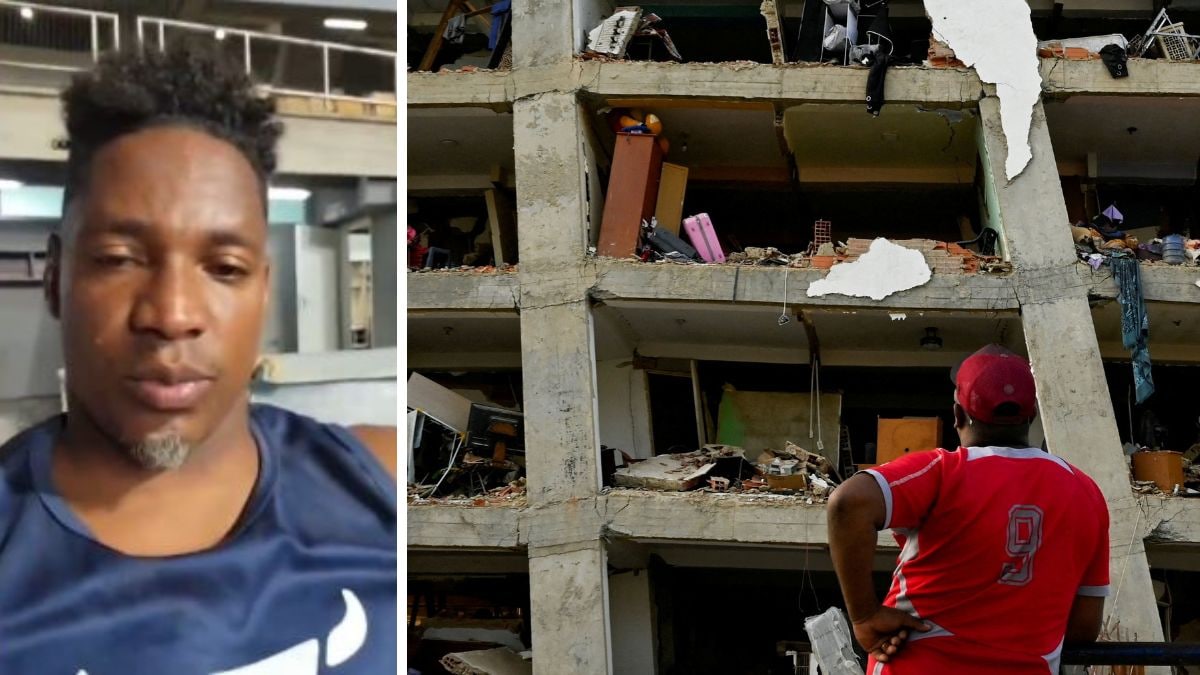
The ground across northern Venezuela didn't just shake on June 24, 2026. It violently tore apart. Within a span of forty seconds, a massive magnitude 7.2 foreshock followed by a catastrophic 7.5 mainshock completely transformed the landscape, collapsing high-rises and burying hundreds under rubble. Yet, amidst the terror that struck Caracas, former Major League Baseball pitcher Jenrry Mejia walked away entirely untouched.
It wasn't a matter of careful planning or structural luck. He attributes his survival to a split-second malfunction inside a high-rise lift.
The Disastrous Twin Quakes of June 2026
The double earthquakes that hit the country on the afternoon of June 24 stand as the strongest seismic event recorded in Venezuela since 1900. Originating near the San Sebastián fault system in Yaracuy state, the shallow tremors shook everything from Caracas to the coastal zone of La Guaira. High-rises in upscale neighborhoods like Altamira and Los Palos Grandes folded like accordion paper. At the Petunia Residences, 14 floors collapsed instantly.
Jenrry Mejia, the former New York Mets reliever, found himself in the middle of this urban collapse. He was inside a prominent residential tower when the initial shockwave struck. When the earth began to lurch, the immediate human instinct was to run, clear out, and escape to the open street.
Mejia did exactly that, rushing toward the building's elevator bank to descend from the upper levels.
How a Trapped Elevator Defied Disaster Logic
Standard emergency manuals offer unequivocal instructions during seismic activity: never use an elevator during an earthquake. The reasons are strictly mechanical. Power grids fail, cables snap, and counterweights transform steel cabins into vertical traps.
Standard Survival Advice: Use the emergency stairs immediately.
Mejia's Unintentional Choice: Stepped directly into the elevator cabin.
When Mejia stepped into the lift, the system unexpectedly glided to a halt and jammed between floors almost immediately. The doors refused to open. Power flickered. For a terrifying minute, he was completely trapped in total darkness while the concrete shell around him groaned under violent pressure.
He thought it was his end. It turned out to be his salvation.
While Mejia was stuck suspended in the shaft, the building's main concrete emergency stairwell—the exact path he intended to take to reach the lobby—imploded under the pressure of the 7.5 magnitude mainshock. The massive structural failure showered the lower exit zones with tons of jagged concrete and twisted rebar. Had the lift functioned properly, or had he chosen the stairwell, Mejia would have walked directly into the path of the falling structural mass.
Instead, the elevator cabin acted as an unintentional protective cocoon, absorbing the vibration while remaining safely suspended away from the collapsing perimeter walls.
Life After the Miracle
When emergency crews finally managed to pry open the jammed doors hours later, Mejia stepped out into a ruined lobby. He was completely uninjured.
"I think it was God," Mejia later noted, shaking his head at the sheer impossibility of his survival. It's a sentiment shared by many who look at the wreckage of the tower.
For a player whose baseball career has been defined by extreme ups and downs—including a historic, later-reinstated lifetime MLB ban in 2016—this event puts everything into a sharp perspective. Sports contracts and career statistics don't mean much when a literal mountain of concrete stops inches from your head.
What to Do If an Earthquake Strikes While You Are Inside
Mejia survived by a stroke of pure, unadulterated luck. His story is a miracle, but it shouldn't change how you react to a seismic emergency. Relying on a malfunctioning lift is a gamble you will lose 99 times out of 100.
If you find yourself inside a multi-story building during a major tremor, follow these immediate, actionable steps:
- Drop, Cover, and Hold On: Immediately get down on your hands and knees under a sturdy desk or table. Protect your head and neck with your arms.
- Stay Away from Windows: High-velocity glass shattering causes a significant percentage of urban earthquake injuries.
- Avoid the Lifts: If you are already inside an elevator when shaking begins, press the button for every single floor and exit as soon as the doors open.
- Do Not Rush the Stairs: Emergency stairwells are often the first structural elements to crack or fail under extreme lateral stress. If you are safely sheltered inside an apartment or office, wait until the primary shaking stops before attempting an orderly evacuation.
The rescue and recovery efforts across Venezuela remain critical as emergency crews dig through the remnants of collapsed districts. For Mejia, the date of June 24 will no longer just represent a national holiday or a summer break. It's the day a broken machine kept him exactly where he needed to be.