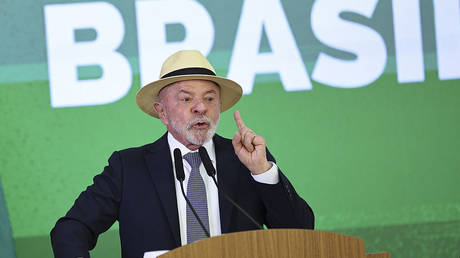
South America's two biggest economies are barely on speaking terms again. Argentine President Javier Milei just crossed a major line by heading to São Paulo and blasting Brazilian President Luiz Inácio Lula da Silva as a "convict" and a "thief."
Diplomatic norms are officially out the window. Brazil responded swiftly by recalling its ambassador to Argentina for consultations. If you want to understand why Latin America's political landscape feels like a permanent boxing ring, you have to look past the fiery headlines and examine the ideological collision driving both leaders.
The São Paulo Speech That Broke the Peace
The friction exploded during a political event in São Paulo. Milei flew into Brazil to support right-wing candidate Flávio Bolsonaro, the son of former Brazilian leader Jair Bolsonaro.
Instead of playing nice with his presidential neighbor, Milei let loose. He didn't use Lula's name directly, but everyone in the room knew who he meant when he labeled Brazil's incumbent leader a "thief" and a "convict." He also took direct aim at the Brazilian Supreme Court, describing Justice Alexandre de Moraes as "bald trash" after being blocked from visiting jailed former leader Jair Bolsonaro.
Brazil's foreign ministry didn't wait around. Foreign Minister Mauro Vieira consulted with Lula, and Ambassador Julio Bitelli was pulled out of Buenos Aires immediately. Brazilian officials called the remarks a direct affront to democratic institutions and the Brazilian public.
Why Milei Is Taking the Fight Across Borders
Milei isn't just venting. He is executing a deliberate strategy to position himself as the global standard-bearer for right-wing libertarianism.
Back home, Milei faces massive economic challenges, public pushback, and intense political scrutiny. By picking fights with regional heavyweights like Lula, he shifts the spotlight outward. He frames his administration as part of a global resistance movement against what he calls "thieving socialists."
When Milei spoke to Argentina's Radio Mitre shortly after the incident, he doubled down. He claimed Argentina is being targeted by a smear campaign financed by left-wing governments in Brazil and Mexico alongside the United States Democratic Party. He offered zero concrete proof, but that rhetorical playbook energizes his base.
The Deep Freeze Between Brasília and Buenos Aires
Relations between South America's twin powerhouses have been ice-cold ever since Milei took office.
- Zero Diplomacy: Milei hasn't sought an official bilateral meeting with Lula during his trips to Brazil.
- Mutual Disdain: Lula has shown zero interest in extending an olive branch or hosting his Argentine counterpart.
- Clashing Models: Brazil leans into regional state-led cooperation, while Argentina's libertarian administration wants radical free-market deregulation and rejects leftist multilateralism.
This isn't a minor disagreement over trade tariffs. It is a fundamental clash of worldviews. Lula represents traditional Latin American leftism and state intervention. Milei wants to burn down the socialist playbook and rebuild the region from a radical free-market perspective.
What Happens Next
Recalling an ambassador is a serious diplomatic slap, but it rarely means total severance of ties. It's a cooling-off period.
Yet, as long as Milei and Lula occupy their respective offices, cooperation between Argentina and Brazil will remain paralyzed. Expect more verbal sparring, canceled summits, and widening ideological divides across the Southern Cone.
Look past the theater. The feud highlights a fractured continent where pragmatic diplomacy takes a backseat to culture-war politics.