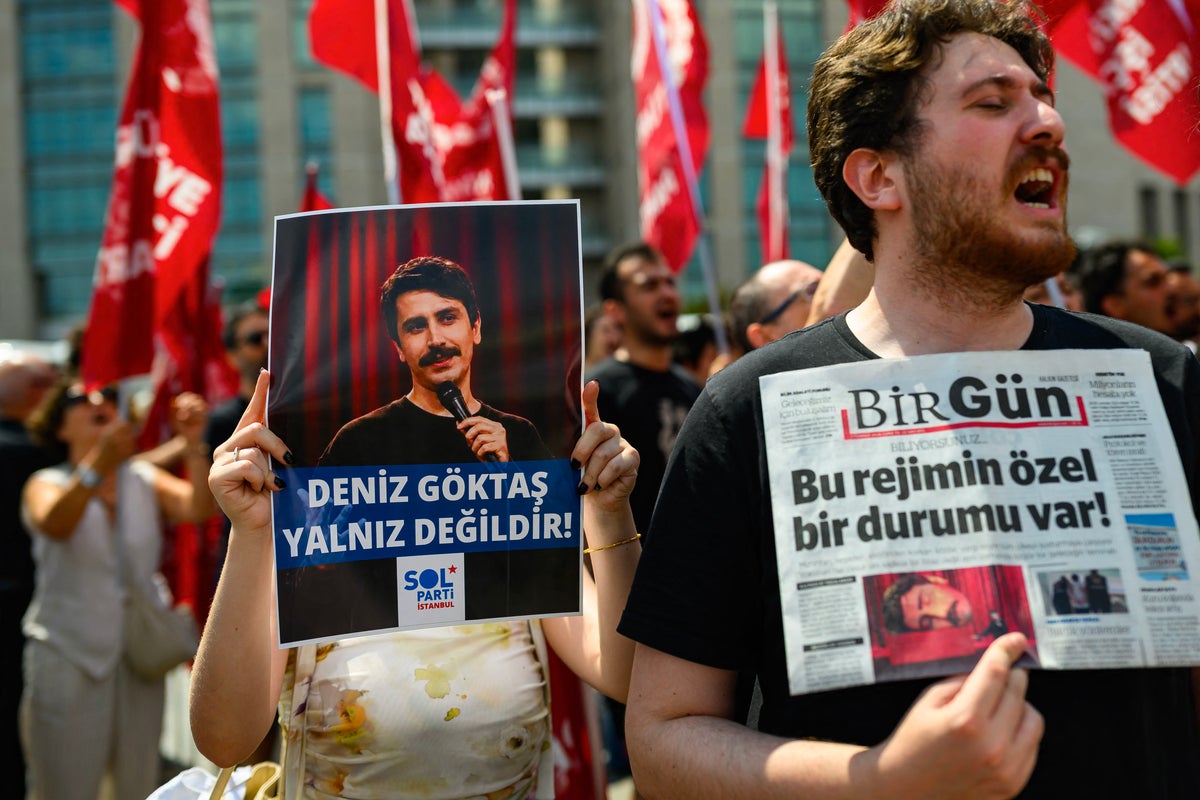
You can't make a joke in Istanbul anymore without checking your rearview mirror. Standup comedian Deniz Göktaş found that out the hard way at passport control. Handcuffed. Taken straight to police headquarters. All because of a YouTube video.
On July 3, 2026, a Turkish court ordered the 32-year-old comic jailed pending trial. His crime was a comedy special that did exactly what comedy is supposed to do. It poked fun at power. The state-run Anadolu Agency quickly confirmed the charges. Publicly insulting religious values. Insulting the president. It's a double whammy designed to keep people quiet.
This isn't just about one guy getting arrested at Istanbul Airport after a vacation. It's about a systematic purge of independent thought. If you watch the show, titled "Ölü Deniz," you'll see a brilliant piece of satire. The title itself is a dark pun. It means Dead Sea, but it also translates to Dead Deniz. Göktaş actually performed next to a giant cardboard cutout of his own decapitated head. He knew what was coming. He predicted his own silencing on stage, and the state proved him right within days.
People are searching for this news because they want to know if Turkey has crossed a point of no return. They want to see if a simple standup routine can really land someone in a cell for years. The short answer is yes. It happens constantly now. The spaces where people can breathe, laugh, and disagree are shrinking to zero.
The Punchline That Packaged a Prison Sentence
What did he actually say to upset the government so much? Göktaş took aim at President Recep Tayyip Erdoğan. He called him a reticent dictator who slowly grew into the role. He joked that Erdoğan evolved from a shy dictator to one who is completely confident in his identity.
That line alone set off an online firestorm.
Government-aligned figures smelled blood. Pro-government newspapers claimed dozens of viewers filed official complaints. Within a week, the show racked up over nine million views on YouTube. Clips spread across social media. Then the Information and Communication Technologies Authority stepped in. They blocked access to the viral clips. They tried to erase the humor from the internet.
During his interrogation, Göktaş didn't back down. He told prosecutors his words were purely satirical. He argued that calling someone a dictator is a political definition, not a personal insult. It didn't matter. In Turkey, the line between political commentary and criminal insult is entirely up to the prosecutor.
The investigation also focused on his riffs about religion and the Quran. Göktaş had actually praised the Quran on stage, calling it the best of the holy books. He used irony to highlight how different faiths compete. But the state has no room for nuance. They viewed it as a direct attack on sacred values.
The Double Legal Trap of Turkish Courts
The state uses two main legal weapons to silence critics. The first is Article 299 of the Turkish Penal Code. This makes insulting the president a criminal offense. It carries a punishment of up to four years behind bars. Erdoğan has been in power for 24 years. Over that time, tens of thousands of citizens have faced investigation under this exact law. High school students, journalists, artists, and grandmothers have all been targeted.
The second weapon is Article 216. This covers the degradation of religious values. It's a vague law. It gets triggered whenever a comic or artist addresses faith without checking with the government's official narrative first.
Look at what happened back in April. A female comedian named Tuba Ulu got detained for a joke about Ottoman Sultan Suleiman the Magnificent. She jokingly referred to his wife, Roxelana, as his friend with benefits. The state accused her of insulting historical and moral values. She faces three years in prison. The message is clear. Don't talk about history. Don't talk about religion. Definitely don't talk about the president.
The political environment in 2026 makes these arrests even more dangerous. The government is actively neutralizing any form of opposition. Istanbul Mayor Ekrem İmamoğlu, Erdoğan's biggest political rival, has been locked up since March of last year on corruption charges. Hundreds of other opposition mayors and officials face similar legal battles. The courts aren't independent. They operate as an extension of the political apparatus.
Why This Comedy Crackdown Matters Globally
When a country jails its comedians, it reveals its own fragility. Thin-skinned leaders can handle protests easier than they can handle laughter. Laughter pops the balloon of authoritarian authority. It makes the powerful look ridiculous.
The arrest of Deniz Göktaş sparked fierce debates inside the Turkish parliament. Members of the ruling AK Party squared off against the main opposition party, the CHP. Government lawmakers claimed Göktaş was destroying social peace. Opposition leaders countered that the government simply uses religion to polarize society and distract from economic failure.
Ordinary citizens are fighting back the only way they can. They are keeping the video alive. Thousands of people have left comments on the YouTube upload, promising to rewatch the special every day until Göktaş is released. Crowds even gathered outside the courthouse in solidarity, chanting slogans against the government.
What You Can Do to Support Free Expression
You don't have to sit idly by while artists face prison for jokes. If you want to track this case and support free speech, take these practical steps.
Follow independent rights organizations inside Turkey. Groups like Bianet and the Media and Law Studies Association provide accurate courtroom reporting that state media ignores. They publish updates in English and Turkish.
Share the original content safely. If you are outside Turkey, keeping the mirror sites and discussions alive ensures the state cannot completely scrub the performance from history. International awareness puts pressure on diplomatic channels.
Support global watchdogs. Organizations like Amnesty International and Human Rights Watch keep tabs on Article 299 abuses. Funding their research helps them lobby international bodies before major summits, forcing authoritarian regimes to answer for their domestic crackdowns.
Comedy is the ultimate stress test for democracy. Right now, Turkey is failing that test completely. When the state treats a joke like a terror plot, the joke isn't on the comedian. It's on the system itself.
(mh=IdJOBUeICKmrckGc)4.jpg)