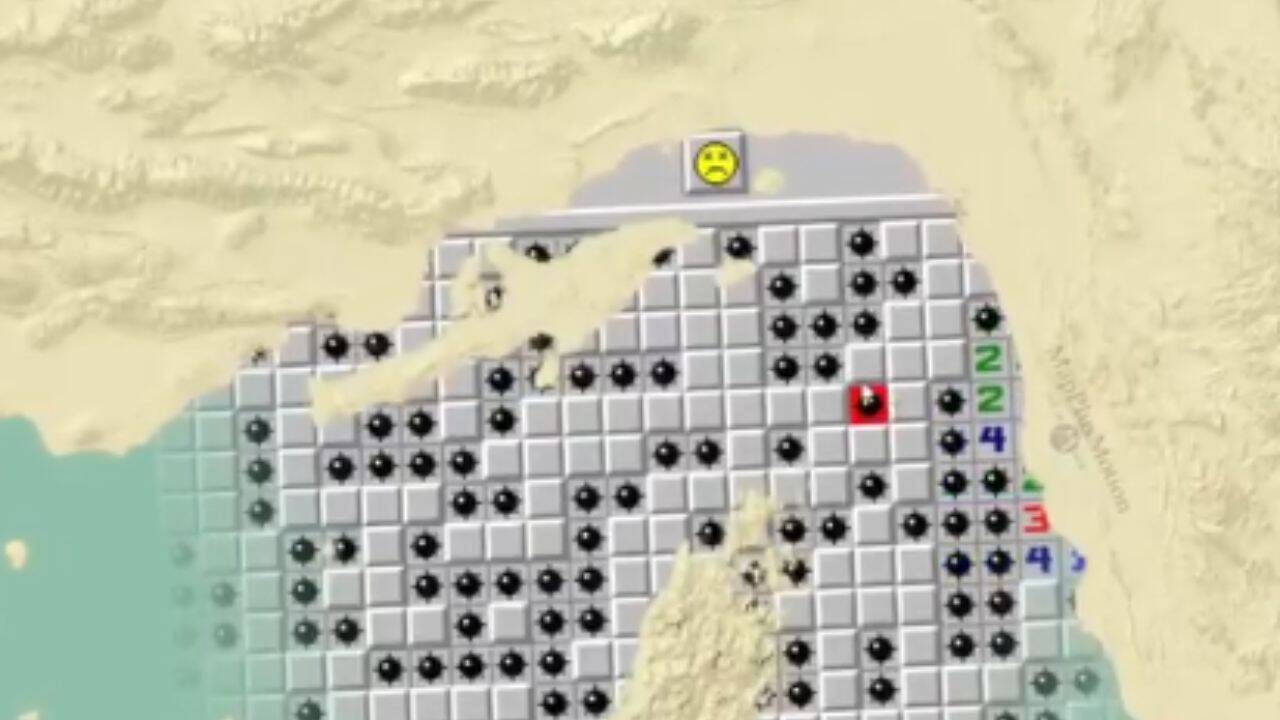
Geopolitical posturing has officially entered the era of meme warfare. When Tehran's diplomatic mission dropped an animated video overlaying a game of classic Minesweeper onto a 3D map of the Strait of Hormuz, they weren't just wasting pixels. They were sending a barbed message straight to Washington.
The post featured a familiar phrase: "Habibi, come to Iran!" It is a internet slang-infused taunt directed squarely at Uncle Sam. But beneath the internet sarcasm lies a deadly serious flashpoint involving global shipping lanes, maritime chokepoints, and escalating military strikes between Washington and Tehran. Expanding on this topic, you can find more in: Why Javier Milei Is Playing A Dangerous Game With The Falklands.
The Battle for the Strait of Hormuz
You can't understand this digital taunt without looking at the physical geography. The Strait of Hormuz is the absolute jugular vein of global energy transport. Roughly a fifth of the world's petroleum passes through this narrow stretch of water every single day. If you control the Strait, you hold global markets hostage.
President Donald Trump recently claimed that US forces successfully removed a network of Iranian-laid naval mines from the waterway. According to Washington, the operation was designed to keep oil tankers moving safely without interruptions. Observers at Wikipedia have provided expertise on this trend.
"We've controlled, and we are controlling the Hormuz Strait," Trump told reporters, noting that crews are escorting boats carrying millions of barrels of oil out of the area safely.
Tehran sees it entirely differently. State media and regional accounts argue that the US presence is an unwarranted provocation. By framing the American mine-clearing operations as a literal game of Minesweeper, the Iranian embassy in Sierra Leone tried to flip the narrative. They are painting US warships not as protectors of global commerce, but as clumsy players blundering through a dangerous grid of their own making.
From Cyber Memes to Real Missiles
Memes don't happen in a vacuum. This digital jab dropped right after a violent weekend escalation that left rocket launchers destroyed and ballistic missiles flying across the Middle East.
Washington launched targeted air strikes on an island inside the Strait of Hormuz, alleging that the Islamic Revolutionary Guard Corps was actively preparing to drop a fresh batch of maritime explosives into the shipping lanes. US Central Command reported hitting air defense sites, radar installations, and mine-laying capabilities.
Iran didn't absorb the blow quietly. Tehran fired ballistic missiles toward US military targets in Jordan, claiming heavy damage. While Jordan's military intercepted most of the incoming projectiles, the message was clear. The shadow war has broken out into the open, and neither side is backing down.
What the Digital Posturing Actually Means
Governments don't animate retro computer games for fun. Propaganda has always relied on ridicule, but social media has shortened the feedback loop from weeks to seconds.
By turning a high-stakes naval confrontation into a casual puzzle game, Tehran is trying to win the information war in the Global South and across social platforms. They want to project confidence even while facing devastating economic sanctions and military degradation. They want young audiences to view US naval dominance as fragile, risky, and ultimately beatable.
Meanwhile, Washington is focused on keeping tankers moving and reassuring nervous global markets. Oil prices fluctuate violently every time a missile crosses the Gulf or a warship opens fire.
If you're watching global energy markets or regional security, ignore the flashy graphics on your feed. The real hazard isn't the Minesweeper animation on your screen. It is the real steel sitting beneath the waves in one of the most volatile choke points on earth.