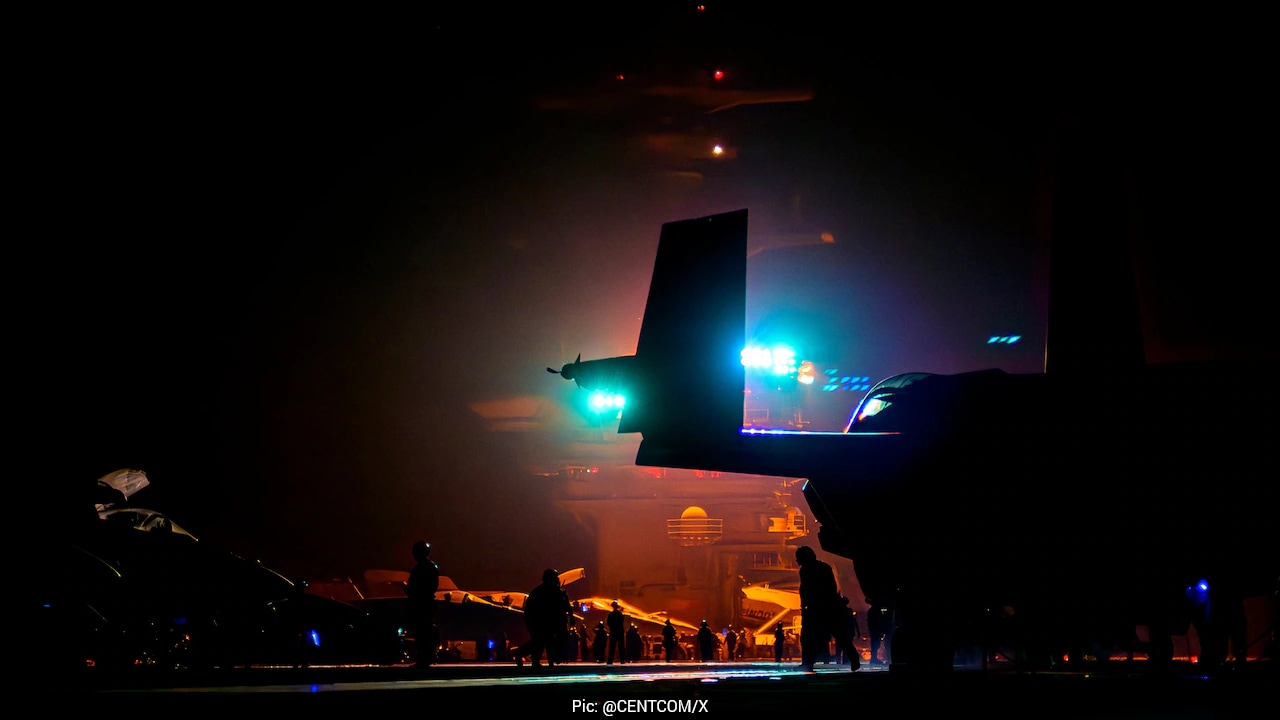
Having three US aircraft carriers operating in the Middle East simultaneously isn't something the Pentagon does on a whim. It signals a massive escalation in naval posture, sending a blunt message across the region as tensions with Iran persist. The arrival of the USS Theodore Roosevelt into the U.S. Central Command area of responsibility brings the total count of active American carrier strike groups in theater to three.
If you're wondering why the military is pooling this much floating firepower into one zone, you have to look past standard operational rotations. This rare triple-carrier deployment—joining the USS George H.W. Bush and the USS George Washington—creates a heavy concentration of naval power that hasn't been routinely matched outside of major wartime buildups.
The Force Breakdown in the Region
When people hear that multiple carriers are deployed, they often picture three flat-tops sitting side by side. That's not how it works. A carrier strike group is a floating city of destroyers, cruisers, and support vessels, all synchronized to project power across thousands of miles of open water and airspace.
Right now, the naval buildup in the Arabian Sea and surrounding waters includes a staggering collection of assets:
- Three active nuclear-powered aircraft carriers (USS Theodore Roosevelt, USS George Washington, and USS George H.W. Bush).
- Roughly a dozen guided-missile destroyers and cruisers equipped for missile defense and strike capabilities.
- Supporting littoral combat ships and replenishment vessels keeping supply chains tight.
This isn't just about showing off muscle. It's about maintaining a persistent operational presence that can enforce a blockade, secure critical trade chokepoints like the Strait of Hormuz, and launch continuous air operations without burning out flight crews or draining maintenance cycles.
Why Three Carriers Matter Right Now
Diplomatic efforts between Washington and Tehran have stalled out completely. With the Trump administration weighing whether to resume large-scale military strikes, having three carriers on station gives the White House immediate options. You can't bluff with empty waters.
Maritime tracking data from firms like Lloyd’s List shows that regional shipping traffic through vital lanes remains heavily impacted compared to prewar baselines. Commercial vessels face persistent security threats, and the US Navy is tasked with keeping commercial corridors viable while cutting off illicit Iranian supply lines.
Operating three carrier strike groups gives commanders round-the-clock combat air patrol capability. While one carrier rotates through maintenance or re-arming, the other two maintain continuous flight operations. It’s a relentless rotation that keeps pressure on regional adversaries and reassures allies that the US military footprint in the region remains heavy.
The Logistical Strain Behind the Power Display
Civilians rarely think about the brutal logistical weight required to keep three carrier strike groups active in a high-risk zone. Nuclear carriers require constant replenishment, secure escort formations to guard against asymmetric drone or missile threats, and massive supply chains stretching back to naval logistics hubs.
Extending the deployment of ships like the USS George H.W. Bush—originally slated to rotate out before getting its tour prolonged through the holidays—takes a heavy toll on sailors and equipment. The Pentagon has to balance this immense display of force against long-term fleet readiness. Pushing ships and crews to their limits creates maintenance backlogs that ripple through the entire Navy for years.
Ultimately, the deployment of three US aircraft carriers operating in the Middle East isn't a routine patrol. It's a high-stakes gamble in power projection, keeping regional deterrence front and center while geopolitical talks remain frozen.
Third US aircraft carrier arrives in Middle East: Media
This video report covers the recent arrival of the USS Theodore Roosevelt in the Middle East, highlighting the strategic deployment of three American carrier strike groups to the region.