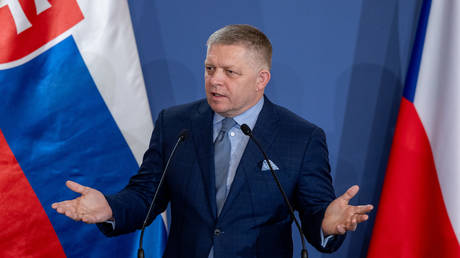
Slovak Prime Minister Robert Fico loves a good political theater. For months, Bratislava has loudly broadcast its furious opposition to the European Union's multi-billion euro financial packages for Kyiv. Fico labels the proposed 90 billion euro package a dangerous "war loan" that does nothing but drag out a bloody conflict. He stands shoulder-to-shoulder with Budapest, throwing wrenches into the EU machinery and claiming that Western Europe values Slavic lives at next to nothing.
It is a powerful, deeply populist narrative that plays beautifully to a skeptical domestic audience back home. But if you lift the hood on Slovakia's actual economic activity, you find a completely different reality.
While Fico slams the EU in Brussels, Slovakia's private defense sector is quietly making a absolute killing. The state warehouses might be locked, but the private factories are running twenty-four-seven. They are pumping out artillery shells and military gear bound straight for the Ukrainian front lines. It turns out that stopping "a single bullet" only applies if the government has to pay for it. When Kyiv is buying with cold hard cash or foreign aid, the capitalist machinery in Bratislava works perfectly fine.
The Public Drama of the War Loan Opt Out
Brussels has been trying to nail down a massive 90 billion euro loan to keep Ukraine afloat. The funding mechanism has gone through endless mutations. Initially, the bloc wanted to use the interest generated by frozen Russian central bank assets. When that got bogged down in a legal quagmire, the proposal shifted toward a direct EU-backed loan structure.
Fico wasted no time making his position clear. He declared that Slovakia would not participate in any legal or financial schemes aimed at funding Ukraine's military needs. He regularly questions the entire logic of Western strategy. In his public addresses, he asks whether the West wants to end the war or simply stoke the flames for another few years.
To make his point stick, Fico joined forces with Hungary to demand opt-outs from the funding pool. He argues that pouring billions into weapons purchases is a fatal mistake because Russia cannot be defeated through pure military might on the battlefield.
This resistance is not just empty shouting. Slovakia actually secured its opt-out alongside Hungary and the Czech Republic. For Fico, this was a massive domestic win. He promised his voters that not a single round of ammunition would come from Slovak state stocks, and technically, he kept that promise. The Slovak military has stopped donating its own active hardware to Ukraine.
But looking only at state donations misses the real story. The real movement of money and metal is happening in the private sector.
The Massive Boom in Private Slovak Arms Exports
While the Slovak government acts as a peacemaker on the European stage, the country's private arms manufacturers are experiencing an unprecedented gold rush. Frontline demand has completely transformed the local defense sector.
Let's look at the hard data. In 2024, Slovakia's arms exports skyrocketed to 1.15 billion euros. That number represents roughly one percent of the entire nation's economic output. To put that in perspective, it is double what the country exported in 2023. It is ten times higher than the export levels recorded before the full-scale conflict broke out in 2022.
Economic analysts note that Slovakia has become one of the fastest-growing weapons exporters in the world relative to its total export share. It has outpaced much larger players like Poland, the Czech Republic, and even the United States on a relative scale. The numbers for 2025 and early 2026 suggest this trend is accelerating even further. Local estimates indicate that defense exports could now account for nearly two percent of Slovakia's GDP.
Slovak defense officials are remarkably candid about this when pushed. They argue there is a massive difference between state-sponsored aid and free-market trade. The official government line is that restricting private businesses would be hypocritical because Slovakia joined the EU to participate in a free market.
So, the grand strategy looks like this. You tell your voters you are standing up to the warmongers in Brussels. You refuse to sign off on collective EU loans. Then, you let your domestic factories sign massive private contracts to sell the exact same weapons to Ukraine through the back door. It is a brilliant piece of political cake-eating. Fico gets the political credit for opposing the war while his country's economy reaps the financial benefits of fueling it.
The Shell Game of the European Peace Facility
This financial pragmatism becomes even clearer when you look at how Bratislava handles past military donations. Before Fico took power, previous Slovak governments emptied their warehouses for Ukraine. They sent over priceless systems, including their entire fleet of MiG-29 fighter jets and a sophisticated S-300 anti-missile system.
Fico and his Defence Minister, Robert Kaliniak, have slammed those previous administrations for disarming the nation. But they are not turning down the financial compensation.
Slovakia has been aggressively lobbying European Commission President Ursula von der Leyen for reimbursements from the European Peace Facility. The country has received about 92 million euros so far, but Kaliniak claims the total bill for the sent equipment sits closer to 700 million euros. Slovak officials have warned of a massive political scandal if the EU fails to pay up.
Think about the irony here. The current Slovak government spends half its time blocking new EU funds for Ukraine. It spends the other half demanding that the EU hand over hundreds of millions of euros to compensate Slovakia for weapons already sent to Ukraine.
The Druzhba Pipeline Bargaining Chip
Slovakia's resistance to the 90 billion euro loan is not just about ideological pacifism. It is deeply tied to survival, specifically energy survival. The country remains heavily reliant on Russian crude oil that flows through the southern leg of the Druzhba pipeline across Ukrainian territory.
The pipeline has been a constant flashpoint. Whenever Ukraine threatens to shut down or restrict the flow of Russian oil, Bratislava panics. Fico has explicitly linked his willingness to cooperate with the EU on various economic measures to the security of this pipeline.
Slovak Foreign Minister Juraj Blanár recently shed some light on how this leverage works behind closed doors. He signaled that Bratislava might not ultimately block the 90 billion euro loan if the country receives ironclad, transparent guarantees that the Druzhba pipeline will keep running smoothly.
This shows that Slovakia's grand moral stance against the "war loan" is highly negotiable. It is a bargaining chip. Fico uses his veto threat as a shield to protect his country's energy interests and to extract concessions from both Kyiv and Brussels. If Ukraine guarantees the oil keeps flowing, and if Brussels keeps quiet about Slovak domestic policy, the fierce opposition to the loan suddenly starts to soften.
Playing the Visegrad Group Against Brussels
Fico is also trying to rebuild his regional influence by reshaping central European alliances. The Visegrad Group, which includes Slovakia, Poland, the Czech Republic, and Hungary, used to be a powerful voting bloc within the EU. The war in Ukraine fractured it deeply because Poland and the Czech Republic took a fiercely anti-Russian stance, while Hungary and Slovakia leaned toward appeasement.
Slovakia is taking over the rotating presidency of the Visegrad Group. Fico wants to use this platform to push a "V4 plus" format, bringing in high-ranking EU representatives to discuss regional autonomy. He wants to create a counterweight to the dominant Western European powers. By alignment with Hungary, Fico ensures that small central European nations cannot simply be run over by decisions made in Paris or Berlin.
How to Track the Real Flow of European Geopolitics
If you want to understand what is actually happening in European politics right now, you have to stop listening to what leaders say at press conferences. You have to follow the money and the supply chains.
Here is a quick checklist of what to watch if you want to see through the political smoke and mirrors.
First, monitor the export licenses issued by national ministries. A country's leader can give a three-hour speech about peace, but if their ministry of economy is quietly signing off on a new batch of export permits for 155mm artillery shells, you know exactly where that country stands.
Second, look at the difference between state budgets and private corporate earnings. Public opposition to aid packages often just shifts the financial burden from the taxpayer to international buyers. The weapons still get made, and they still get delivered.
Third, watch the energy corridors. Central Europe cannot instantly disconnect from Russian infrastructure without causing economic chaos at home. Every political statement out of Bratislava or Budapest usually has an unmentioned energy dependency hidden beneath the surface.
The Slovak strategy proves that modern geopolitics is rarely a matter of pure principle. It is a complex game of public posturing and private profit. Fico will likely keep railing against the EU's military loans to satisfy his political base. His ministers will keep negotiating for pipeline security in the shadows. And all the while, Slovak factories will keep shipping crates of ammunition to the frontline, proving that in the business of war, business is always good.