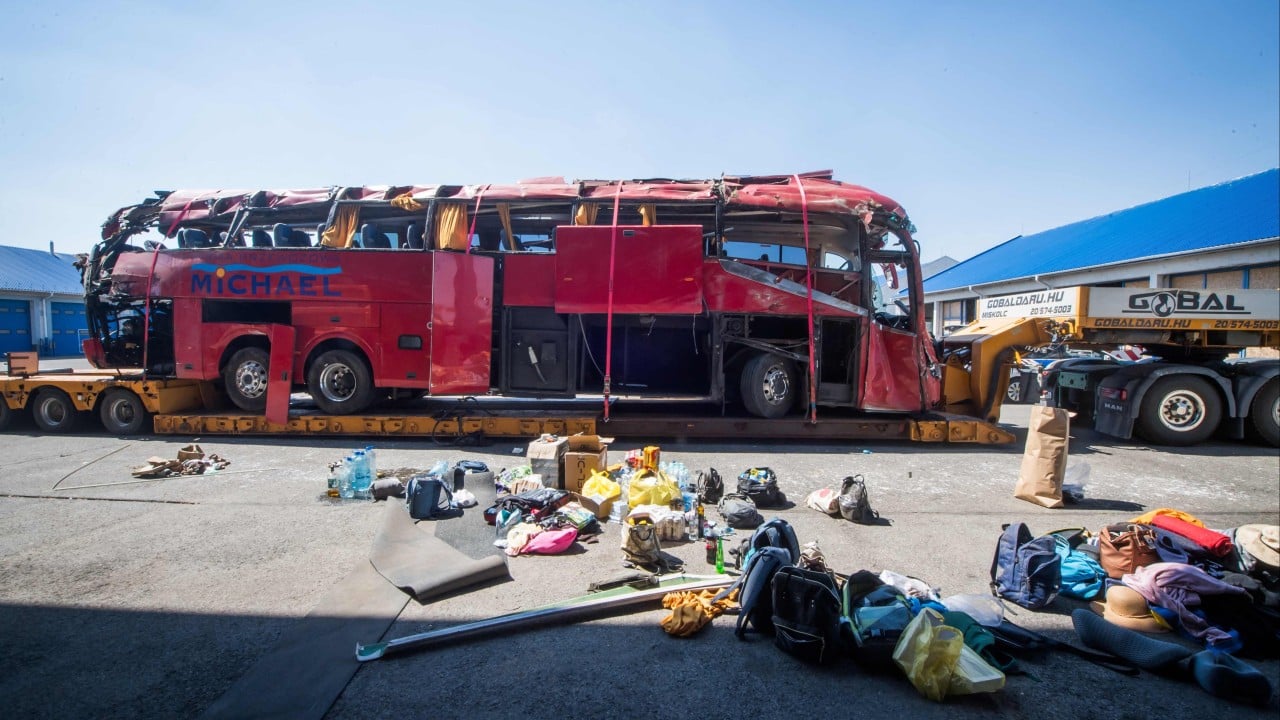
Midnight highway travel always carries a quiet, hidden danger. At 1 a.m. on a Sunday along Hungary's M3 motorway, that danger turned catastrophic when a long-distance coach veered off the asphalt, plunged into a roadside ditch, and flipped entirely onto its side. Twelve people lost their lives, and dozens more suffered severe injuries.
When a massive passenger vehicle carrying 57 passengers and two drivers leaves the road under clear conditions, authorities look immediately for human error. Hungarian police detained one of the bus drivers following preliminary investigations, pointing directly to a terrifying reality of modern long-haul transportation: driver fatigue.
The Anatomy of the M3 Motorway Tragedy
The crash happened roughly 140 kilometers (87 miles) east of Budapest, near the town of Mezőkeresztes. The bus, bearing Polish license plates, was packed with Polish tourists from the southeastern Podkarpackie region. They weren't partygoers or casual vacationers; they were returning home from a religious pilgrimage in Bosnia-Herzegovina.
Instead of completing their journey, they encountered a nightmare. The impact was violent enough to trap multiple passengers underneath the twisted frame of the heavy vehicle. Hungary's National Directorate for Disaster Management rushed emergency responders, medical personnel, and heavy lifting equipment to the scene, but twelve victims succumbed to their injuries before they could be saved.
At least ten other passengers sustained critical, life-altering injuries, scattering the survivors across hospitals in four different cities throughout eastern Hungary.
Why Long-Distance Coach Safety Fails
People assume professional drivers are invincible. They aren't. Operating heavy commercial transport through the dead of night defies human biology.
Hungarian police officials stated early on that initial evidence strongly suggests the driver fell asleep at the wheel. Commercial transit regulations dictate strict limits on driving hours, but enforcement across international borders remains porous. When tour groups charter buses for cross-border religious or cultural trips spanning multiple nations, schedules are tight. Drivers often push through exhaustion to meet deadlines, cutting rest periods short.
Fatigue impairs cognitive function just as severely as alcohol. Reaction times plummet. Micro-sleeps—unintentional lapses in consciousness lasting anywhere from a fraction of a second to a few seconds—can cause a vehicle traveling at highway speeds to drift off course instantly before the driver even realizes what happened. On an open motorway at 1 a.m., a single second of lost focus is all it takes to wipe out a dozen lives.
The Immediate Diplomatic and Medical Response
The fallout of an international transit disaster moves fast. Polish authorities mobilized immediately. Poland's Ministry of Foreign Affairs and the Ministry of Health organized an emergency medical flight to Hungary.
A specialized team consisting of an anesthesiologist, a surgeon, an orthopedic surgeon, and three experienced paramedics deployed directly to the hospital network treating the victims. Their mission is clear: stabilize the most vulnerable patients and assess who is fit for medical repatriation back to Poland. Meanwhile, hospitals across Poland prepped trauma wards to receive the survivors as soon as transport protocols cleared.
High-ranking officials from both nations voiced public grief. Hungarian Prime Minister Péter Magyar released statements thanking emergency personnel and extending condolences to the grieving families. Polish President Karol Nawrocki shared his deep sorrow on social media, echoing a unified sense of national mourning in Poland.
What Needs to Change in Cross-Border Coach Transit
Condolences and detained drivers don't bring people back. Every time a catastrophic coach accident happens, the industry faces uncomfortable questions it refuses to answer.
Why aren't advanced driver-assistance systems, like mandatory lane-departure warnings and automated emergency braking paired with fatigue-monitoring cameras, standard equipment on all passenger coaches across Europe? Technology exists to track eye movement and detect head nods, sounding aggressive alarms long before a vehicle enters a ditch.
Tour operators need intense auditing regarding driver rotation schedules. Relying on just two drivers for an exhausting multi-day international pilgrimage route invites disaster if rest requirements are bypassed or poorly managed.
Check your travel logistics. If you book long-distance coach travel, ask operators about their safety protocols and driver rotation policies. Demand accountability from transit providers before stepping on board.