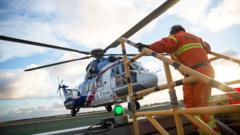
Safety rules on oil and gas rigs are tightening, and hundreds of workers are caught in the crossfire. With new weight restrictions for offshore helicopter travel taking effect in November, roughly 800 workers remain above the permitted threshold. If you fail to hit the target, you don't fly. And if you can't fly to the rig, your job is on the line.
The industry body Offshore Energies UK (OEUK) set a hard limit. From November onward, anyone boarding a North Sea helicopter must weigh no more than 19 stone 7 pounds (124.7 kilograms) fully clothed and wearing their standard footwear. When officials first floated these rules, more than 2,200 workers exceeded the limit. Data collected between April and August shows numbers have dropped significantly, with about 3.4% of the offshore workforce—roughly 800 people—still sitting above the cutoff.
The Physics of a Rescue Winch
Why the strict cutoff? It comes down to basic physics and life-or-safety limits set by the Maritime and Coastguard Agency (MCA).
When a rescue helicopter hovers over a stormy North Sea, a winchman drops down to hoist a worker out of the water or off a platform deck. The total capacity of a standard search-and-rescue winch sits at around 39 stone (249 kilograms). That total weight limit isn't just for the person being rescued. It has to account for:
- The maximum clothed weight of the passenger.
- The average 14-stone weight of the rescue worker.
- A 4-stone 7-pound emergency stretcher.
- Around 7 pounds of standard rescue kit.
When you add those constants together, heavy passengers push the system past its certified margin of error. If the winch fails during a crisis because the load is too heavy, disaster follows. The rules aren't arbitrary bureaucracy—they are hard mathematical limits dictated by rescue equipment.
A Heavier Workforce and Tight Margins
The average weight of offshore personnel has climbed steadily. Data shows that the average worker is nearly 10 kilograms heavier today than back in 2008. Life on an installation involves long shifts, limited cardio options, and calorie-dense catering facilities. While many riggers and technicians maintain intense physical jobs, centuries of offshore culture have taken a toll on overall body mass metrics.
This is the second major physical restriction introduced for North Sea travel in recent years. Earlier rules targeted shoulder width. Passengers measuring 22 inches or wider were classified as extra broad and forced to sit next to specific emergency windows to ensure they could squeeze out during an evacuation.
Now, the weight issue hits harder. Occupational health specialists note that some veteran workers have chosen to quit the industry altogether rather than attempt drastic weight loss. Meanwhile, employment lawyers point out that companies are scrambling to see if affected workers can be transitioned into onshore roles. Yet, onshore positions are limited, and many specialized offshore trades do not easily translate to an office desk.
What Happens Next for Affected Workers
The countdown is ticking. Workers who remain over 124.7 kilograms face stark choices. Some companies introduced support programs months ago, offering dietary assistance and health counseling to help employees clear the threshold before the enforcement deadline.
For the remaining 800 individuals, the window is almost closed. Anyone denied boarding when November arrives faces potential disciplinary action, grounding, or termination. The North Sea has always been a demanding, unforgiving workplace. Now, staying on the payroll means passing the scale before you even reach the helideck.