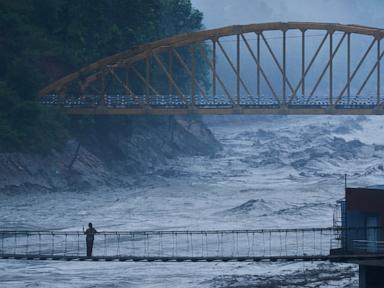
When an entire village is swallowed by a wall of thick, grey-brown sediment in a matter of minutes, standard emergency response protocols don't just fail—they vanish. That is the grim reality facing communities across Nepal right now. Following catastrophic flash floods triggered by a glacial collapse high in the Himalayas, authorities have issued urgent new warnings about secondary deluges, leaving survivors trapped in a cycle of constant terror.
If you look at mainstream news reports, you'll see dry casualty figures and brief updates on rising water levels in the Bhotekoshi River. What those summaries miss is the human exhaustion on the ground. Families aren't just mourning lost homes; they are living out of suitcases on makeshift highway bridges, jumping at every automated alert pinging on their phones, and wondering if the next rumble from the mountains will take what little they have left.
The Reality of Living on High Alert
Disaster management in mountainous regions is a nightmare of logistics. When Dharam Raj Uprety, chief executive of Nepal's National Disaster Risk Reduction and Management Authority, receives warnings from Chinese counterparts about increased water flow upstream, the message goes out via mobile alerts. But constant alarms without clear evacuation paths create panic rather than safety.
Local residents like Govind Shreshta describe the psychological toll bluntly. Running to higher ground in the middle of the night, carrying elderly parents over uneven terrain, and dealing with relentless rain pushes human endurance past its breaking point.
- Infrastructure collapse: Major transit veins like the Prithivi Highway remain choked with mud and debris, complicating supply chains for food and fuel into Kathmandu.
- The hydropower trap: Rescue efforts have shifted toward underground tunnels at major complexes like the Upper Trishuli project, where hundreds are feared trapped in pitch-black conditions.
- Geographic isolation: With concrete and suspension bridges snapped like twigs, communities on opposite riverbanks are entirely cut off from medical care and aid distribution.
Why Traditional Early Warning Systems Fall Short
We rely heavily on technology to predict natural disasters, but sensors and upstream data feeds mean nothing if communities lack the physical infrastructure to escape. Himalayan flash floods move too fast for text messages to save everyone. When glacial lakes burst, water volumes staggering in scale roar down narrow valleys in seconds.
Foreign Minister Shisir Khanal pointed out a brutal irony: Nepal contributes roughly 0.1 percent to global carbon emissions, yet its citizens bear the brunt of extreme climate shifts. This structural vulnerability means that standard disaster recovery playbooks—designed for flat terrain or predictable river basins—simply do not work here.
What Needs to Change Right Now
Fixing this isn't just about sending emergency rations after the fact. It requires a complete overhaul of how vulnerable Himalayan settlements handle high-altitude risks.
First, micro-zoning must replace broad regional alerts. Blanket warnings cause fatigue, leading people to ignore life-saving instructions. Second, governments need to invest in redundant communication networks that don't rely entirely on cellular towers easily knocked out by landslides. Finally, structural engineering around hydropower projects must account for catastrophic debris flows, protecting workers before disaster strikes rather than scrambling through tunnels afterward.
The water recedes eventually, leaving behind hardened mud and ruined rice terraces. But until mountain infrastructure catches up to the reality of a warming planet, the communities left behind will keep watching the river, waiting for the next alarm.