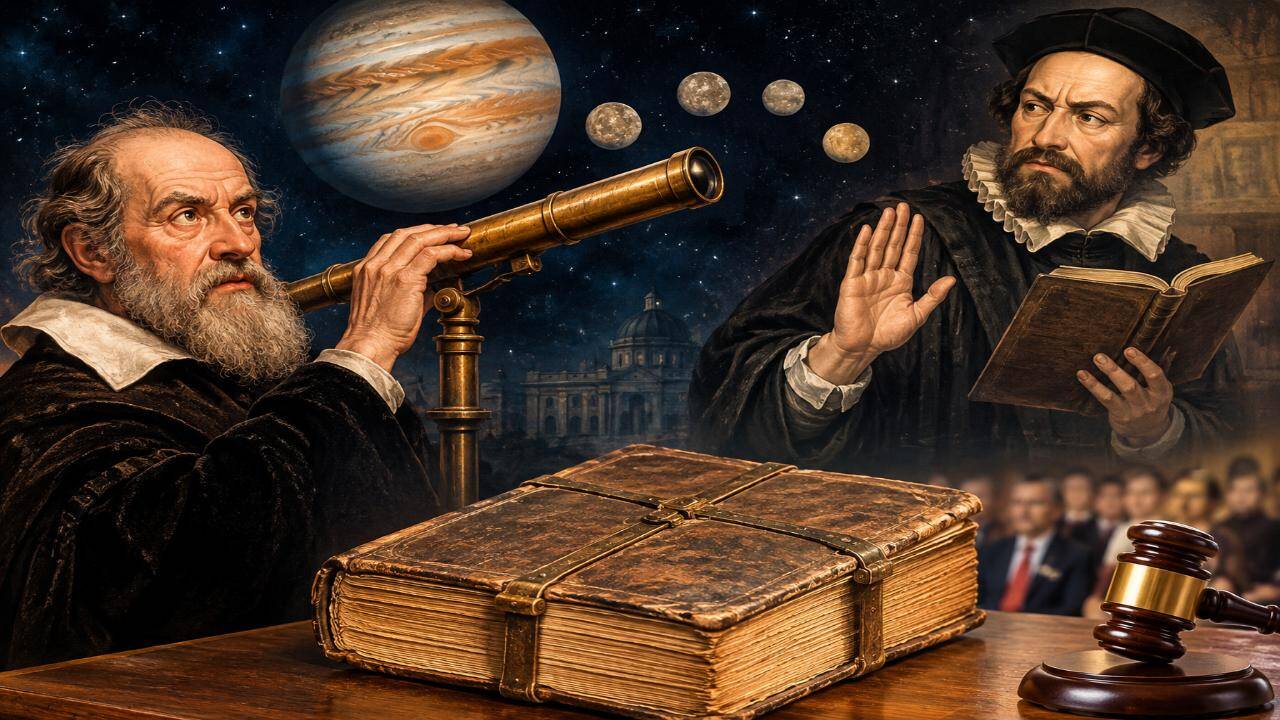
History rarely preserves its bitterest arguments quite like this. In March 1610, Galileo Galilei published Sidereus Nuncius, a slim text detailing four tiny points of light orbiting Jupiter that shattered the geocentric universe. Almost immediately, traditional scholars tried to dismantle his findings. Among them, astronomer Francesco Sizzi argued that these supposed moons were merely optical tricks manufactured by spyglasses. Centuries later, a single surviving volume containing Galileo's breakthrough alongside Sizzi's aggressive rebuttal fetched $217,600 at a Christie's auction.
You see, humanity loves a clean narrative where the lone genius triumphs instantly over ignorant detractors. Reality is messier. When Galileo pointed his homemade telescope at the night sky, he wasn't just introducing humanity to Io, Europa, Ganymede, and Callisto. He was fundamentally threatening the Aristotelian worldview that placed Earth dead-center in the cosmos. People didn't hate his math out of pure malice; their entire intellectual security blanket was on the line.
The Spyglass That Broke the Universe
Galileo didn't invent the telescope, but he certainly perfected its application. By late 1609, he had built instruments capable of roughly thirtyfold magnification. When he trained those lenses on Jupiter in January 1610, he noticed stellar companions shifting positions across successive nights. They weren't fixed stars. They were moons orbiting another planet.
Sidereus Nuncius captured this revelation in vivid detail, alongside observations of lunar craters and countless unseen stars in the Milky Way. The book made him an overnight celebrity across Europe. Yet, acceptance wasn't guaranteed. Critics lined up to poke holes in data gathered through an unproven, distortion-prone piece of glass.
When Skepticism Meets Pride
Enter Francesco Sizzi. In 1611, Sizzi published Dianoia astronomica, optica, physica in Venice, mounting a direct challenge to Galileo's assertions. Sizzi claimed that the human body, the week, and the planets all naturally totaled seven, so inventing extra moons around Jupiter defied cosmic order. More practically, he argued that lenses could create visual artifacts that mimic celestial bodies.
Sizzi wasn't a crackpot by the standards of his day; he was working within a rigid framework of natural philosophy that prioritized ancient philosophical harmony over raw empirical data. He trusted established doctrine more than glass and metal lenses ground in a workshop.
What makes this feud fascinating isn't the disagreement itself. It is how their dueling thoughts survived.
The Survival of a Sammelband
The book that sold for a small fortune isn't just a pristine first edition sitting on a velvet pillow. It is a Sammelband—a composite volume where an early owner bound multiple separate publications together under one roof.
Alongside Galileo's groundbreaking messenger and Sizzi's skeptical counterblast, the volume includes early treatises on optics, light refraction, and spherical concave mirrors by Marcus Antonius de Dominis and Giovanni Antonio Magini. Bound in stiff vellum boards, this single artifact even features a recycled scrap from a 1474 Latin translation of Herodotus tucked into the inside cover.
Historians note that Galileo actually maintained a surprisingly amicable stance toward Sizzi, declining to engage in bitter public mudslinging to preserve professional courtesy. He let the observational evidence speak for itself.
Collectors and historians value these composite volumes because they capture the raw, messy friction of a scientific revolution in real-time. Science doesn't happen in a vacuum. It thrives when bold claims face harsh skepticism, even when the skeptics turn out to be completely wrong.
Grab an old book or dive into digital archives of early modern science, and you will see that every paradigm shift comes packed with fierce resistance. If you want to understand how humanity finally looked past its own backyard, look no further than the arguments preserved between the covers of a four-hundred-year-old book.