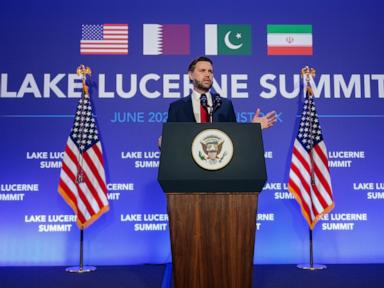
Diplomacy under the current administration looks less like a chess match and more like a high-stakes demolition derby. If you watched the news coming out of the Swiss mountain resort of Bürgenstock, you probably saw headlines celebrating a foundational breakthrough. Vice President JD Vance just spent an exhausting 18 hours in face-to-face talks with Iranian officials, declaring they have built a good foundation for a successful final deal to end the conflict.
But don't pop the champagne just yet.
What the major networks are calling a smooth diplomatic triumph was actually a volatile, chaotic midnight sprint that almost fell apart multiple times before dawn. While Vance was sitting across from Iran’s parliamentary speaker Mohammad Bagher Qalibaf trying to hammer out a framework, President Donald Trump was firing off explosive posts on social media from thousands of miles away, threatening to hit Iran harder than ever. The Iranians threatened to walk out. The entire negotiation stood on the edge of a knife.
To understand why these talks matter, and what they actually achieved, you have to look past the carefully staged press conferences. This isn't just about a temporary truce. It's an aggressive rewrite of how Washington deals with Tehran, complete with back-channel agricultural trades, unfreezing billions in cash, and trying to handle a volatile situation in Lebanon that neither side can fully control.
Shouting on Social Media While Vance Talks With Iranian Officials
The Lake Lucerne Summit was doomed before it even started on Sunday. The goal was clear: take the shaky memorandum of understanding signed last week and turn it into a permanent resolution to end the war that exploded back in late February.
Then Trump opened his mouth. Or rather, his phone.
While Vance, negotiator Steve Witkoff, and Trump’s son-in-law Jared Kushner were sitting down in a room with Qalibaf and Iranian Foreign Minister Abbas Araghchi, Trump dropped a bomb on social media. He warned Iran to control its proxies in Lebanon or face catastrophic military strikes. He told media outlets that if Iran tried to close the crucial Strait of Hormuz shipping lane, they wouldn't have a country left.
Predictably, the Iranian delegation blew up.
Iranian state media immediately reported that the talks entered a difficult phase and recessed due to the insulting messages from the American president. Qalibaf shot back publicly, telling Trump that Iran's armed forces were ready to act, not just talk. The delegation physically walked out of the immediate negotiating room to huddle with Qatari mediators.
Vance has downplayed the drama. He told reporters that while the Iranians did throw social media tantrums and threaten to leave, the American team kept them at the table until well past one in the morning. His take on it was pure millennial bluntness: if you engage in trash talk, you can't be surprised when the president hits back.
It is a bizarre good-cop, bad-cop routine. Vance plays the steady, pragmatic dealmaker in the room, while Trump plays the unpredictable wild card on the outside. It is risky, it infuriates foreign diplomats, but this time, it somehow kept the wheels from falling off completely.
The House and the Foundation
Vance used a simple analogy to describe where things stand. He said the final deal is the house. Right now, they haven't built the walls or put on the roof, but they have laid a solid concrete foundation.
So what does that foundation actually look like?
The most immediate victory for the U.S. delegation is Iran’s formal agreement to invite inspectors from the International Atomic Energy Agency back into the country. This is a massive concession. Iran’s main nuclear enrichment sites took a brutal beating from American bunker-buster bombs during the height of the fighting last year. Since then, the international community has been terrified that Tehran was rushing toward a breakout weapons capability in secret mountain facilities.
Vance noted that the U.S. team was calling nuclear inspectors at two in the morning right from the Swiss resort. Nobody picked up because of the hour, but the framework is set. Inspections could start almost immediately to map out exactly what enriched material Iran has left.
The second major pillar is keeping the Strait of Hormuz open. Just days ago, Iran's Revolutionary Guards threatened to shut down the strait entirely, a move that would throw global energy markets into absolute chaos. To stop a global economic meltdown, the two sides agreed to a permanent communication line and a dedicated deconfliction cell. It gives both militaries a direct line to talk before they shoot, protecting commercial shipping vessels from accidental escalation.
Jared Kushner and the Grain Diplomacy Move
The most fascinating, and controversial, part of these talks revolves around money. Iran wants its money back. Decades of Western sanctions, asset freezes, and legal warfare have left tens of billions of Iranian dollars trapped in international banks. Tehran made it clear that a permanent peace requires that cash to be unfrozen.
The Trump administration knows that handing billions of raw dollars to Tehran is a political nightmare at home. Critics would scream that Washington is funding the very state apparatus it just fought a war against.
Enter Jared Kushner and the government of Qatar.
Kushner, acting as a lead negotiator, cooked up a creative workaround alongside Qatari officials. Instead of giving Iran an open checking account, the U.S. is proposing a strict, supervised pipeline. Under this plan, the frozen assets would be unlocked solely to buy American agricultural products.
We are talking about millions of tons of American soy, corn, and wheat shipped directly to Iranian ports. Qatar would have complete oversight and veto power over the transactions to ensure not a single dollar goes toward weapons or military funding.
Vance pitched this as a massive win-win. American farmers get an enormous, guaranteed market for their crops, and the Iranian people get direct humanitarian relief to combat the severe food inflation caused by the war.
It is brilliant branding, but the Iranians haven't officially bought into it yet. Iranian state media has stayed completely silent on whether they will accept a deal where they are told exactly how to spend their own money. They want unconditional economic relief, not a grocery voucher from Washington.
The Untamed Wild Card in Lebanon
You can write up all the beautiful frameworks you want in a Swiss mountain resort, but diplomacy means nothing if the guns don't stop firing. And right now, the biggest threat to this entire peace plan is the border between Israel and Lebanon.
Technically, the interim deal signed last week mandated a total, permanent halt to military actions on all fronts. But Israel and Hezbollah have kept right on trading blows. Over the weekend, Israeli airstrikes pounded southern Lebanon, killing at least 16 people. Hezbollah responded with rocket volleys, prompting the Revolutionary Guards to briefly declare the Strait of Hormuz closed in retaliation.
This highlights the absurdity of the current situation. Neither Israel nor Hezbollah are actual signatories to the U.S.-Iran agreement. Yet, they hold total veto power over its success.
The Iranian delegation pushed hard to put Lebanon at the top of the agenda, calling it the first real test of whether Washington can deliver on its promises. In response, the Swiss talks yielded an agreement to set up a specific deconfliction cell designed to bring an end to the fighting in Lebanon.
The good news is that a renewed ceasefire seemed to hold through Monday morning, with the Israeli military even lifting safety restrictions for citizens near the northern border. The bad news is that the political rhetoric remains incredibly toxic. Israeli Defense Minister Israel Katz stated bluntly that there are zero restrictions on Israeli soldiers acting against threats in Lebanon. Netanyahu echoed that, insisting troops will stay in the southern security zone as long as they see fit.
Vance openly acknowledged this tension, stating that while the U.S. wants to protect Israel's security, it also must protect Lebanon's sovereignty. Balancing those two opposing realities is going to be an ongoing, agonizing conversation.
The Sixty Day Countdown Begins
Now that Vance and the top-tier political leaders have left Switzerland, the real, grueling work starts. The high-level political posturing is over, and the arena has been handed over to teams of lower-level technical negotiators who will remain in Switzerland this week.
They have exactly 60 days to transform this basic framework into a binding treaty.
To keep the wheels turning and give Iran an incentive to stay at the negotiating table, the U.S. Treasury just threw them an economic lifeline. Washington has issued a temporary sanctions waiver that authorizes all transactions related to the production, sale, and transport of Iranian crude oil until August 21, 2026.
This is a massive gamble. It allows Iran to immediately pump oil back into global markets to generate quick cash. The administration is banking on the fact that the threat of letting this waiver expire in August will force the Iranian regime to make painful compromises on their nuclear program and their regional proxies.
What Happens Next
The Swiss summit didn't end the geopolitical crisis, but it drew the map for how to get out of it. If you are tracking this situation, watch these three specific signs over the next two weeks to see if the deal is real or just a photo-op:
- The Verification Step: Watch for the exact date IAEA inspectors physically cross the Iranian border and enter the damaged enrichment sites. If Iran delays their entry or restricts their access, the Swiss agreement is dead on arrival.
- The Oil Flow Factor: Monitor global oil tracking data to see how quickly Iranian crude hits the market under the new August 21 Treasury waiver. A massive surge in volume will tell you how fast the Iranian economy is breathing again.
- The Lebanon Ceasefire Watch: Watch the daily military logs along the Israel-Lebanon border. If the new deconfliction cell fails to stop localized rocket exchanges, the entire regional truce will implode regardless of what Vance and Qalibaf signed.