For years, asking free web readers to pull out their credit cards felt like publisher suicide. You spend decades feeding internet audiences gratis content, and then you slam a paywall in their face. Most people assume the traffic vanishes overnight.
Groupe Actu proved everyone wrong.
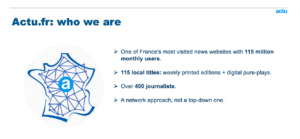
As one of France's largest digital news ecosystems, pulling in around 115 million monthly users across its network, Actu took a massive gamble. They shifted from a purely ad-supported model to a hybrid subscription setup. Instead of crashing their numbers, they started pulling in roughly 1,500 new digital subscribers every single month.
If you run a digital publication or manage online content, you're probably wondering how they pulled off this transition without breaking their traffic engine. Let's look at the actual mechanics behind Actu's strategy, why newsrooms initially panicked, and what you can learn from their playbook.
The Problem with Relying Only on Ad Revenue
Relying entirely on programmatic advertising is a slow trap. You need astronomical page views just to keep the lights on, and algorithm updates can slash your revenue overnight.
Actu knew this pain well. Owned by CIPA Ouest-France, the group historically relied on a massive print footprint with dozens of regional weekly editions across Brittany and Normandy. When they moved digital, they operated dozens of fragmented sites. Some local pages barely scraped 2,000 unique visitors a month.
They made their first major structural fix in 2016 by migrating 80 different titles onto a single unified platform. Traffic exploded. They built a massive national footprint while retaining local grassroots reporting.
The advertising cash flowed nicely, but market volatility made leadership uneasy. They faced a choice: wait for ad yields to compress further or figure out how to get free readers to pay. They chose the latter, but the newsrooms were terrified.
Overcoming Internal Panic and Fear of Audience Loss
When Amandine Briand and the leadership team floated the subscription project, the internal pushback was fierce. Journalists had one primary fear.
Will this monetisation project kill our audience?
Reporters had spent years training readers to expect free local news. Asking those same readers to pay felt counterintuitive. Furthermore, critics inside the organization worried they were arriving to the subscription game way too late. Competitors had already locked down paid models across France, leaving Actu labeled as the "free" news alternative.
Overcoming this required changing how journalists thought about their own work.
Training Newsrooms to Think Like Product Teams
Journalists usually measure value by effort. If a reporter spends three weeks investigating a municipal corruption scandal, they assume the audience values it massively. But reader value doesn't always map to reporter hours.
Actu rolled out extensive training sessions for their newsrooms to explain the mechanics of the subscription funnel and the user needs model. They taught reporters to identify what actually drives conversions: practical utility, deep community connection, curiosity, and emotional resonance.
They didn't automate the paywall. They trusted individual newsrooms to decide which articles went behind the lock. However, they instituted a strict rule: 30 percent of all content must be paywalled.
Why 30 percent? It's a calculated sweet spot. It preserves enough open content to maintain ad inventory and feed top-of-funnel traffic, while introducing enough friction to push heavy readers toward a subscription.
They tested the model carefully, starting with La Presse de la Manche before rolling it out across regional waves.
What the Data Says About Paying Readers
The results shattered internal fears. Readers started paying immediately.
Actu accumulated nearly 19,000 active paywall subscriptions, creating a net positive subscriber growth trend that hadn't been seen since the pandemic era. Their average revenue per user climbed, and digital revenue now accounts for 35 percent of the total group earnings.
More importantly, the data revealed fascinating behavioral patterns about these paying users:
- Super-consumers drive conversions: Subscribers often visit the site three times a day.
- Engagement spikes: Paying users stay on the site for an average of seven minutes per visit, compared to just two minutes for non-subscribers.
- The free tier still matters: Nearly 70 percent of the content consumed by logged-in subscribers is actually free articles. The paywall acts as a gate, but the open ecosystem builds the trust required to stay.
Stories that trigger empathy, solve everyday local problems, or touch directly on community life prove to be the strongest conversion engines.
Next Steps for Publishers Eyeing a Paywall Shift
If you're thinking about converting a free audience into paying customers, don't copy a generic Wall Street Journal playbook. Local and regional publishers require a completely different approach rooted in community proximity.
Start by auditing your content through the lens of reader value rather than reporting effort. Identify your heavy users—the ones visiting multiple times a day—and target your initial conversion prompts directly at them. Keep a healthy percentage of your content open to sustain discovery, but protect the high-utility reporting that solves real problems.
Build trust first, introduce friction second, and never assume your audience won't pay for quality local information.