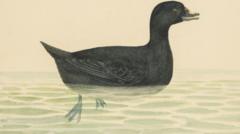
Most people think the highest-stakes art auctions only happen in London or New York. They're wrong. Right now, Welsh art collectors are focusing entirely on Cardiff, where a genuinely rare piece of ceramic and natural history is hitting the block. A bound album of 41 original bird watercolours by William Weston Young is expected to bring between £20,000 and £25,000 at Rogers Jones Auctioneers on July 27, 2026.
If you aren't deep into the world of Welsh pottery, that name might not mean much. But to anyone who understands the legacy of the Cambrian Pottery in Swansea or the famed Nantgarw China Works, Young is royalty. Finding his work on paper is almost unheard of. He didn't leave behind a massive archive of sketches. He was too busy surviving bankruptcy, running businesses, and changing the face of porcelain decoration.
This isn't just a book of pretty pictures. It's a critical missing link in 19th-century industrial artistry.
The Desperate Origin of a Masterpiece
William Weston Young didn't start out planning to be a ceramic decorator. Born into a devout Bristol Quaker family in 1776, he was an entrepreneur by nature. But early financial failure forced his hand. By 1803, completely broke, he moved to Swansea to work under a fellow Quaker, Lewis Weston Dillwyn, at the Cambrian Pottery. His starting salary was a modest £75 a year.
That financial scramble produced something incredible. Young and Dillwyn bonded over a mutual obsession with botany and ornithology. Instead of mindlessly copying the stylized, unrealistic Chinese or London patterns popular at the time, Young started looking at the actual wildlife outside his window.
The album up for sale, titled British Birds and dated 1804, was created during this intense creative burst. Measuring roughly 16.3 by 25.7 centimeters per page, these 41 watercolours served as the actual working blueprints for his iconic porcelain designs. He isolated British birds on simple mossy patches or detached branches, using negative space to let the underlying material breathe.
It was scientific realism applied to commercial luxury goods.
Why This Specific Album Matters to Collectors
If you look at the auction records for William Weston Young, his loose paper sketches usually fetch modest sums, often under $1,000. So why is this album expected to break records with a £25,000 estimate?
It comes down to three things: completeness, provenance, and intent.
- The Working Blueprint: These aren't casual drawings done for leisure. These are the exact prototype sketches for his famous Nantgarw and Cambrian bird studies. You can see the direct line between the paint on these pages and the priceless museum pieces resting in the Victoria and Albert Museum or the National Museum of Wales today.
- Traceable Provenance: The volume has an immaculate pedigree. It bears the marks of the eminent 19th-century naturalist William Yarrell and later passed through the hands of F.E. Andrews, a descendant of the man who built Victorian Cardiff. It's bound in 19th-century calf leather with gilt blocking that reads British Birds / By / William Weston Young / Neath. 1804.
- Pre-Photography Importance: Created in 1804, these drawings predated modern field guides. They were used for practical identification, blending raw artistic skill with rigid scientific taxonomy.
"Young’s name carries real weight among collectors of Welsh ceramics," says auctioneer Ben Rogers Jones. "His original watercolours rarely appear on the market. That combination of true rarity, his standing in Welsh ceramic history, and an appealing natural-history subject makes the album especially desirable."
The Broader Cardiff Auction Scene
This item isn't selling in a vacuum. The Rogers Jones "Welsh Sale" is splitting its heavy hitters across late July. While art historians are sweating over the Young album on Monday, July 27, sports memorabilia collectors are eyeing the previous session on Saturday, July 25.
That earlier session includes the legendary 1972 Llanelli rugby jersey worn by Tommy David during the historic victory over the All Blacks, estimated to fetch up to £15,000. It shows the sheer variety of cultural history crossing the block this month, capturing defining moments of regional identity.
What to Do Next if You Want to Bid
If you're serious about acquiring a foundational piece of Welsh ceramic heritage, don't just turn up on the day expecting to flip through the pages.
- Request the Specific Condition Report: The album was expertly rebacked around 1940 by Bayntun of Bath. You'll want to review how the mounts and tipped-in pages have held up over the decades.
- Book a Private Viewing: Because of its immense museum-grade value, the auction house isn't letting casual tourists thumb through the book. Serious bidders must arrange a viewing, wear the mandatory protective gloves, and inspect the pencil captions on the mounts in person.
- Register Early for Part II: The rugby and sports history rolls out on Saturday, July 25, but the British Birds album sells during Part II on Monday, July 27, starting at 11:00 AM. Ensure your financial credentials are cleared with the Cardiff saleroom well ahead of the hammer.