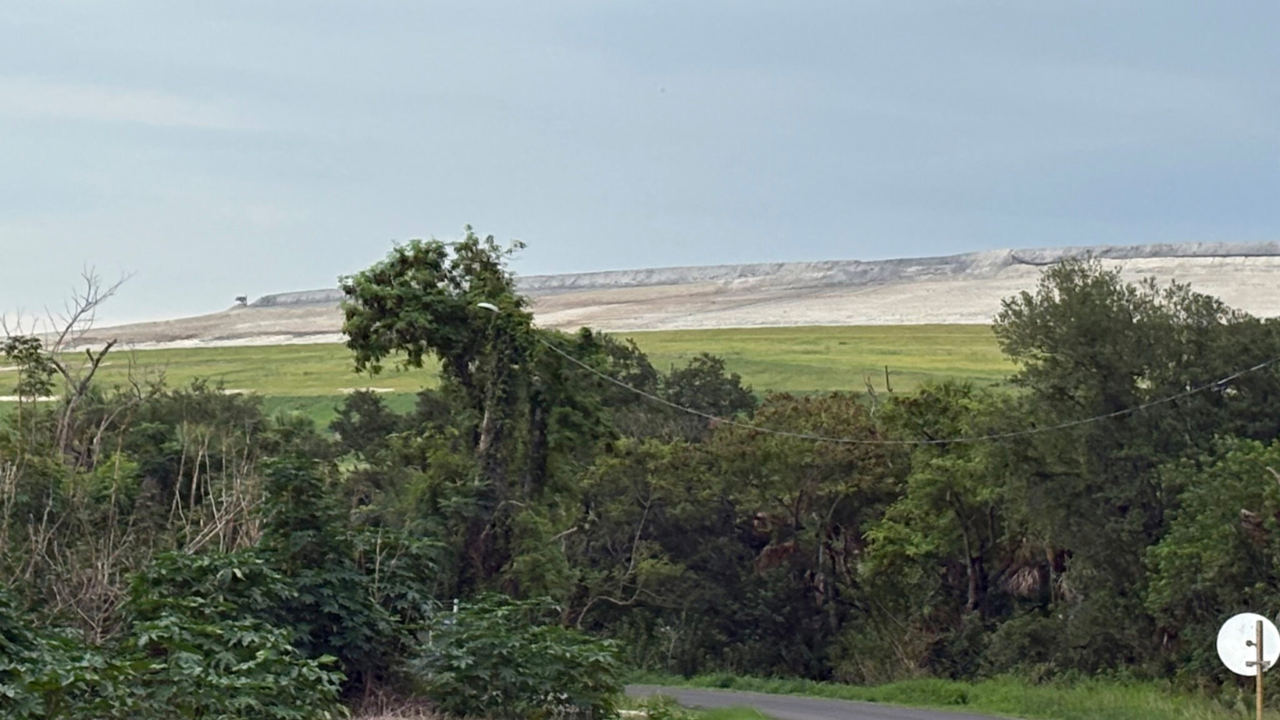
Drive through parts of Central Florida, and you'll spot massive, artificial hills looming over the horizon. They look like natural landscape features until you realize they are towering stacks of industrial garbage. We aren't talking about standard household trash. These are phosphogypsum stacks, and they pack a radioactive punch.
Thousands of people live right next to these toxic mountains. They smell the chemical plants, watch the weather radar during hurricane season, and wonder when the next containment pond is going to fail.
What Actually Goes Into a Phosphogypsum Stack
To understand why communities are terrified, you have to look at how fertilizer is made. Florida holds a massive share of the world's phosphate mining reserves. When companies process raw phosphate rock with sulfuric acid to manufacture phosphoric acid for commercial fertilizer, they generate an astronomical amount of solid waste.
For every ton of phosphoric acid produced, roughly five tons of phosphogypsum are left behind. Florida currently stores over one billion tons of this material across roughly two dozen giant stacks.
The problem goes deeper than mere volume. Phosphate ore naturally contains trace elements of radioactive materials like uranium, thorium, and radium. When the rock is processed, those radioactive elements transfer directly into the waste byproduct.
Radium is the heavy hitter here. It decays into radon, a radioactive gas linked to lung cancer following prolonged exposure. Living within spitting distance of a mountain of radioactive gypsum means dealing with a permanent, low-grade environmental risk that doesn't just go away.
The Historic Burden on Vulnerable Neighborhoods
Environmental hazards never distribute themselves equally. Take Progress Village, a historic neighborhood near Tampa. Established in the 1950s as a planned community for Black residents during an era of rigid segregation, the neighborhood had very few places it could grow.
Decades later, heavy industry crept right up to its borders. When additional phosphogypsum stacks were proposed nearby in the 1980s, residents pushed back hard. Their protests were ignored. The stacks went up, and the community became permanent neighbors to millions of tons of industrial waste.
Local engineers and community advocates have spent years pointing out the glaring equity issue. Wealthy coastal developments don't host radioactive waste piles. Historically marginalized neighborhoods do.
The Nightmare Scenario of Water Leaks and Extreme Weather
Radiation isn't the only threat keeping people awake at night. At the peak of these giant gypsum stacks sit massive retention ponds filled with acidic process wastewater.
Florida weather makes these ponds ticking time bombs. Hurricanes drop torrential rain, testing the structural integrity of the earthen dikes holding back millions of gallons of toxic liquid.
We've seen this movie before. Think back to the 2021 crisis at the old Piney Point facility in Manatee County. A major leak in a gypsum stack pond threatened an imminent structural collapse. Authorities scrambled to declare a state of emergency, order urgent neighborhood evacuations, and dump over 200 million gallons of polluted wastewater directly into Tampa Bay to prevent an uncontrolled catastrophe.
The result? A massive toxic surge that triggered one of the worst red-tide algae blooms the region had witnessed in decades, killing millions of fish and choking marine life.
When residents near active stacks look at a hurricane forecast, they aren't just worrying about wind damage. They're calculating whether a wall of acidic, radioactive water is about to breach containment and flood their streets.
Bad Ideas Masquering as Solutions
State officials have repeatedly flirted with ways to get rid of the mountain of waste instead of securing it properly. Lawmakers previously advanced proposals to allow phosphogypsum to be recycled into road construction aggregate materials.
Think about that for a second. Paving everyday highways with radioactive fertilizer waste means road crews, drivers, and nearby groundwater systems are exposed to materials containing radium-226, an isotope with a half-life spanning 1,600 years.
While federal legislation like the proposed No Radioactive Roads Act attempts to block these reuse schemes, the push-and-pull between industrial convenience and public safety remains entirely unresolved.
What Needs to Happen Now
Ignoring the reality of Florida's phosphogypsum stacks won't make them shrink. If you live near one of these industrial zones or want to understand local environmental policies, passive observation won't cut it.
Track local zoning decisions. Pay attention to state-level environmental protection agency hearings regarding stack capping and liner maintenance. Support grassroots organizations fighting for transparent air and groundwater monitoring around industrial facilities.
The radioactive waste piles aren't going away on their own. Protecting the communities living in their shadow requires demanding strict oversight before the next major storm exposes another structural flaw.


