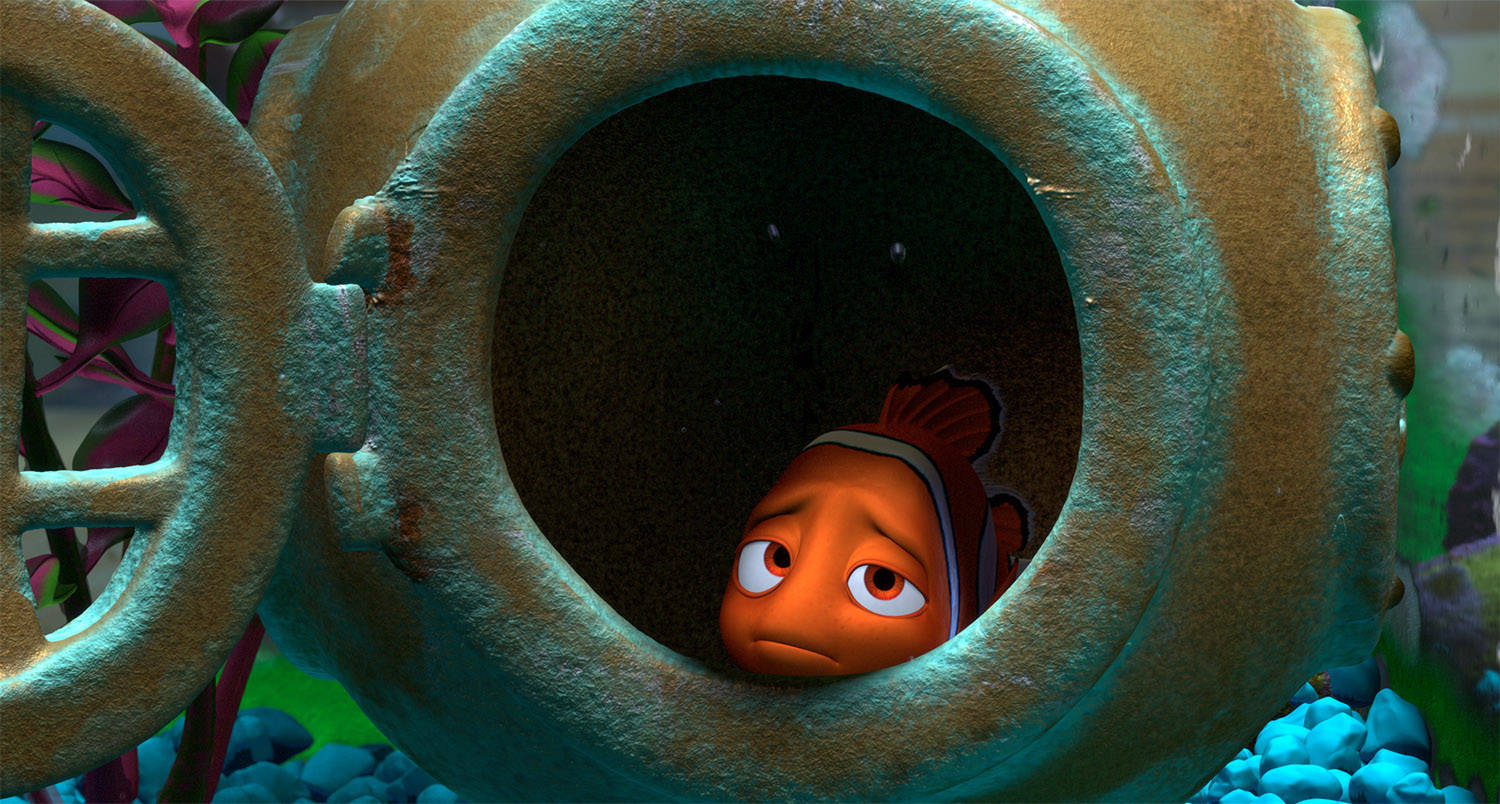
The child sat cross-legged on the carpet, his face bathed in the flicker of a cathode-ray tube television that hummed with static and warmth. On the screen, a frantic clownfish named Marlin realized he was trapped in a plastic bag, staring out at the jagged, volcanic peaks of an aquarium ornament. This was the moment of the initiation, a high-stakes ritual where the domestic meets the wild, known to an entire generation of children and parents as Finding Nemo The Ring Of Fire. The air in the living room felt heavy with the imaginary scent of saltwater and the very real tension of a father separated from his son by an ocean of impossible blue. It was more than a plot point in a 2003 Pixar masterpiece; it was a metaphorical threshold, the point where the safety of the glass tank dissolved into the terrifying, beautiful chaos of the East Australian Current.
The sequence remains a marvel of digital choreography and emotional resonance. Within the confines of a dentist’s office overlooking Sydney Harbour, a ragtag collection of pet store refugees gathers around a bubbling plastic volcano. They are led by Gill, a scarred Moorish Idol whose voice carries the gravelly weight of a man who has seen too much of the world beyond the glass. The ritual is meant to welcome the young protagonist into their "fraternity," but it functions as a masterclass in how we use storytelling to process our deepest anxieties about captivity and freedom. The glow of the red LEDs inside the plastic mountain mimics the tectonic fury of the actual Pacific basin, turning a hobbyist’s decoration into a site of profound transformation.
When Andrew Stanton and Lee Unkrich directed this odyssey, they weren't just making a movie about a lost fish; they were exploring the boundaries of the nuclear family. The film arrived at a time when the world felt increasingly precarious, yet the narrative offered a bridge between the paralyzing fear of loss and the necessity of risk. The aquarium, with its artificial coral and regulated pH levels, represented a sterile kind of safety that Marlin—and by extension, the audience—craved. But the story argues that true life only begins when the bubbles stop and the real current takes hold. This tension between the plastic and the organic is what gives the movie its enduring power, making it a cultural touchstone that refuses to fade even as the technology that created it ages into nostalgia.
Finding Nemo The Ring Of Fire and the Architecture of Fear
To understand why this specific sequence resonates so deeply, one has to look at the visual language of the early 2000s. Computer-generated imagery was still finding its soul. Pixar had conquered toys, bugs, and monsters, but the translucency of water and the organic movement of marine life presented a geometric nightmare. The animators spent months studying the physics of light beneath the surface, trying to capture the "murk"—the particulate matter that gives the ocean its volume and its mystery. When the characters participate in the ritual, the lighting shifts from the clinical, overexposed brightness of the dentist’s office to a theatrical, moody crimson. It is a shift in genre, a brief detour into a heist movie or a war epic, tucked inside a family adventure.
The Moorish Idol, Gill, serves as the architect of this shift. His character is a foil to Marlin’s neurosis. While Marlin views the ocean as a graveyard of potential tragedies, Gill views the tank as a prison of certain stagnation. The "Mount Wannahockaloogie" scene is where these two philosophies collide. The young Nemo, terrified and missing a fin that his father calls "lucky" to mask its fragility, must swim through the rising bubbles to prove he is more than his limitations. It is a scene about the agency of the child, a terrifying moment for any parent watching, where the boy stops being an object to be protected and becomes a subject with his own destiny.
The brilliance of the writing lies in how it uses humor to diffuse the existential dread. The "Shark Bait" chant, performed by a neurotic royal gramma and a starfish obsessed with dental hygiene, turns a moment of genuine peril into a playground game. This is how humans, and apparently fish, deal with the overwhelming scale of the world. We shrink the "Ring of Fire" down to the size of a tabletop ornament so we can find the courage to jump through it. It is a psychological coping mechanism rendered in 24 frames per second, a way of saying that even the most daunting obstacles can be negotiated if you have a tribe to chant your name while you do it.
Scientific consultants were brought in to ensure that while the fish talked, their environments felt grounded in reality. The Great Barrier Reef was recreated with a level of detail that felt revolutionary at the time. Yet, the emotional core of the film remained rooted in the very human experience of the "empty nest" or, more accurately, the "lost nest." This story isn't just about a fish finding his son; it’s about a father finding his own capacity for bravery. Every time Marlin encounters a new danger—the toothy grin of Bruce the shark or the stinging forest of the jellyfish—he is forced to confront the fact that his overprotectiveness was a cage more restrictive than any aquarium.
The Cultural Current and the Ethics of the Glass
The success of the film had unintended consequences that ripple through the real world even today. After the movie's release, the demand for "clownfish" in home aquariums skyrocketed, leading to a surge in the collection of wild specimens from reefs in Vanuatu and the Solomon Islands. This irony—that a film about the longing for freedom led to the captivity of thousands of real-world Nemos—is a tension that environmentalists continue to navigate. It highlights a fundamental human contradiction: we are moved by stories of liberation, yet our first instinct is often to possess the thing that inspired us.
The real Pacific "Ring of Fire" is a massive horseshoe-shaped string of volcanoes and sites of seismic activity that circles the ocean. In the film, this name is appropriated for a bit of domestic theater, but it anchors the story in a geographic reality that is inherently unstable. Life in the Pacific is lived on the edge of tectonic shifts and sudden depths. By naming the ritual Finding Nemo The Ring Of Fire, the filmmakers tapped into an ancient human fascination with the volatile earth. It suggests that growth requires a walk through the flames, or at least a swim through the bubbles of a plastic volcano.
The Moorish Idol is a notoriously difficult fish to keep in captivity. They often refuse to eat and die shortly after being placed in tanks, a fact that gives Gill’s desperation a literal, biological urgency. When he tells Nemo that "fish aren't meant to be in a box," it isn't just a scripted line; it’s a reflection of the species' actual fragility. This layer of realism adds a somber undertone to the comedy. The stakes aren't just about getting back to the reef; they are about surviving a world that treats living creatures as interior design.
As the years pass, the film’s influence has shifted from the screen to the classroom. Marine biologists often cite the movie as their first introduction to the concept of the "EAC" or the complexities of symbiotic relationships between anemones and their inhabitants. While the movie takes liberties—clownfish are sequential hermaphrodites in the wild, a fact the film conveniently ignores to maintain the father-son dynamic—the spirit of the ocean it portrays is one of immense interconnectedness. It taught a generation that the "Big Blue" is not just a void, but a highway of life, pulsing with its own rhythms and rules.
The final movement of the narrative isn't the rescue itself, but the moment Nemo chooses to go back into danger to save a school of fish caught in a net. It is the ultimate culmination of the lessons learned during the volcano ritual. The boy who was once afraid of the bubbles becomes the leader who understands that the strength of the many outweighs the fear of the one. Marlin, watching from the outside, finally lets go. He realizes that he cannot prevent his son from facing the world; he can only hope he has given him the tools to navigate it.
The legacy of the film is found in the quiet moments of recognition between parents and children. It is found in the way we talk about our "lucky fins" and the way we remind each other to "just keep swimming" when the current turns against us. The plastic volcano in the dentist's office is long gone, likely replaced by a modern digital screen or a sleeker piece of decor, but the image of the small fish hovering over the red glow remains. It is a reminder that the greatest adventures often begin in the most confined spaces, and that the heat of the fire is what finally tempers the soul.
The sun sets over the real Sydney Harbour now, casting long shadows across the water where a fictional boat once carried a small orange fish away from his home. The waves continue their rhythmic assault on the sandstone cliffs, indifferent to the stories we tell about them. Somewhere beneath the surface, in the darkness where the light begins to fail, the real currents are moving, pulling the vast, uncounted billions of sea creatures toward their own destinies. We stand on the shore, peering into the depths, forever looking for a flash of orange in the blue, hoping that wherever they are, they are free.
The boy on the carpet is an adult now, perhaps sitting with a child of his own, watching the same flickering light. The technology has changed—the screens are thinner, the colors more vivid—but the feeling is the same. The terror of the abyss is still there, but so is the promise of the return. The circle of life is not a straight line; it is a jagged, volcanic arc, a trial by fire that we all must pass through before we can truly say we have come home.
The water is cold, the journey is long, and the mountain is still bubbling.