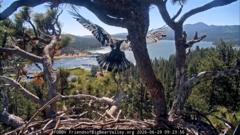
Watching a juvenile bald eagle take its very first flight looks nothing like the majestic nature documentaries lead you to believe. It is messy. It involves a lot of awkward flapping, visible hesitation, and a decent amount of pure luck.
Recently, thousands of people watched exactly that happen on a live camera feed in California. A young bald eagle named Luna, nesting in the mountains of Big Bear Valley, finally left the branch. For months, wildlife fans watched this bird grow from a fuzzy gray hatchling into a massive predator. When Luna finally took the plunge, it was a chaotic, beautiful moment that reminds us why the internet fell in love with wildlife cams in the first place.
If you missed the stream hosted by the Friends of Big Bear Valley, you missed a masterclass in avian anxiety.
The Real Story Behind Luna First Flight
Most news clips show you the clean three-second video of an eagle spreading its wings and gliding away. They don't show the hours of mental preparation that happen before the jump.
Luna spent days doing what biologists call branchling behavior. This is when an eaglet hops around the edges of the nest, grips nearby tree limbs, and vigorously flaps its wings without letting go. It is essentially an engine check before takeoff.
On the day of the flight, Luna stood at the edge of the Jeffrey pine tree nest, tested the mountain wind, and hesitated. When the moment came, it wasn't a graceful dive. It was a clumsy push-off, followed by frantic, heavy wingbeats.
But it worked. Luna caught a thermal breeze, stabilized, and officially transitioned from a nestling to a fledge.
What Most People Get Wrong About Eaglet Fledging
People often assume that once an eagle flies away, it is done with the nest. They think the parents throw them out and say goodbye.
That is not how it works at all.
Fledging is just step one of a long, awkward transition to adulthood. Here is what actually happens after that viral first flight.
- The Return Home: Fledglings usually return to the nest or nearby branches for several weeks. They still rely on their parents for free meals because they don't know how to hunt yet.
- Crash Landings: The first flight is often the easiest part. Landing is the real challenge. It takes weeks for a young eagle to figure out how to judge wind speed and branch stability without overshooting and crashing into bushes.
- The Survival Rate: Nature is brutal. Biologists estimate that roughly 50% of bald eagles don't survive their first year. Accidents during early flights, starvation, and rodenticide poisoning are massive threats.
Why Big Bear Valley Is a Wildlife Goldmine
The nesting site in Big Bear is unique because it sits about 7,000 feet up in the San Bernardino National Forest. The high altitude means these birds face intense weather variations, from blazing summer heat to brutal winter snowstorms.
The local ecosystem provides a steady supply of fish from the lake and local waterfowl, making it prime real estate for a breeding pair. The Friends of Big Bear Valley installed the solar-powered camera system years ago, and it inadvertently turned local eagles into international celebrities.
Watching these birds reveals the harsh realities of conservation. Just days around Luna's big moment, another local eaglet named Sandy gave viewers a heart-stopping scare by slipping and falling down through the branches out of camera view. The local advocacy group confirmed via security footage that Sandy was fine and managed to fly to a lower tree, but it highlights just how precarious life is at the top of the canopy.
How to Support Local Eagle Conservation Right Now
If watching Luna makes you want to protect these birds, don't just sit there watching the stream. Get involved in actual conservation work.
First, stop using rodenticides on your property if you live near wildlife corridors. Secondary poisoning happens when an eagle eats a rat that ingested poison, and it is a leading cause of death for raptors.
Second, support organizations like the Friends of Big Bear Valley or your local wildlife rehabilitation centers. They are the ones monitoring these nests, educating the public, and rescuing injured birds when those first flights go sideways. Keep your distance from known nesting trees during fledging season to give these young birds the space they need to learn to fly without human interference.