When people talk about droughts in Europe, they usually focus on withered crops, cracked earth, or restrictions on filling swimming pools. But there is a silent crisis unfolding beneath the surface that rarely gets the front-page attention it deserves. Europe's relentless summer heatwaves and historic lack of rainfall are turning rivers, lakes, and aquaculture ponds into death traps for aquatic life.
If you look at the numbers, the scale is staggering. Nearly 99% of Hungary's land area has faced severe or extreme drought conditions recently. In places like Serbia, fish are trapped in shrinking side channels of the Danube where water temperatures are surging past 30 degrees Celsius, which is 86 degrees Fahrenheit. That is way too warm for species trying to survive in stagnant, shallow pools with plunging oxygen levels.
Fishermen and fish farmers are watching years of work evaporate overnight.
The Devastation on the Ground
Take what is happening across Central and Eastern Europe right now. In Hungary, the Agriculture and Food Economy Ministry reported that persistent water shortages forced 1,588 hectares of fish ponds to completely dry out. That single wave of destruction killed nearly 280 metric tons of fish across 20 different farms, racking up an estimated $4.2 million in losses.
Operators have been forced into desperate survival mode. Some have had to completely drain one pond just to divert whatever moisture is left to keep fish alive in another.
It is a similar story in Romania. Catalin Platon, who heads the ROMFISH National Association of Fish Producers, points out that the crisis isn't just about a single bad summer. For carp producers, the production cycle spans three or four years. That means a massive loss in 2023 or 2024 ripples forward, hitting businesses year after year. To make matters worse, competing water-use policies often prioritize crop irrigation during dry spells, leaving fish farmers high and dry with zero allocated water resources.
Meanwhile, in Bosnia, trout breeders near Trebinje face a completely different thermal nightmare. Trout are cold-water fish that demand oxygen-rich environments. When summer temperatures spike, farmers have to slash production and feeding schedules just to help the business barely survive, sometimes resorting to dumping liquid oxygen tanks straight into the water just to keep the fish breathing until the autumn rains finally arrive.
Emergency Measures and Short-Term Fixes
Governments and local associations are scrambling with patchwork fixes.
In eastern Slovenia, firefighters had to pump roughly 8 million liters of water into Lake Pristava just to stop a mass suffocation event caused by falling water levels and invasive water chestnut overgrowth choking the surface. Local associations admitted they were genuinely shocked that anything managed to survive at all.
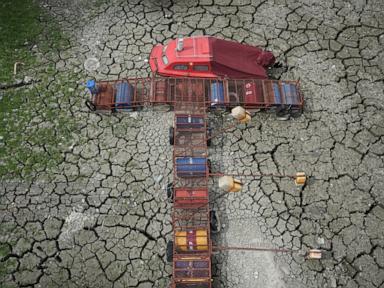
Up in northern Serbia, fishermen like Dusan Jovanovic are working with what little they have left. In shriveled side channels of the Danube near Novi Sad, small boats sit completely stranded on cracked mud while juvenile fish swim in claustrophobic, shrinking puddles. The only real solution left on the table is manually netting and moving the stranded fish to entirely new locations before the remaining water vanishes completely.
Why This Matters Beyond the Riverbanks
We tend to view fisheries and aquaculture through an economic lens, counting euros, dollars, and metric tons of lost stock. But the reality is much bigger. These recurring environmental shocks threaten food security, local culinary traditions, and entire rural economies that have relied on these waterways for generations.
Fixing this won't be easy. Throwing emergency water into a dying lake via firehose is a band-aid, not a strategy. Experts agree that the region needs serious, long-term water retention infrastructure and smarter allocation policies that balance agriculture needs with aquatic ecosystems. Until those changes happen, every hot summer will remain a high-stakes gamble for Europe's freshwater life.
30°C Water, Dying Fish! Europe's Rivers & Fish Farms Hit By Severe Drought
This video provides an on-the-ground look at how record-shattering temperatures and plummeting river levels are threatening fish farms and wildlife habitats across Central and Eastern Europe.