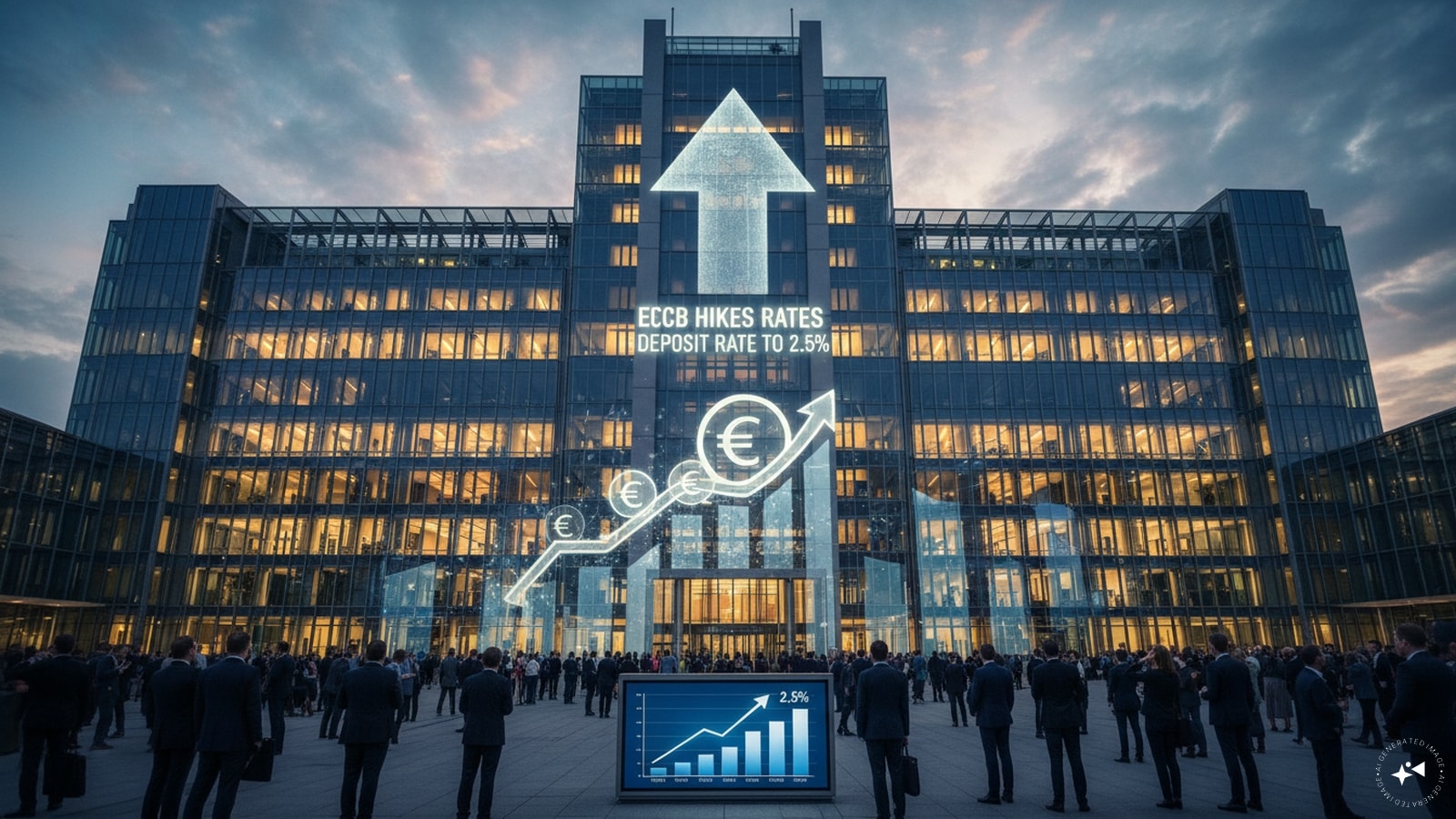
Borrowing money in Europe just got more expensive. The European Central Bank officially pushed its key deposit rate up by a quarter-point to 2.50%, hitting the upper bound of what economists consider neutral.
If you expected ECB President Christine Lagarde to map out the rest of the year, you were left guessing. She flatly refused to pre-commit to any specific path for October or December, leaving markets scrambling to price in what comes next.
Let's break down what this move actually means for your cash, your loans, and the broader economic landscape without the central bank jargon.
Why the ECB Had No Choice
Inflation isn't behaving. Eurozone headline inflation jumped to 3.3% in August, fueled largely by an energy shock tied directly to conflict in the Middle East and supply disruptions.
When energy costs spike, prices for everything else follow. The ECB's primary mandate is price stability at a 2% target. Leaving rates alone at 2.25% while inflation re-accelerates wasn't an option.
The central bank also bumped up its inflation projections for 2027 to 2.5%, proving that officials expect these price pressures to stick around longer than initially hoped.
The Numbers That Matter
Starting September 16, the ECB's three key rates sit at these levels:
- Deposit facility rate: 2.50% (up from 2.25%)
- Main refinancing operations: 2.65% (up from 2.40%)
- Marginal lending facility: 2.90% (up from 2.65%)
Hitting 2.50% is a psychological milestone. Chief economist Philip Lane and other policy experts view this figure as the ceiling of the neutral rate band. Every single basis point past this point crosses into genuinely restrictive territory, meaning the ECB is now actively trying to slow economic activity down to choke off inflation.
Lagarde Plays It Close to the Chest
Markets hate uncertainty, but uncertainty is all Christine Lagarde offered during her press conference.
Traders walked into the meeting pricing in roughly 60 to 75 basis points of additional tightening through mid-2027. They wanted validation. They wanted a roadmap. Instead, Lagarde insisted that every single future decision will be made on a strict meeting-by-meeting, data-dependent basis.
Why the hesitation? Because the current inflation spike is driven by supply-side energy shocks, not runaway domestic wage-push inflation. Central bank rate hikes are blunt instruments. They cannot drill oil wells, reopen shipping lanes, or resolve geopolitical conflicts. Raising rates too aggressively risks choking off the eurozone's fragile economic growth—which actually got a slight upward revision to 0.9% for this year.
What This Means for You Right Now
If you are managing personal finances, running a business, or trying to time a mortgage in Europe, this shift demands immediate action.
- Lock in savings rates while you can. Commercial banks mirror the ECB deposit rate. Higher yields on cash savings accounts are here, but they won't last forever if growth slows and the ECB eventually has to reverse course.
- Brace for pricier commercial loans. Borrowing costs are sitting at their highest points since 2011. If you have variable-rate debt, expect your monthly servicing costs to increase immediately.
- Watch the energy markets. Since the current inflation cycle is entirely tied to energy volatility, keep a close eye on oil and gas prices. They dictate what the ECB does next far more than any domestic economic report.
Stop waiting for central bankers to give you a clear script. They don't know what next month's data will look like either. Stay liquid, reduce variable debt exposure, and build a buffer for higher borrowing costs through the end of the year.


/IRAN URANIUM-min.jpg)