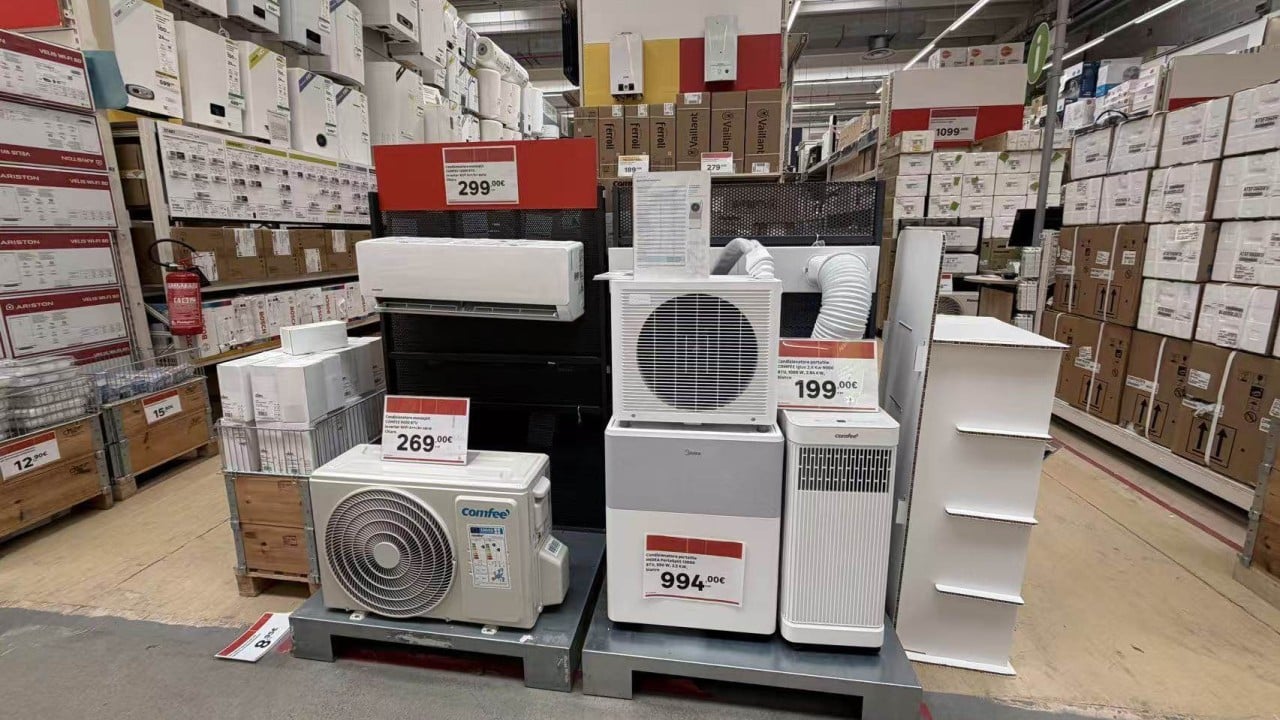
Brussels wants a trade war, but European consumers just want to stay cool. As a record-breaking heatwave bakes the continent from Paris to Berlin, a massive surge in imports of Chinese air conditioners is completely undermining the European Union's plans to decouple from Beijing.
European trade officials are trying hard to narrow a massive 360 billion euro trade deficit. They're launch investigations into Chinese electric vehicles, targeting cheap e-commerce platforms, and setting strict rules on solar panels. But when temperatures skyrocket and asphalt starts melting, grand geopolitical strategies disappear. Consumers are voting with their wallets. They are buying units from Chinese brands like Midea, Haier, and Gree in unprecedented numbers. Meanwhile, you can find similar events here: Why The Latest Northern Metropolis Land Bid Changes The Game For Hong Kong Property.
This creates a massive contradiction for European policy. Brussels talks about economic sovereignty and reducing dependencies. Yet, when a climate crisis hits, European households rely entirely on Chinese manufacturing lines to survive the summer. This situation reveals a massive gap between the high-minded trade policies designed in clean government offices and the practical, daily realities of regular citizens.
The Boiling Point of European Climate Policy
Europe is one of the least air-conditioned developed markets on earth. Only about 20% of European households have any form of cooling, compared to roughly 90% in the United States and Japan. Historically, European summers were mild. Air conditioning was viewed as an American luxury or an unnecessary environmental hazard. To explore the full picture, we recommend the detailed article by The Wall Street Journal.
That old reality is gone. Heatwaves are longer, more frequent, and far more dangerous. When store shelves empty out during a hot spell, European manufacturers cannot fill the void. Local manufacturing capacity for residential cooling is tiny, slow to scale, and heavily focused on expensive industrial heat pumps rather than quick consumer solutions.
Chinese appliance giants anticipated this gap perfectly. They didn't just dump cheap products onto the market. They spent years studying the specific friction points of European housing and local laws, designing products that fit perfectly into the narrow cracks of European regulations.
How Chinese Manufacturers Outsmarted European Regulations
European regulators often think their complex, strict product rules protect domestic industries from foreign imports. In reality, these rules have choked out small local innovators while large Chinese companies with massive research budgets simply engineer their way around them.
The level of regulatory engineering on display is remarkable. Look at how Chinese products navigate specific national laws across the continent.
The Two Kilogram Refrigerant Loophole
In France, environmental regulations dictate that any cooling system containing more than 2 kg of refrigerant must undergo regular, mandatory inspections by certified professional personnel. This adds a massive recurring cost for a standard homeowner. Chinese manufacturers responded by engineering residential units that contain precisely 1.99 kg of refrigerant. They completely bypass the inspection requirement while remaining perfectly legal.
Bypassing Professional Installation Fines
Italy enforces strict rules stating that traditional air conditioning systems must be installed by certified professional technicians. If an unauthorized person drills a hole and mounts a unit, they can face fines of up to 100,000 euros. To counter this, Chinese brands heavily pushed high-efficiency portable split units. These require no drilling and no wall-mounted brackets. They can sit on a terrace or a window sill, requiring zero professional installation and avoiding any legal risk for the buyer.
Meeting the Silent German Night
Germany maintains strict noise pollution laws, dictating that outdoor residential noise levels in certain areas must not exceed 35 decibels at night. Traditional outdoor AC compressors easily exceed this. Chinese engineers designed specific silent modes for the European market that operate at exactly 35 decibels. They hit the regulatory limit perfectly without sacrificing too much cooling performance.
Squeezing Into Swiss Efficiency Bands
Switzerland requires an energy efficiency rating of at least A++ for many imported cooling appliances. Chinese manufacturers adapted their compressors to achieve a Seasonal Energy Efficiency Ratio (SEER) of 6.1. That score barely scrapes into the A++ bracket, allowing them to clear the regulatory hurdle and enter the wealthy Swiss market.
The Hit Product Driving the Market
A prime example of this market dominance is Midea's PortaSplit model. It became an absolute sensation across European cities this summer, selling out instantly and spawning tracking websites where desperate buyers monitor retail restocks.
The product combines research from Midea's engineering center in Stuttgart, Germany, design styling from its studio in Milan, and the ultra-low-cost assembly lines of Guangdong Province. It solves the ultimate European dilemma. It provides the high cooling efficiency of a traditional split system without requiring a landlord's permission to drill holes through historic brick walls.
Local European appliance companies don't have a comparable product ready for mass production at a matching price point. While Brussels complains about unfair competition, Chinese firms are simply doing better consumer research and execution.
The F-Gas Irony
The policy failure goes deeper when you look at the EU's updated F-gas Regulation. This policy forces a phased reduction in hydrofluorocarbons (HFCs), the traditional gases used in air conditioning. The goal was to create a policy-backed wave of equipment replacement, pushing the market toward greener alternatives like propane-based systems.
The law mandates strict quota cuts on HFCs, dropping available supply significantly. This makes servicing older European-made cooling units incredibly expensive. Instead of paying a premium to fix an old system with expensive, regulated gases, consumers choose to throw the old unit away. They replace it with a brand-new, highly efficient, affordable Chinese unit that already complies with the latest eco-design rules.
The regulation intended to help Europe transition to its own green industrial future. Instead, it accelerated a massive replacement cycle that feeds directly into China's export machine.
Why Decoupling Is a Fantasy for Crucial Infrastructure
European trade chief Maros Sefcovic and various Chinese officials have been holding intense meetings to discuss trade imbalances. Brussels wants "tangible results" to lower the deficit, threatening more tariffs and restrictions.
But air conditioning shows that a blanket trade war is impractical. If the EU slaps aggressive tariffs on Chinese cooling technology, they aren't protecting a domestic industry because a viable, mass-market European equivalent doesn't exist. They would simply be making it more expensive for their own citizens to survive extreme weather.
Air conditioners aren't advanced microchips or military hardware. They don't represent an immediate national security threat. Attempting to force supply chain decoupling on basic consumer appliances during a climate emergency is a losing political strategy.
Next Steps for European Policy Creators
If European leaders want to fix this trade imbalance, they need to change their strategy entirely. Punitive tariffs will fail. Here is what needs to happen next.
- Subsidize Domestic Micro-Manufacturing: Provide direct financial incentives for European companies to manufacture portable, heritage-friendly cooling units locally, rather than focusing entirely on heavy industrial heat pumps.
- Streamline Local Permitting: Ease the absurdly complex rental and heritage building rules that block people from installing standard, efficient cooling systems, which currently forces them to buy portable Chinese workarounds.
- Partner on Green Tech Transfer: Accept that China leads in appliance manufacturing scale. Focus on joint ventures where Chinese production capacity builds systems designed to meet Europe's strict environmental goals, keeping assembly or distribution jobs within the bloc.
The current approach isn't working. Brussels can release all the trade strategy papers it wants, but as long as the summers keep getting hotter, European consumers will keep buying Chinese air conditioners.
Firstpost analysis on the EU-China trade dilemma provides an excellent breakdown of how extreme weather events are colliding directly with Europe's geopolitical ambitions to reduce its manufacturing reliance on Beijing.