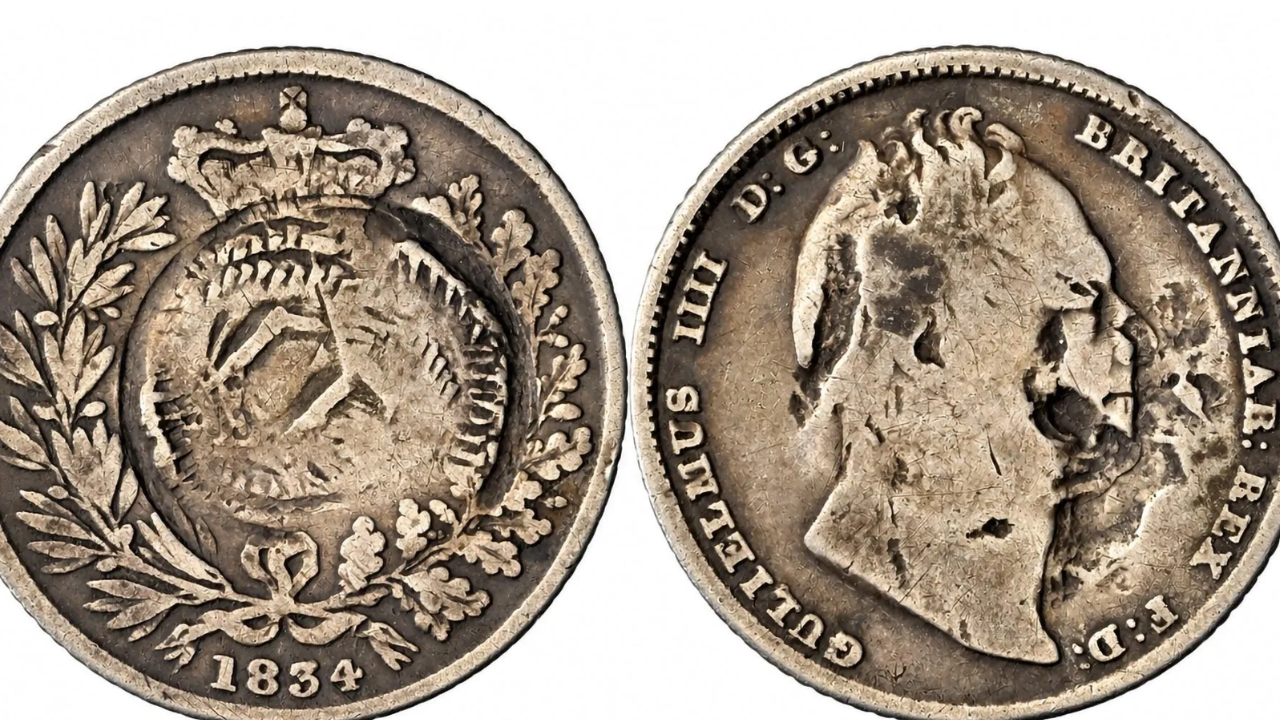
You never know what's sitting in a dusty box at a weekend market. A bargain hunter in Greater Manchester recently found out by dropping eight pounds on an assorted coin album, accidentally pulling a rare 1834 silver sixpence that spent 192 years hiding a bizarre manufacturing secret.
At first glance, the piece looked like junk. The central portrait of King William IV was crushed, warped, and barely legible, while the outer rim and edge grooves remained crisp and intact. Most collectors would have tossed it into a scrap pile or written it off as severe wear from heavy circulation. Instead, modern scientific imaging just proved that the distortion happened before the coin ever left the workshop.
Inside the Lab and the 1834 Minting Mystery
Numismatics is full of urban legends about mint errors, but physical proof from the early Victorian steam press era is surprisingly scarce. When IA STUDIO researchers published their findings in npj Heritage Science, they used advanced optical surface profilometry, scanning electron microscopy, and chemical assays to figure out what happened to this particular piece of currency.
The scans mapped a height difference of roughly zero point seven five millimeters across the damaged portrait. That sounds tiny until you look at how thin a sixpence actually is. The metal didn't wear down gradually from loose change rubbing in someone's pocket. It suffered sharp depressions and raised ridges caused by intense, localized crushing force.
Chemical tests showed a standard silver-copper alloy in the intact areas, while the warped zones showed distinct corrosion patterns. Yet corrosion alone doesn't bend metal into specific mechanical fault lines. The data pointed straight toward a severe striking anomaly during the original manufacturing process.
The Brutal Reality of Early Industrial Coin Production
By 1834, British mints had largely transitioned to steam-powered coining presses. Production speeds skyrocketed, letting workers stamp out thousands of pieces per hour. That kind of mechanical output comes with a downside. When things jammed, they jammed hard.
Quality control inspectors were supposed to catch mangled blanks and feed them straight back into the melting pot to recover the precious metal. Somehow, this deformed sixpence slipped past the supervisors and out into the wild. It survived nearly two centuries of coin collectors, pocket linings, and scrap dealers without anyone realizing its physical structure told a story of a factory floor accident from the reign of William IV.
What This Means For Modern Collectors
Finds like this change how we look at damaged antiques. For decades, standard grading services would dock points or completely dismiss heavily distorted coins as damaged goods with zero numismatic value. Advanced 3D surface mapping proves that factory errors can easily mimic post-production abuse.
If you sort through old coin lots or estate sales, stop ignoring the ugly pieces. Look closely at how the metal flows around the edges. If the rim is pristine while the face is crushed under heavy pressure, you might be holding a rare manufacturing artifact rather than a worthless bent token.
Check your collections, look past the surface grime, and remember that sometimes the worst-looking coin in the box is the only one worth keeping.