You talk to your dog like they understand every single word. Turns out, you aren't just projecting. Recent neurological research published in the journal Science reveals that canine brains process human speech using a specific shortcut previously thought to be exclusive to people.
Forget the idea that your pet is just reacting to the pitch of your voice or an excited tone. Dogs use a trick called a "consonant bias" to break down the wall of sound coming out of your mouth into distinct, recognizable pieces.
The Science Behind Canine Speech Processing
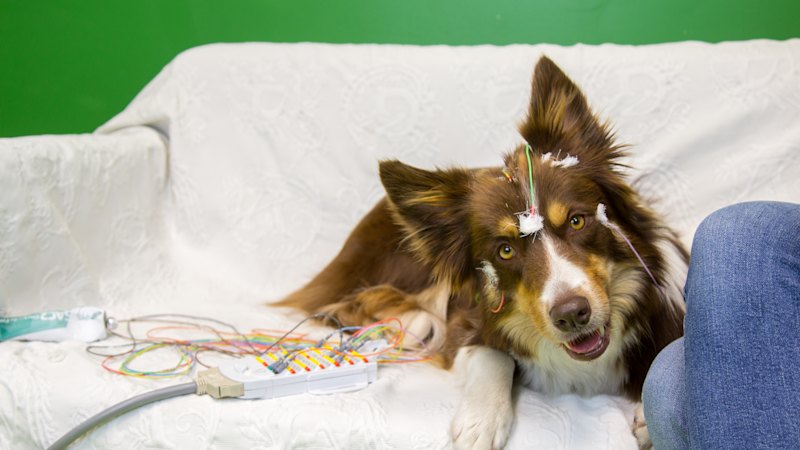
Researchers at Eötvös Loránd University in Hungary decided to test how canine brains handle continuous streams of speech. They used non-invasive electroencephalography (EEG) on 20 companion dogs and 20 human volunteers. Both species listened to spoken audio tracks where words were structured primarily around consonants or vowels.
The results surprised the research team. Both human and dog brains showed distinct electrical activity spikes about 400 milliseconds after a word started, proving that both species were actively tracking and segmenting speech. More importantly, both groups showed much stronger neural synchronization when consonants carried the structure of the words. Vowel-heavy patterns didn't trigger the same clean neurological tracking in dogs, even though human brains handled both with relative ease.
This consonant bias has never been documented in other animals. Primates don't do it, despite sharing a much closer evolutionary tree with us than canines do.
Why Consonants Matter More Than Vowels
If you have ever tried to learn a foreign language, you know how hard it is to tell where one word ends and the next begins. Spoken language is messy. It flows as one continuous wave of acoustic energy.
Human infants crack this code early by latching onto consonants. Consonants provide the architectural backbone of human vocabulary. Your dog's brain does the exact same thing. When you tell your dog to "sit" versus "sat," their brain isn't just taking an emotional snapshot. It is isolating that hard middle or starting consonant to separate commands.
Kinga G. Tóth, a co-author of the study, noted that this is the first time researchers have seen a consonant bias emerge naturally in a non-human species.
Nature Versus Nurture in the Dog Brain
You might assume that pampered household pets develop this ability because they spend all day sitting on the couch listening to podcasts or family chatter. The researchers tested this theory by comparing family dogs with animals that had spent their early months in shelters or on the streets.
The shelter dogs displayed the exact same consonant bias as the house pets.
Lead researcher Attila Andics points out that this adaptation doesn't require a pre-wired human linguistic apparatus. Regular, ongoing exposure to human speech throughout life is enough to shift how the canine brain functions. Living alongside humans for thousands of years has essentially tuned the animal brain to latch onto our linguistic building blocks.
What This Means for How You Train Your Dog
Stop shouting long, rambling sentences expecting your dog to parse them out. They aren't tracking your narrative arc. They are scanning for acoustic markers.
Keep your commands sharp, clear, and rich in distinct consonant sounds. If you want your dog to listen better, don't change your pitch—change your clarity. Enunciate the hard edges of your words.
Your dog is listening closer than you think. Give them better architecture to work with.
Dogs Can Decode Human Speech? New Science Study Reveals A Shocking Brain Trick
This video provides a helpful visual breakdown of the recent EEG study showing how dog brains process speech patterns and consonants similarly to humans.