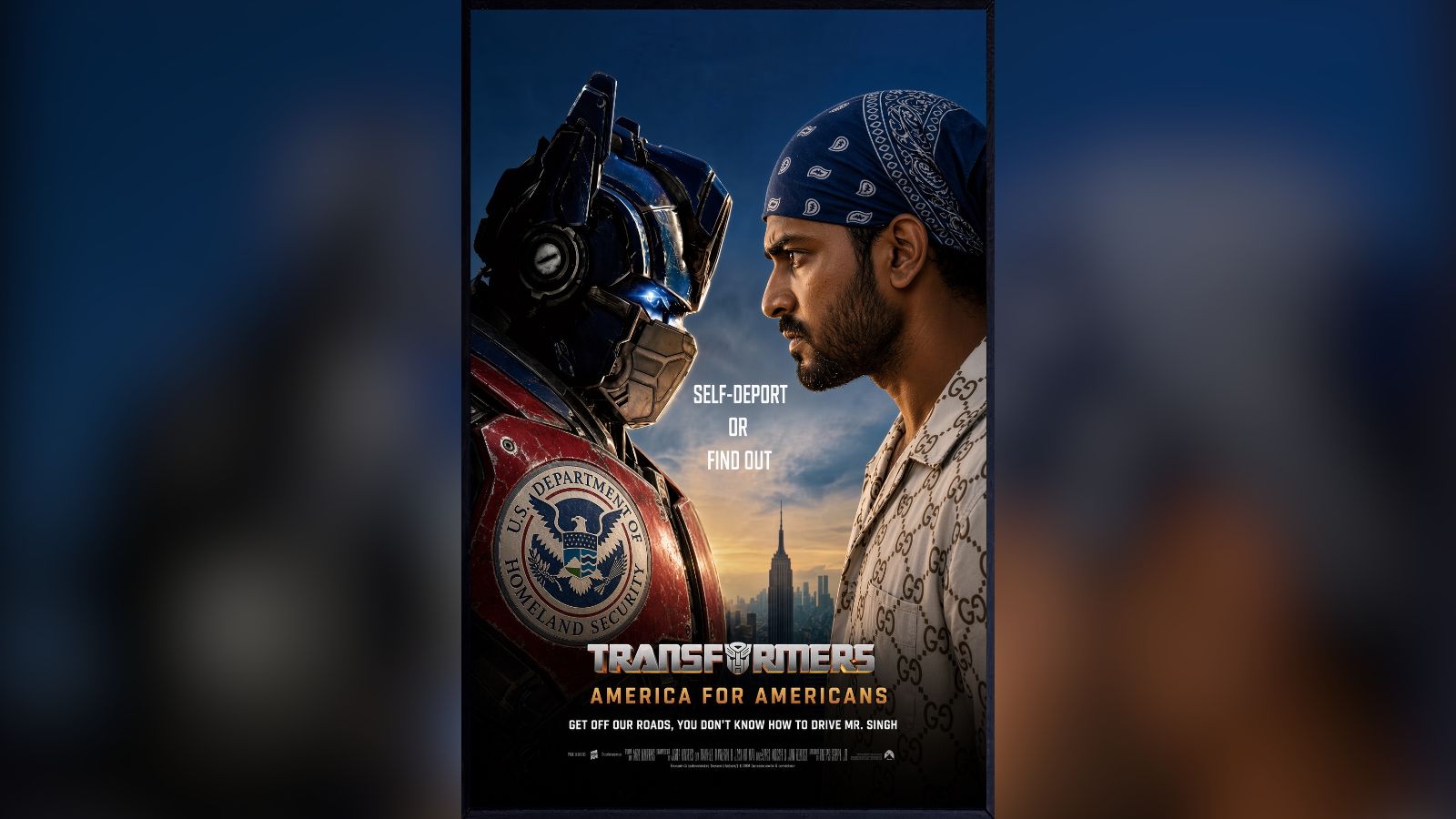
When a federal agency turns to artificial intelligence to generate immigration ads, things can go sideways fast. That is exactly what happened when the United States Department of Homeland Security published a controversial social media post targeting a fictional or composite figure dubbed "Mr Singh". The digital campaign vanished shortly after going live, but the shockwaves left behind exposed deep sensitivities surrounding federal communication, identity, and immigration enforcement.
If you missed the initial rollout, the department posted graphics styled as a parody of the Transformers franchise, complete with AI-generated visuals of a turbaned and bearded man. Taglines like "Get off our roads, you don't know how to drive Mr Singh" and "Self-deport or find out" quickly flooded feeds on X. The posts were tied to an aggressive push for the CBP Home program, which encourages undocumented individuals to register for voluntary exit in exchange for travel assistance and a financial incentive.
The Backlash From Community Groups
The reaction was swift and fierce. Civil rights organizations, diaspora coalitions, and faith-based groups immediately called out the campaign as a form of blatant racial and religious profiling.
Groups like the Hindu American Foundation and the Sikh Coalition pointed out a dangerous flaw in the government's messaging. More than 160,000 people in the United States carry the surname Singh, which holds deep historical and spiritual significance. Painting an entire demographic with a broad brush based on a common surname and specific religious markers alienates millions of law-abiding citizens.
The Sikh Coalition put it bluntly, noting that decades after the systemic prejudices that followed major historical security crises, community members still face targeted suspicion because of how they look. When a government body uses a caricature that mirrors a specific faith tradition to push an enforcement agenda, it normalizes xenophobia.
The Government Defense and Counter-Attacks
Faced with mounting pressure from both Democratic lawmakers and some within their own political circles, the department took the posts down. Yet, officials didn't back down quietly.
Instead of an apology, the administration defended the core of its campaign by pointing to real-world incidents. Officials argued that the imagery specifically referenced individuals like Harjinder Singh, a commercial truck driver involved in a fatal 2025 crash on the Florida Turnpike that left three people dead. The agency even engaged in digital sparring with critics like California Governor Gavin Newsom, blaming state-level licensing errors for allowing unqualified drivers onto major highways.
This defense opened a secondary front involving corporate copyright. Hasbro, the owner of the Transformers intellectual property, made it clear they never authorized the use of Optimus Prime or related franchise elements in official immigration propaganda. Using corporate heroes to push hardline deportation policies turned out to be a legal and branding miscalculation on top of everything else.
Why This Matters Moving Forward
Public sector communication is supposed to uphold standards of neutrality and legal precision. When federal bodies rely on meme culture, AI-generated caricatures, and generalized surnames to drive policy awareness, trust erodes rapidly.
Enforcing traffic safety laws and managing immigration compliance are distinct administrative duties. Conflating public safety violations by specific individuals with an entire ethnic or religious group creates a hostile environment for citizens and legal residents who share those names.
Taking down a controversial graphic is only a cosmetic fix. The real challenge lies in how federal agencies choose to communicate policy without fueling division or compromising basic civic dignity.