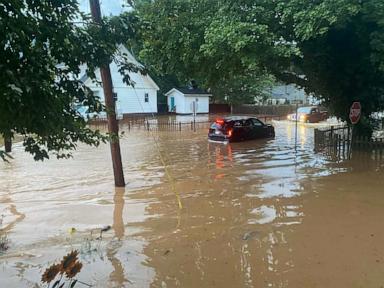
Two people are dead in West Virginia, and the stark truth is that weather like this leaves almost zero room for error.
When 4.5 inches of rain dumps onto mountain towns in just 37 minutes, normal drainage systems don't just fail—they disappear entirely. The governor's office confirmed the fatalities after torrential downpours battered the north-central part of the state, leaving communities stranded, submerged, and searching through wreckage. Also making headlines in this space: Why Syria Getting Removed From The Us Terror List Changes Everything For Reconstruction.
If you live anywhere near steep hillsides or small river valleys, what happened in Buckhannon and Weston this week is a terrifying reminder of how fast water takes over. Forecasters reported localized rainfall totals hitting up to 7 inches. That isn't just a heavy rainstorm. That's a wall of water coming down a mountainside with the force of a concrete mixer.
Lars Dalseide, communications director for Gov. Patrick Morrisey, confirmed the two deaths via email. While officials haven't released the names or exact circumstances surrounding how the victims died, the physical evidence scattered across Lewis and Upshur counties tells a vivid story. Cars bobbing like corks in parking lots. Hotel lobbies filled with brown river sludge. First responders conducting swift-water rescues while floodwaters blocked the very roads they needed to drive on. Further insights regarding the matter are explored by USA.gov.
Here is an honest breakdown of how this disaster unfolded, why Appalachian geography makes these storms so dangerous, and what you need to do when water starts rising around your car or home.
The Raw Math Behind a Mountain Flash Flood
Water moves differently in the mountains. In a flat region, 4 inches of rain creates giant puddles and slow-moving street flooding. In West Virginia, 4 inches of rain in under an hour creates a flash wave.
Think about the sheer volume of water involved here. One inch of rain falling on a single acre equals roughly 27,154 gallons of water. When you multiply that by 4.5 inches across thousands of acres of steep, rock-lined hillsides in less than 40 minutes, millions of gallons of water are forced into narrow creek beds simultaneously.
Soil simply cannot absorb moisture at that rate. Hydrogeologists call this exceeding the infiltration capacity. Once the soil tops out, 100 percent of the remaining rainfall becomes surface runoff.
- 37 minutes was all it took for 4.5 inches of rain to fall in peak storm zones.
- 7 inches total rain fell in the worst-hit areas during the multi-day system.
- Dozens of rescues were carried out by emergency teams pulling trapped motorists out of flooded vehicles.
In Weston, water poured off the surrounding hills and rushed into commercial districts. Social media footage showed the parking lot of the local Walmart completely under water, with muddy waves pushing up against the store entrance. Across the highway, the main floor of a hotel drowned in runoff.
When rain falls that hard, drainage pipes and storm sewers are utterly useless. They are designed for standard storms, not atmospheric firehoses.
Why Appalachian Geography Acts as an Accelerator
You hear meteorologists talk about flash flooding all the time, but the terrain in West Virginia turns standard heavy rain into a localized crisis.
The state sits squarely in the ridge-and-valley region of the Appalachian Mountains. Towns naturally grew up along valley floors—what locals call "hollows" or "holler" bottoms. That's where the flat land is. It's where roads are built, homes sit, and businesses thrive.
But those valleys act as funnel necks.
When heavy rain strikes a ridge, gravity forces every drop down toward the center of the valley. Small, quiet streams like Stonecoal Creek near Horner can swell from a trickle into a roaring torrent in fifteen minutes flat.
Mountain Ridge (Rain falls heavily)
       \               /
        \  Runoff     /
         \  Speeds   /
          \ Down   /
           \  V   /
      Valley Floor & Towns
 (Massive Water Concentration)
There's nowhere else for the water to go. It sweeps up gravel, fallen trees, and road debris along the way. That debris clogs culverts and bridges, turning small road crossings into makeshift dams. When those temporary dams break under the pressure, a fresh wall of mud and debris surges downstream.
Gov. Morrisey noted that National Guard units had to be deployed to north-central West Virginia to help local emergency teams reach cut-off zones. When roads wash out in hollows, people aren't just flooded—they're completely trapped because there's often only one road in and out.
What People Get Wrong About Driving in Floodwaters
Look at the photos coming out of Buckhannon and Weston right now. You'll see submerged sedans and trucks stuck up to their windows.
Every single time a flash flood hits, first responders spend hours pulling drivers out of sunken cars. Why? Because human beings are notoriously bad at judging water depth from inside a dry cabin.
Here's the reality of what happens when you drive into moving water:
- Six inches of water is enough to knock you off your feet. It's also deep enough to touch the undercarriage of a standard sedan, causing you to lose steering control.
- Twelve inches of water will float most small cars. Once a vehicle floats, tires lose traction entirely. You aren't driving anymore; you're boating without a rudder.
- Two feet of rushing water can sweep away SUVs and pickup trucks. Weight doesn't save you. Buoyancy and lateral force win every single time.
When water fills a road in a flash flood, you also have no idea if the pavement beneath that water is still intact. Rushing water constantly erodes asphalt from underneath. What looks like a shallow puddle might actually be a six-foot-deep sinkhole where a culvert collapsed five minutes earlier.
Dozens of people in West Virginia found that out the hard way this week when floodwaters cut off escape routes and stranded them inside their cabs.
How Emergency Services Respond When Infrastructure Fails
When torrential rain strikes with this kind of speed, emergency dispatch centers get overwhelmed immediately.
In a typical storm, emergency calls come in spread out over several hours. In a flash flood like Tuesday's storm, hundreds of 911 calls hit the switchboards within a 15-minute window.
Dispatchers have to triage life-threatening situations instantly. A report of a basement filling up takes a backseat to a motorist trapped on top of a car roof in a rising creek.
Swift-water rescue teams face unique hazards during mountain floods:
- High-velocity water filled with hidden debris like floating logs, propane tanks, and fence wire.
- Contaminated water carrying diesel, sewage, and agricultural runoff.
- Unpredictable currents caused by submerged obstacles and washed-out structures.
- Complete loss of cellular and radio communications when cell towers lose power or backup generators drown.
When the governor deployed National Guard personnel to north-central West Virginia, it wasn't just for show. High-clearance military vehicles and specialized rescue crews are often the only machinery capable of navigating flooded roads and reaching isolated mountain homes.
Real Preparation Steps for Rapid Mountain Floods
Waiting for an official warning during a severe thunderstorm in steep terrain is a mistake. Flash floods happen too fast for conventional warning pipelines to reach everyone in time. If you hear heavy rain pounding your roof and see water standing in your yard, you need to act immediately.
Before the Storm Hits
- Map out two exit routes. If you live in a valley or near a creek, know the highest ground near you that doesn't require driving through low-lying dips.
- Keep an emergency bag by the door. Include waterproof flashlights, vital documents in sealed plastic bags, medication, and a battery-powered radio.
- Clean out gutters and ditch lines. Blocked culverts on your own property will force water directly toward your foundation.
When Water Starts Rising
- Never attempt to drive through flooded roads. Turn around. It's not worth risking your life to save twenty minutes on a detour.
- Move to higher ground on foot if it's safe. If your house begins to flood, move to the highest floor. Do not climb into an enclosed attic unless you have a tool to break through the roof.
- Stay away from storm drains and flooded creeks. The suction around submerged culverts can pull an adult underwater in seconds.
- Disconnect main electrical switches if water approaches your home. Only do this if you can reach the breaker panel without standing in dampness or water.
What Happens Next for Hard-Hit West Virginia Communities
Recovery from a event like this takes months, not days.
Once the floodwaters recede, residents in Buckhannon, Weston, and surrounding hollows face the daunting task of mucking out mud, tearing out waterlogged drywall, and assessing structural damage. Floodwater is dirty, toxic stuff. It carries bacteria, chemicals, and mold spores that begin multiplying within 24 to 48 hours.
Local authorities will be conducting detailed damage assessments to clear roads, repair shattered bridges, and evaluate public utility lines. The governor's office will continue coordinating state emergency resources while official fatality details are finalized.
If you live in flood-prone areas, check your local weather warnings continuously during summer storm season. Keep your phone charged, stay off flooded roadways, and respect the speed and power of mountain water.