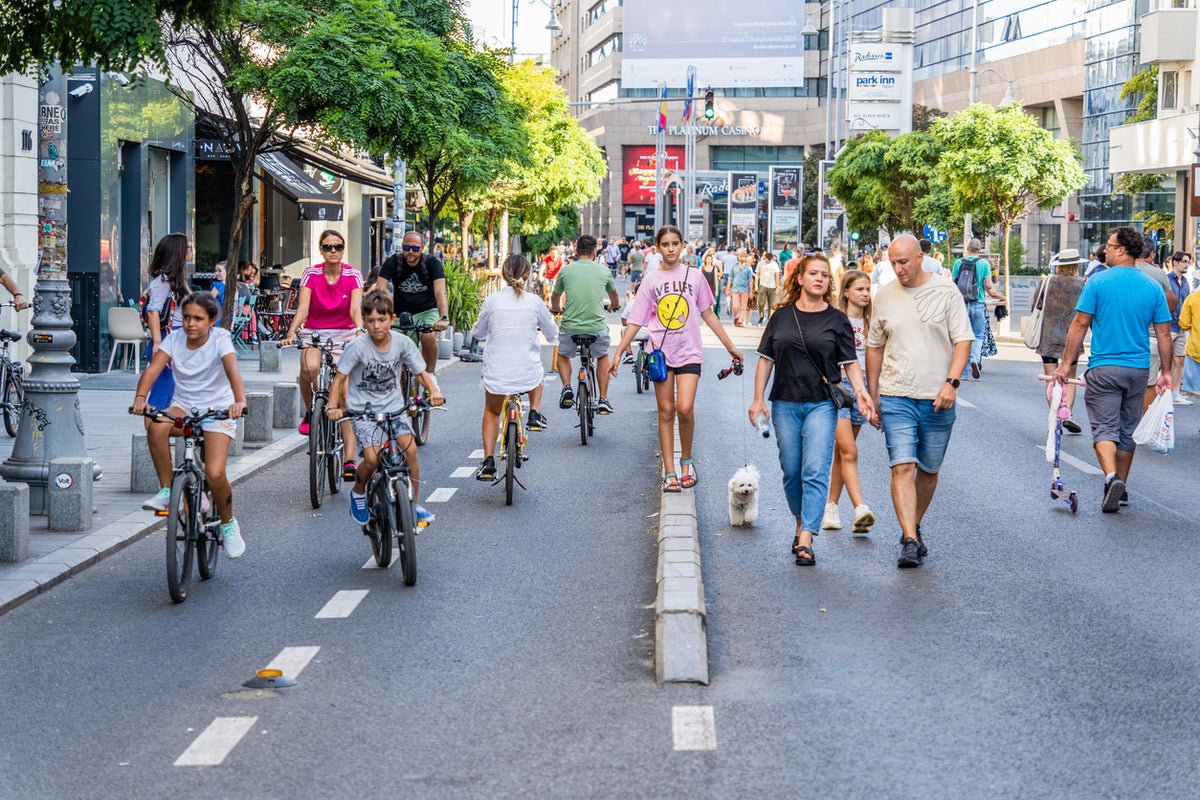
Step outside in almost any major city and close your eyes. What do you hear? It is not the chatter of people, the wind rustling through trees, or birds. It is a low, aggressive, non-stop hum. Tires slapping against asphalt. Heavy engines idling at red lights. Horns blaring.
We have accepted this deafening din as the price of modern life. But it is not.
Cities are not loud. Cars are loud.
For generations, urban planners designed our lives around the private automobile. We sliced up vibrant neighborhoods with multi-lane highways. We turned beautiful plazas into concrete parking lots. Today, a quiet revolution is happening as cities slowly realize that closing streets to cars is the single best way to bring our urban spaces back to life. It makes us healthier, helps local businesses thrive, and honestly, just makes life a whole lot more fun.
The Invisible Threat in Your Inhaled Air
Most of us think about car pollution as a hazy cloud of smog hanging over a distant highway. The reality is much closer to home.
A recent study by researchers at Carleton University in Ottawa shed light on this. They ran a brilliant natural experiment on the Queen Elizabeth Driveway, a roadway that regularly closes to cars on summer weekends to allow walking and cycling. They set up twelve measurement stations to test what happens when you kick the cars out.
The results were staggering. When cars were allowed on the road, air pollution was roughly 70 percent higher than on car-free days. Noise levels shot up by 50 percent.
Think about what that 50 percent increase in noise actually does to your body. It is not just annoying. Constant traffic noise keeps your nervous system in a state of low-grade, perpetual stress. It raises your blood pressure. It ruins your sleep. When you are sitting at an outdoor cafe trying to enjoy a coffee, that noise is the difference between a relaxed conversation and having to shout across the table.
If you want another example, look at the High Line in New York City. Because this converted park sits elevated above the car-choked streets below, researchers found that both noise and air pollution are 40 percent lower up on the path than they are down on the sidewalk.
The Electric Vehicle Trap
Some people think we do not need to ban cars because electric vehicles will save us.
That is a dangerous myth.
While electric cars do not have tailpipes, they do not solve our noise or air problems. At speeds over 50 kilometers per hour (about 30 miles per hour), most traffic noise does not even come from the engine. It comes from tire friction against the road and wind resistance. Electric cars still make that noise.
Even worse, electric vehicles are incredibly heavy because of their massive batteries. This extra weight means they wear down their tires and the road surface much faster. This tire wear creates high amounts of non-tailpipe particulate matter, which is kicked straight into the air you breathe.
The Business Myth That Keeps Cities Trapped in Asphalt
Every time a city proposes closing streets to cars, local business owners panic.
"If people can't park right outside my shop, I'll go bankrupt!"
It sounds logical, but it is flat-out wrong. Study after study shows that shopkeepers consistently overestimate how many of their customers arrive by car, while vastly underestimating how many walk, cycle, or take transit.
When you make a street walkable, people linger. They stop. They look in windows. They drop in spontaneously. Drivers do none of those things. A driver is looking at the road, searching for a parking spot, and driving right past your storefront.
Look at the data from New York City’s Open Streets program. During the height of the pandemic, the city closed several corridors to cars to allow outdoor dining. A report from the NYC Department of Transportation analyzed tax data to see how those businesses fared compared to others.
On Vanderbilt Avenue in Brooklyn, which was closed to cars, restaurants and bars saw their sales jump 19 percent above pre-pandemic levels. Meanwhile, similar businesses on nearby streets that remained open to cars saw their sales drop by 29 percent.
We see the same success in Canada. Vancouver recently decided to keep Granville Street pedestrianized through the summer months because of how much foot traffic and economic activity it generated. When you design spaces for people instead of steel boxes, cash registers start ringing.
Why Closing Streets Actually Makes Traffic Better
Another common objection is that closing a street will simply push cars onto neighboring roads, creating gridlock elsewhere.
This sounds like common sense, but urban traffic does not behave like water in a pipe. It behaves more like a gas. It expands or contracts to fill the space you give it.
This is a concept known as "reduced demand" or "traffic evaporation." When you make driving more difficult and walking or cycling more pleasant, some car trips simply disappear. People change their habits. They walk to the local market instead of driving to a mega-supermarket. They take the subway. They ride a bike.
There is a fascinating mathematical concept called Braess’ Paradox. It states that adding a road to a congested network can actually make travel times worse, because drivers make selfish choices that clog up the system. The reverse is also true. Closing certain roads can actually make the overall traffic flow better.
A study modeling the downtown street network of Winnipeg found that selectively closing specific streets to cars actually reduced overall vehicle travel times in the area.
When New York closed Broadway through Times Square to cars in 2009, critics predicted disaster. Instead, taxi travel times in the area improved, and pedestrian injuries on those blocks dropped by 40 percent.
Saving Lives on the Asphalt
We have grown incredibly desensitized to the sheer violence of car traffic.
In 2023, roughly 1.2 million people died in road traffic accidents globally. A quarter of those deaths were pedestrians and cyclists. Think about that. Hundreds of thousands of people are killed every year simply for trying to cross the street or ride a bike in their own neighborhoods.
When we close streets to cars, those collisions drop to zero.
This is especially vital around schools. In New York, traffic injuries among kids are 57 percent higher on days when school is in session, with most injuries happening within 250 feet of the school building. By creating temporary "School Streets" that block cars during drop-off and pick-up hours, we keep kids safe and give them back their independence.
In Brooklyn, one school used its car-free street to host a bike education program. The percentage of second graders who could ride a bike jumped from 35 percent to over 90 percent. That is the kind of childhood we steal when we surrender our streets to traffic.
How to Get Your Street Back
You do not have to wait for your mayor to have a sudden moment of clarity. Change almost always starts from the ground up. If you want to see your neighborhood transformed, here are the exact steps you can take today.
- Start small with a block party. Most cities have a simple, cheap permit process that lets residents close a single block for an afternoon. It is the easiest way to show your neighbors what a car-free street feels like.
- Advocate for a "School Street." Talk to your local school board and city councilor about restricting car traffic for just thirty minutes during morning drop-off and afternoon pick-up. It is an easy sell because nobody wants to argue against child safety.
- Support temporary weekend closures. Push for your city to close a scenic road on Sundays. Once people experience how peaceful and pleasant a car-free corridor is, they rarely want to give it back to the cars.
Stop accepting the noise, the soot, and the danger as normal. Our streets belong to us, not our cars. It is time we took them back.