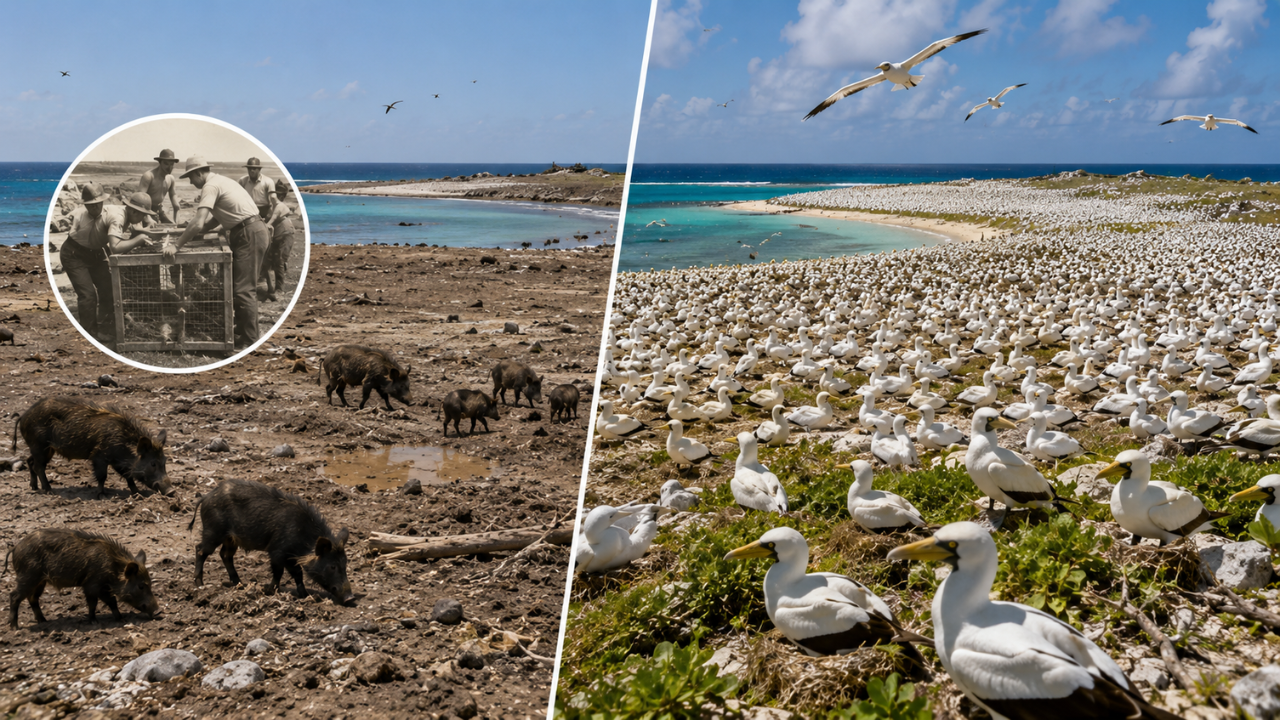
Isolated atolls hide strange stories. If you look at Clipperton Island on a map, you see a tiny, lonely ring of land lost in the eastern Pacific Ocean. Back in 1958, that isolation didn't protect it from human interference. An American ornithologist named Kenneth Stager arrived on the atoll and found a biological disaster. Guano miners had previously brought pigs to the island as a food supply. Those animals went feral, multiplied, and started treating native ground-nesting seabirds and land crabs as an open-air buffet.
Stager counted roughly 650 surviving Brown and Masked Boobies. That number was a pathetic fraction of what the atoll should have hosted. Armed with direct methods, he eliminated the 58 feral pigs roaming the island. What happened next wasn't just a simple animal rescue. It triggered a massive ecological chain reaction that decades later resulted in a seabird explosion exceeding 137,000 birds.
The Messy Reality of Island Food Webs
People love simple before-and-after stories. You remove a bad element, and nature instantly heals itself. Real ecology is messier.
When Stager cleared out those 58 pigs, he didn't just save a few individual boobies from getting eaten. He yanked out a keystone disruption in a fragile web. The pigs had been gorging themselves on the island's massive populations of land crabs. With the predatory pressure of the pigs gone, the land crabs bounced back hard.
Those crabs played a massive role in shaping the physical landscape. Millions of land crabs started foraging across the atoll, keeping rampant vegetation and sprouting coconut palms under control. Without that crab-driven cleanup crew, invasive coconut palms—introduced during human occupation—would have choked out the open, bare ground. Masked Boobies hate trees; they need open dirt to nest. By removing the pigs, the crabs returned, the trees stayed manageable, and the nesting grounds opened back up.
Why the Numbers Tell a Wild Story
Fast forward to 2003. Researchers including Robert Pitman, Lisa Ballance, and François Bost evaluated aerial photographs of Clipperton Island. They counted around 25,000 Brown Boobies and over 112,000 Masked Boobies. Total that up, and you get more than 137,000 seabirds.
The Masked Booby population surge was so extreme that scientists identified Clipperton as the largest known colony of that species on earth, holding roughly half of the global population.
| Factor | 1958 Status | 2003 Status |
|---|---|---|
| Feral Pigs | 58 active predators | Zero |
| Land Crabs | Heavily suppressed | Millions active |
| Booby Population | ~650 birds | 137,000+ birds |
Numbers like these give conservationists hope. Yet, they also highlight a major truth: you can't tinker with an isolated ecosystem without expecting unpredictable fallout. For instance, surging crab numbers and shifting plant life also created environments that later attracted other invasive headaches, like rats. Fixing nature isn't about pushing a reset button. It's about accepting long-term stewardship.
Lessons for Modern Conservation
If you think this is just old history about a rock in the middle of nowhere, look closer. Conservation strategists like Brad Keitt, Bernie Tershy, and Don Croll used the exact lessons learned from islands like Clipperton to design massive predator eradication projects off Baja California and beyond.
When evaluating ecological restoration projects today, keep these core takeaways in mind:
- Look beyond the target species: Removing a predator changes the entire food chain, impacting vegetation, insects, and competitors.
- Protect the habitat structure: Native birds need specific terrain—like open dirt for boobies—meaning you must manage plant life just as actively as animal life.
- Commit to long-term monitoring: A single intervention is just step one. Recovery plays out over decades, requiring constant vigilance against secondary invasions like rats.
Stop assuming nature will always balance itself out once human damage is done. Sometimes, it takes a deliberate, calculated strike to give native species a fighting chance to reclaim their home.