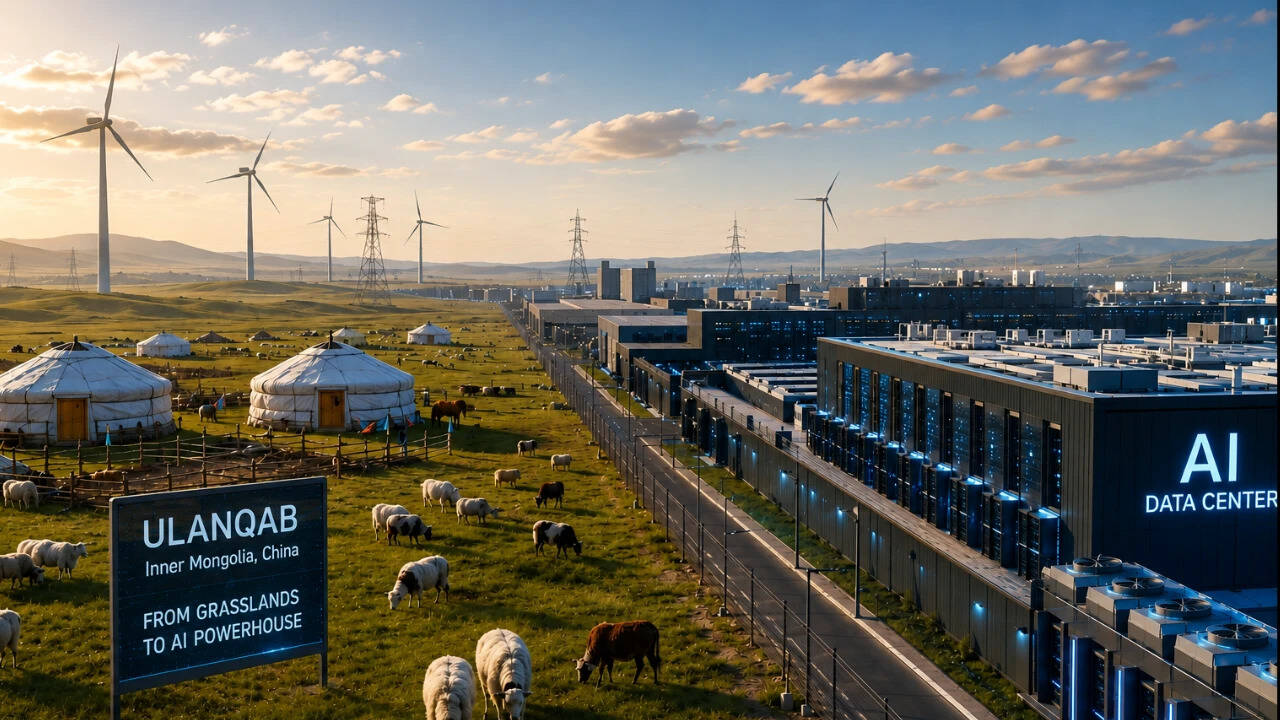
You won't find the real engine of China's artificial intelligence boom inside the shiny office towers of Beijing or Shenzhen. Drive a couple of hours west out of the capital, past the sprawling concrete limits, and you will hit the windswept pastures of Inner Mongolia. This region used to be known for cattle grazing and potatoes. Today, it hosts towering wind turbines, massive construction cranes, and broad boulevards named after global tech brands.
China is building its primary digital infrastructure out on these remote grasslands because traditional tech hubs are running out of power. Training modern machine learning models requires staggering amounts of electricity. If you want to understand how Beijing plans to scale its computing power without crashing local electrical grids, you have to look at the vast open spaces of the north.
The Math Behind the Grassland Shift
Why move heavy computing workloads hundreds of kilometers away from major population centers? It comes down to basic constraints. Urban electricity prices are climbing, and local governments are slapping strict caps on power consumption to meet environmental quotas. Coastal tech hubs simply cannot handle the surge in demand from thousands of graphics processing units running day and night.
Inner Mongolia offers a different equation entirely. Power is cheap because the region sits on massive coal reserves while simultaneously scaling up wind and solar farms. Electricity costs hover around 0.36 yuan per kilowatt-hour in parts of the regional capital, Hohhot. For a data center housing tens of thousands of high-end chips, that price difference saves tens of millions of dollars every single year.
Beating the Heat Without Air Conditioning
Keeping servers cool is one of the biggest expenses for any massive computing installation. Most facilities burn through enormous amounts of energy just running cooling systems to prevent chips from melting down.
Inner Mongolia solves this problem through geography. The region features high elevations and long, freezing winters. Cities like Ulanqab experience more than two hundred days a year where the outdoor air is cold enough to cool server racks naturally. Facilities use outdoor air systems to cut cooling expenditures by over twenty percent, stripping away a massive hidden operational cost.
The Reality of Green Energy Targets
Building an AI powerhouse on open land sounds completely green on paper, but the transition remains messy. Beijing wants new facilities in these western computing hubs to source more than eighty percent of their energy from renewable sources. Companies like Envision Group have built massive campuses, such as the Galaxy Campus in Ulanqab, designed to pull power directly from dedicated wind and solar arrays.
Yet coal still plays a heavy role. Roughly thirty-seven percent of the electricity running through parts of this northern infrastructure still comes from fossil fuels. Building clean energy faster than data centers can plug into the grid is a constant race. Water scarcity presents another major hurdle. Ulanqab receives very little rainfall annually, and local authorities are already grappling with the heavy water demands required to service sprawling server farms.
Why Distance No Longer Matters for Model Training
Ten years ago, putting a data center far away from major cities was a terrible idea because data lag ruined user experience. AI has completely rewritten that rule.
Training large language models involves running massive computations for months at a time without needing immediate real-time interaction from end users. Dedicated fiber-optic lines have dropped data latency between Beijing and these northern data hubs to under five milliseconds anyway. Companies like DeepSeek, ByteDance, and Alibaba can ship massive amounts of data back and forth without breaking a sweat. Model training happens on the quiet grasslands while the user queries get answered seamlessly down south.
If you're tracking where the hardware actually lands, look north. The future of computational scale isn't hidden in a secret basement lab. It's sitting right out in the open air, powered by the wind and fueled by an insatiable hunger for raw compute.
Why Inner Mongolia's Grasslands are Powering the Future
This video provides an on-the-ground look at how cities like Ulanqab are transforming their geography and clean energy networks to support China's massive AI infrastructure expansion.